
Mark Carney’s Surprise Makeover of Canada

Mark Carney’s duping delight seems to be tattooed on his face, but when you’re dealing with sheeple, that’s what happens: you mistake being a farmer with being a god.
But you can see why the farmer is so smug. Canadians woke up this week to discover that the furniture has been rearranged.
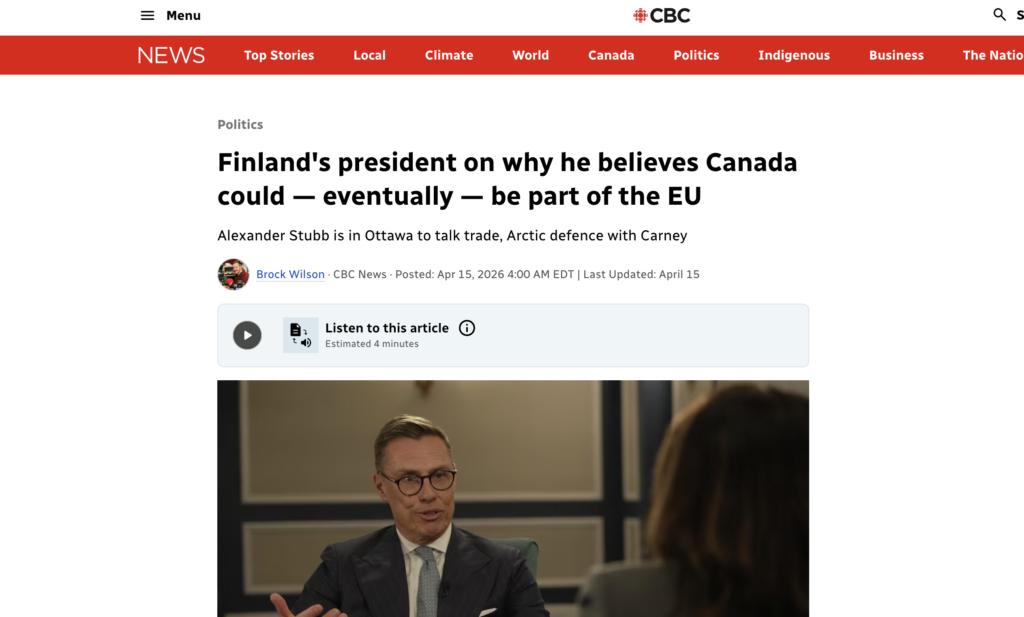
While we were trying to keep up with grocery bills and rent, Prime Minister Mark Carney was on the ice with Finland’s President Alexander Stubb, talking defence, AI, quantum, and the “future of Europe”, including the idea that Canada could “eventually” be part of a much larger EU.
The optics were cute: two sensible centrists, high‑vis vests swapped for hockey jerseys, assuring us that our pragmatic little country is on the right path.
The substance was something else: binding security‑of‑information talks, deeper technology and defence cooperation, and the quiet normalization of Canada as an honorary European protectorate without anything resembling a national conversation.
This isn’t consultation.
This is brute‑force livestocking.
Moving the fences, then announcing the “choice”
In his CBC interview, Stubb mused that he can “envisage a much larger EU,” and gently floated the notion that Canada could, theoretically, be part of that enlarged project because our “value base” is so close to Europe’s.
He framed it as Canada’s choice, but the order of operations gives the game away: first you deepen defence, tech, and standards integration, then you introduce the idea that Canada is practically European already.
That’s livestocking: move the fences in the night, then in the morning tell the herd they’ve “decided” to graze in a new pasture.
By the time ordinary Canadians are told about “strategic partnerships” and “values‑based multilateralism,” the important decisions: about security posture, supply chains, and who really holds the reins on standards, are already made.
Commenters have already noticed that Stubb’s line is being clipped, shared, and spun as proof that Canada “belongs” in Europe, even though he also says explicitly that it’s up to Canada, meaning, in theory, Canadians.
In practice, this flirtation is happening between leaders who text each other “almost daily,” skating together for the cameras while the substance gets buried in readouts no one voted on.
The majority built without a fresh mandate
All of this would still be troubling under a clear, recent electoral mandate.
Carney doesn’t have one.
He just secured a majority not by going back to the country, but through three by‑elections and floor crossings that pushed his Liberals over the line in the House of Commons.
It’s constitutional, but deeply anti‑consultative: voters never had a chance to say whether they wanted a Carney majority that can now ram through legislation and control committees with minimal resistance.
When critics point this out, the answer from his defenders is always the same: calm down, grown‑ups are in charge.
Carney, we are told, is the consummate technocrat, global central banker, Davos veteran, manager of crises, who simply knows better than the people who would otherwise slow him down.
That is not a partner.
That is a controlling spouse.
Canada as the controlled partner
The marriage metaphor fits because this is intimate power, not just abstract policy.
Carney’s public persona is the classic “responsible” husband who insists on handling the finances because it’s all very complicated and stressful, and besides, he’s so good at it.
He speaks fluent banker and summit‑ese, so he expects Canadians to accept that he alone can navigate climate rules, AI norms, defence industrial policy, and now the delicate courtship with a “larger EU” on our behalf.
When people object: to his path to majority, to his climate and economic strategies, to his habit of framing critics as unserious or dangerous, they’re treated like unreasonable spouses making a scene at a dinner party.
The message is: you’re overreacting, you don’t understand the big picture, and anyway, look at how much worse it could be with someone else.
Meanwhile, the “house” is being fundamentally altered. Our defence spending trajectory, our tech and AI alignments, our geopolitical identity: from NAFTA appendage to North Atlantic buffer state, are being quietly rewritten, and we are expected to be grateful for the upgrade.
Love‑bombing with hockey and hope
Look at how this Finland visit has been packaged.
We get hockey scrimmages, warm buddy‑cop shots on the ice, and upbeat clips about youth not losing hope in the future. We get soothing talk about “pragmatism” and “values,” and about Canada’s admirable role as a multilateral middle power in a dangerous world.
What we don’t get is a prime‑time, plain‑language explanation of what these agreements mean for our sovereignty, our budget, our ability to say no to future demands from NATO, Brussels, or future Stubb‑style interlocutors.
We certainly don’t get any mechanism for saying: actually, we’d like to have a say before you sign us up for the new package deal.
In abusive dynamics, this is called love‑bombing: big gestures, gifts, and affirmations deployed right after unilateral decisions, to make the partner doubt their own discomfort.
Livestock or partner?
Carney’s Canada project is being sold as inevitable modernization: a so-called necessary “realignment” of our political system and geopolitical posture for a harsher century.
Maybe that’s the conversation we need.
But we are not getting a conversation.
We are getting a reveal.
The livestocking is in the sequencing: move the fences, then point to the new pasture and say we’ve always belonged there. The controlling‑spouse dynamic is in the attitude: if you don’t appreciate it, the problem is you.
Carney isn’t asking Canadians whether they like the new décor.
He’s telling them it’s the best décor because he picked it, and only backward people, the implication goes, would want their old furniture and their old pasture back, or heaven forbid, a different kind of haven.
Tags: Brock Wilson, Canada, CBC, Donald Trump, EU, European Union, Mark Carney, Propaganda, United States