
Performative Nationalism: Canada’s “Buy Canadian” Illusion

Executive Summary
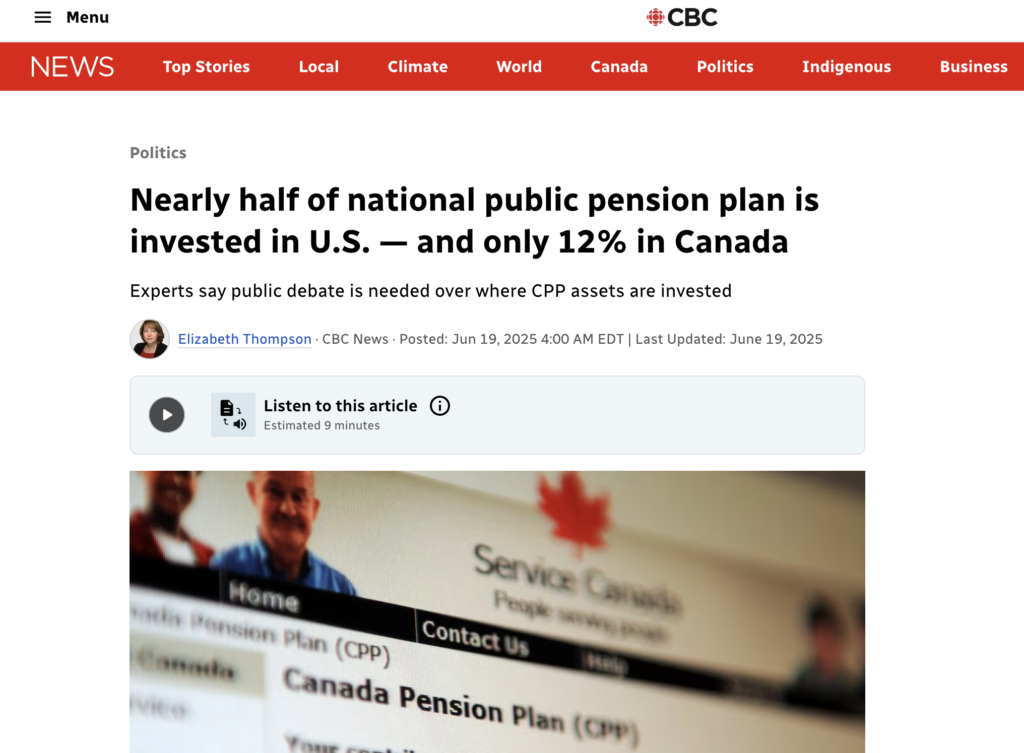
Canada has a long-standing ritual: when external pressure mounts, Ottawa declares war on dependency, wraps itself in a maple leaf, and issues commands to citizens to “Buy Canadian.” Then, quietly, the fine print arrives. This dossier argues that the current “Buy Canadian” campaign under Prime Minister Mark Carney is a textbook instance of what can be called performative nationalism, a political performance stage-managed for a crisis moment, while the actual operating system of Canadian capital continues doing exactly what it was doing before. The evidence is visible in two parallel tracks: a procurement policy that defines “Canadian” so loosely that 100-percent foreign-owned corporations qualify for its benefits, and a national pension fund that holds 47 percent of its assets in the United States while Canadians are lectured at the checkout line about sovereignty.
The Decree and Its Undoing
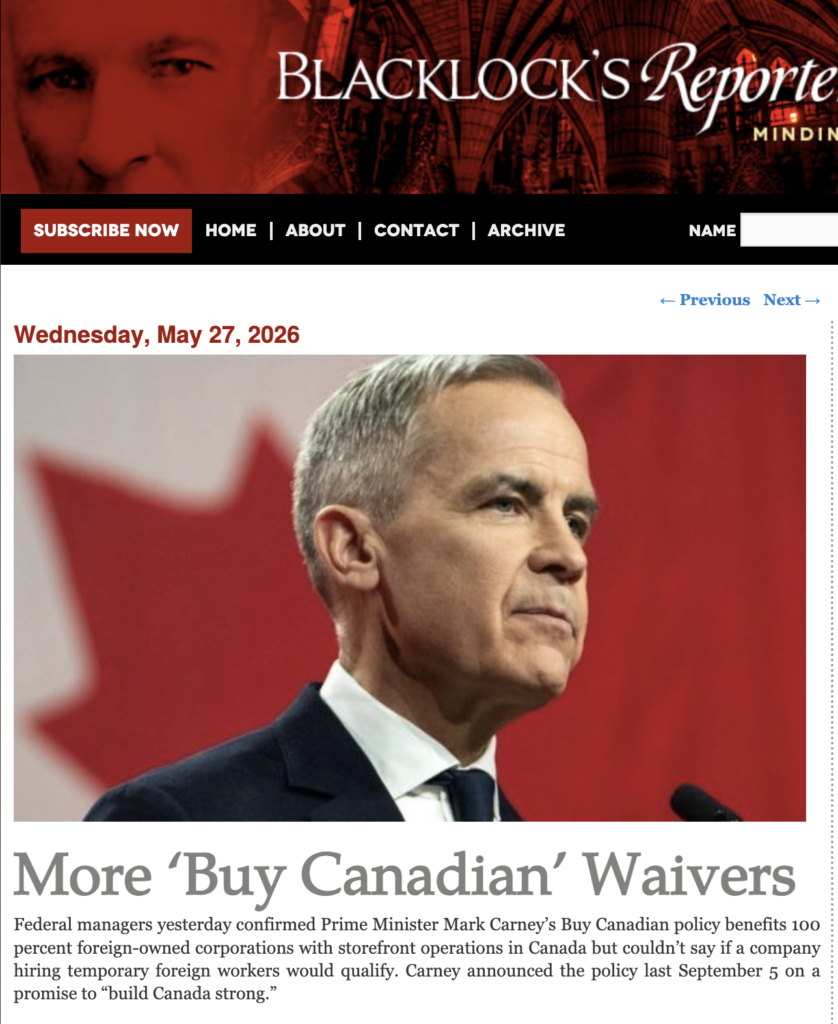
On September 5, 2025, Prime Minister Mark Carney announced a “Buy Canadian” policy, framing it as a smart sovereign decision to reduce external dependency in an economically uncertain world. The announcement was timed to a trade crisis driven by U.S. tariffs and escalating rhetoric about Canadian sovereignty from the Trump administration. The political signal was unmistakable: Canada would reorient its public spending toward domestic producers.
The formal policy, the Policy on Prioritizing Canadian Suppliers and Canadian Content, came into effect December 16, 2025. On paper, it prioritizes Canadian-produced steel, aluminum, and wood in large federal construction and defence projects, and gives advantage to Canadian suppliers in procurements over $25 million, expanding to $5 million contracts by spring 2026.
What followed was a quiet, systematic dismantling of that promise through bureaucratic redefinition.
“Buy Canadian” Is Not Literal. Housing Minister Gregor Robertson confirmed that the policy does not require a majority of supplies used in public works or home construction to actually be Canadian. “We’re not being rigid about this,” he told reporters in March 2026.
“Buy Canadian” Is Not Canadian. The Department of Public Works confirmed that companies 100 percent foreign-owned still qualify as “Canadian” under the policy, provided they have a storefront presence in Canada. The definition is so broad it would apply to foreign-owned corporations with branches here such as the Bank of China, according to government records. Officials, pressed by parliamentarians, could only respond: “We need to go back to what the Prime Minister said.”
“Buy Canadian” Is Incremental. A memo from Public Works revealed that the policy is to be “phased in over an indefinite period.” The September 5 announcement did not imply Canadians would receive immediate preferential treatment in contracting. “Measures will be phased in,” the memo stated.
The cumulative effect of these three qualifications is to render the policy almost entirely symbolic. Opposition MPs grilled Public Services and Procurement Canada officials in committee hearings in May 2026, pressing hard on the loopholes that allow foreign corporations to benefit from a policy sold to Canadians as protection against foreign corporations.
The Hidden Ledger: Where Canadian Capital Actually Lives
While the public procurement system was being defined down to near-meaninglessness at street level, the numbers inside Canada’s largest capital pool told a different story entirely.
The Canada Pension Plan fund has reached a record $793.3 billion in net assets as of the 2026 fiscal year, a $78.9 billion increase consisting of $56.9 billion in net income and $22 billion in net transfers. CPP Investments reported a return of 7.8 percent for its 2026 fiscal year.
Of that $793 billion, 47 percent is allocated to U.S. investments. Only 13 percent is held in Canada. On average across all major Canadian pension plans, approximately 26 percent of assets are held domestically, meaning even this figure represents an overstatement of Canadian commitment relative to CPP’s specific portfolio.
This proportion of U.S. investment has remained unchanged since Trump assumed office again in January 2025, the very crisis that ostensibly triggered the “Buy Canadian” imperative. The CPP’s trajectory in U.S. assets has been on a steady upward climb since 2005, when Ottawa removed a cap on foreign holdings in Canadian pensions and RRSPs. That cap removal, a quiet legislative decision with enormous long-term structural consequences, was the real policy. “Buy Canadian” is the press conference.
The combined base and additional CPP accounts have delivered a 10-year annualized net return of 8.4 percent, with cumulative net income of $543.4 billion since 1999. Keith Ambachtsheer, director emeritus of the International Centre for Pension Management, told CBC News that pensions like CPP should invest globally and focus on maximizing returns, and that by that metric, they have done well. That is a defensible position. What is less defensible is the double standard: global diversification is considered essential and self-evident for institutional capital, while retail consumers are moralized into domestic loyalty.
Two Canadas, One Passport
The contradiction at the heart of “Buy Canadian” is not a policy failure. It is a structural feature of how Canadian nationalism operates.
Canada has historically constructed national identity through economic policy, trade protections, Crown corporations, cultural mandates, as a way of building imagined community in a geographically vast and ethnically diverse country. The nation, as Benedict Anderson observed, is a collective imagination; in Canada, governments have consistently activated that imagination in moments of external pressure to promote cohesion and unity. The current crisis, U.S. tariffs, sovereignty provocations from Washington, a general anxiety about Canadian economic independence, is precisely the kind of moment that triggers the nationalist reflex.
But there are, in practice, two audiences for “Buy Canadian”:
- Retail Canada is told to accept higher prices, swap foreign products for domestic ones, and treat consumption as a form of civic duty. The guilt trip is explicit: buying a U.S. product during a trade war is framed as a kind of betrayal.
- Capital Canada, CPP, major pension funds, and Ottawa’s own procurement framework, is simultaneously structured to maximize returns globally, define “Canadian” as a flexible legal category that money can wear when it wants a benefit, and proceed with business-as-usual investment in American assets, American corporations, and American real estate.
This is not mere hypocrisy. It is a coherent system. Citizens are the bearers of the symbolic nation; capital is exempt from it.
The Fortress North America Paradox
The absurdity sharpens when set against the government’s simultaneous pivot on the diplomatic front. Even as ordinary Canadians were being urged to boycott U.S. goods and pension funds were parked in U.S. markets, Prime Minister Carney was in Toronto on May 9, 2026 telling an audience of international policy leaders that Canada “remains open to deeper integration, including options for Fortress North America in certain sectors.” He added: “offers are on the table.”
The concept of Fortress North America involves a more tightly aligned North American economy, shared standards, aligned supply chains, coordinated industrial policy across the border, and deeper cooperation on defence procurement and technology. Carney has framed this as conditional on U.S. tariff removal, presenting it as a strategic position rather than a contradiction.
But the optics tell a different story: the government that told citizens “the old integrated relationship with the United States is over” and urged them to Buy Canadian is simultaneously extending offers of deeper economic integration with the United States, in sectors that matter most to capital, namely defence and technology.
Canada is not, in this reading, pivoting away from the United States. It is managing the domestic narrative of doing so, while keeping the actual levers, procurement exceptions, pension allocation, defence and tech integration, pointed toward the same destination.
The Pattern: Crisis Decree, Quiet Continuity
This is not a new dynamic. Canada’s nationalist reflexes in moments of external pressure have historically served more to consolidate political legitimacy than to produce structural change. What changes is the register: the language becomes louder, the flags come out, and the announcements multiply. What does not change is the underlying allocation of benefits.
The “Buy Canadian” episode is notable for how quickly, within months of the initial September 2025 announcement, the bureaucratic qualification machine produced its three key retreats: indefinite phasing, foreign ownership loophole, and non-mandatory content rules. The policy was always designed to be a posture, not an operational commitment.
The pension fund situation is the longer institutional story of the same logic: the 2005 removal of the foreign property cap was a real policy decision with real consequences. It was a decision made not during a nationalist moment but in a period of quiet normalcy, embedding a structural preference for global capital allocation that no amount of Buy Canadian press conferencing can reverse, because reversing it would require acknowledging that the real decisions were made long ago, without a press conference, without a flag, and without asking citizens.
The Language of Sovereignty as Misdirection
At the core of performative nationalism is a linguistic operation: words like “Canadian,” “sovereign,” “local,” and “home-grown” are defined at the podium with one meaning and redefined in the memo with another.
The word “Canadian” now functions like a tax credit, not a nationality. It is a legal costume available to any entity that needs to access a policy benefit, including a 100-percent foreign-owned corporation with a storefront. The word “sovereignty” is invoked by a Prime Minister who is simultaneously offering deeper integration with the country whose tariffs provoked the sovereignty crisis. The phrase “Buy Canadian” is deployed as a moral command aimed at consumers while the nation’s $793 billion retirement fund buys America at a rate of nearly one dollar in two.
Citizens are not wrong to sense that the story keeps changing. The story was always designed to change, the decree is for the front page, the waiver is for the back office, and the structural allocation of capital runs quietly beneath both.
Conclusion
The “Buy Canadian” campaign is best understood not as a failed policy but as a successfully executed performance. Its function was never primarily to redirect capital, that would require confronting the 2005 foreign property rule repeal, the definition of “Canadian” in procurement law, and the structural incentives of global pension management. Its function was to provide the government with a sovereign-sounding narrative during a crisis, while leaving all the actual mechanisms of Canadian institutional capital untouched.
The deeper scandal is not that a foreign-owned corporation can call itself Canadian for procurement purposes. The deeper scandal is that this is the known, documented outcome of a policy sold as its opposite, and that the documentation exists in plain sight in Blacklock’s Reporter memos, CBC investigations, and CPP’s own published figures, while the headline “Buy Canadian” continues to circulate as though the fine print does not exist.
Performative nationalism disciplines citizens without inconveniencing capital. That’s not a bug. That’s the rig. For a reason.
Addition research from Perplexity