
The Latecomer’s Confession: A Dossier on the Cottage Industry of Belated Journalism Criticism

Overview
A pattern has emerged in Western media commentary over the past several years: journalists and broadcasters who spent careers inside institutional newsrooms are now publishing books, Substacks, and essays diagnosing the professional failures of those same institutions. These accounts are being received as brave, original, and forensically honest. They are none of those things. They are, in clinical terms, retrospective self-exculpation, a form of institutional laundering in which the agent of a failed system rebrands as its analyst only after the system has discarded them.
This dossier establishes a documented timeline, a body of prior scholarly and critical work, and a structural argument: the thesis now being marketed as insurgent was researched, written, sourced, and published, with documented independence and at professional cost, years and in some cases decades before the current wave of insider confessionals appeared. The case presented here is not personal. It is a question of intellectual provenance, institutional complicity, and the mechanics of a media ecosystem that once gatekept dissent and now monetizes it.
Part I: The Prior Record
The Research Impetus, Mid-1990s
The observation that journalism was structurally compromised did not originate in a newsroom resignation letter filed in 2022. It emerged from watching, in the mid-1990s, how coverage of the wars in the former Yugoslavia was being shaped not by reporters on the ground but by PR and lobbying firms hired by the combatant parties. Serbia engaged Wise Communications in Washington and Ian Greer Associates in London. Croatia hired Ruder Finn Global Public Affairs in August 1991. Bosnia-Herzegovina also retained Ruder Finn. Every party to that conflict had a professional communications apparatus feeding content to Western newsrooms, and Western journalists, including those physically present in the region, were repeating press-release narratives verbatim. The press corps was not reporting a war. It was processing managed information and presenting it as independent witness.
This was not a new pathology. The incubator hoax of the Gulf War had already demonstrated the same mechanism at scale. In October 1990, a teenage girl identified only as “Nayirah” testified before the US Congressional Human Rights Caucus that she had watched Iraqi soldiers remove babies from incubators in a Kuwaiti hospital and leave them to die on the floor. Six US senators cited her testimony when voting to authorize force. The resolution passed by five votes. It was later established that the testimony was fabricated, that “Nayirah” was the daughter of Kuwait’s ambassador to Washington, and that the campaign was orchestrated by the PR firm Hill & Knowlton, paid approximately $10.7 million by the Kuwaiti government’s Citizens for a Free Kuwait front group. Media organizations had repeated the story without verification.
These two episodes, the managed Balkan narrative and the manufactured Gulf War atrocity story, were not aberrations. They were demonstrations of a reproducible system: PR firms as primary sources, newsrooms as distribution channels, and journalists without the subject expertise to identify fabrication, deflection, or strategic narrative. The research impetus that followed was methodological, not ideological. The question was not whether journalism was “too liberal” or “too conservative.” The question was whether it was functioning at all as an independent epistemological enterprise, and the evidence, visible to anyone who examined primary records rather than professional mythology, was that it was not.
The Published Record: 2005–2023
The documented output of this research is as follows:
- Don’t Believe It!: How Lies Become News (Disinformation Company, 2005) : A systematic examination of how fabricated stories enter and propagate through the news pipeline. Published when the current generation of journalism critics were either students, junior producers, or compliant staff members at the institutions they would later denounce.
- OutFoxed: Rupert Murdoch’s War on Journalism (with Robert Greenwald, Disinformation Company, 2005) : An analysis of media consolidation, propaganda mechanics, and how a single ideologically directed media empire could reshape the epistemic environment of an entire democratic polity. Published when media concentration was being treated as a business story, not a democracy story.
- When Journalism Was a Thing (Zer0 Books/Simon & Schuster, 2018): A comprehensive autopsy of the profession, including 64 pages of documented references. Published four years before any of the current prominent resignations-turned-Substacks existed, and eight years before the book being reviewed as a breakthrough “forensic autopsy” of journalism’s death.
- The Mind Under Siege: Mechanisms of War Propaganda (Academica Press, 2020): A documented account of propaganda psychology applied to wartime media, demonstrating how primal appeals are engineered to bypass critical faculties and how journalists without expertise in the relevant fields fail to identify them in real time.
- Four journalism textbooks (Cambridge Scholars Publishing, 2020–2023): Published as instructional texts for journalism education, outlining the same structural failures of the profession in the format used to train the next generation of practitioners.
This body of work was produced from a position of independence: no institutional salary, no press gallery access, no broadcasting platform, no government subsidy. It was produced precisely because the institutional machinery of journalism, the newsrooms, the editors, the professional associations, the awards circuits, were not producing it and had structural incentives not to.
Part II: The Case Study: Tara Henley and The Trust Spiral
Career Profile
Tara Henley is a Canadian writer and broadcaster. Her career at the CBC began in 2013, when she joined as an interview producer on George Stroumboulopoulos Tonight. She subsequently moved into current affairs and radio production, working for the CBC for approximately eight years. During those years, she functioned as a fully integrated institutional employee, booking guests, shaping programming, and operating within the editorial culture of Canada’s national public broadcaster. Her 2020 book Lean Out: A Meditation on the Madness of Modern Life was a personal lifestyle reflection, not a structural critique of journalism.
In December 2021, Henley resigned from the CBC. In January 2022, she published an open letter on Substack explaining her departure. The letter went viral. It attributed CBC’s failures primarily to a “radical political agenda” imported from American Ivy League institutions, to “woke” identity politics, and to an editorial culture she described as ideologically blinkered. The letter was reprinted in full by Bari Weiss’s Common Sense Substack and praised by Fox News. It positioned Henley, in the words of The Free Press, as “a distinguished journalist” who had “rejected the blinkered ideology of the Canadian Broadcasting Corporation.”
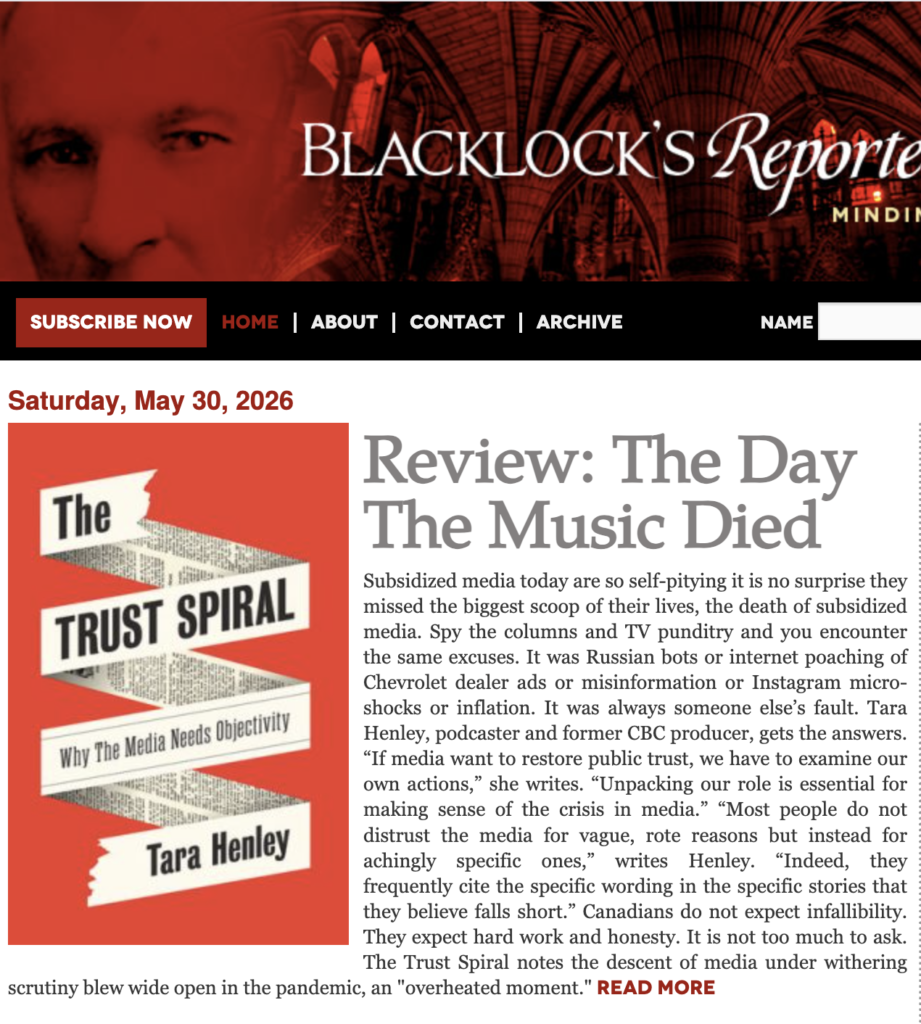
In 2026, Henley published The Trust Spiral: Why the Media Needs Objectivity (Polity Press). The book argues that restoring trust in media requires admitting mistakes in coverage, reaffirming the value of objectivity, and returning to the basics of journalism. Also in 2026, she published a separate book, The Trust Spiral, which received a prominent review in Blacklock’s Reporter as a “forensic autopsy of what killed newsrooms.” The review praised her for “carefully, methodically, citing sources” as she “builds her case.” It described subsidized Canadian media as “so self-pitying it is no surprise they missed the biggest scoop of their lives, the death of their own profession.”
The Structural Problem
The Blacklock’s review treats Henley’s work as a new discovery. The structural analysis it praises, media as self-pitying, institutionally captured, unable to examine its own failures, is not new. It is the thesis of When Journalism Was a Thing (2018), sourced across 64 documented pages. It is the thesis of Don’t Believe It! (2005), which demonstrated the mechanics of how fabricated narratives enter and propagate through the news system before Henley had begun her career at the CBC. The question of what killed the newsroom was not posed for the first time in 2026 or even 2022. It was posed, researched, and documented when the answer was professionally inconvenient rather than personally advantageous.
The specific framing Henley deploys, objectivity as the solution, media trust as the problem, deserves scrutiny. Her diagnosis arrived only after her personal exit from the system. Between 2013 and 2021, while working as a CBC producer, Henley did not publish structural critiques of journalism’s propaganda mechanics, its reliance on PR firms as primary sources, its editorial assignment of beats to reporters without subject expertise, or its institutional incapacity to distinguish fabrication from fact. Her critique, when it came, was framed not as a failure of journalism’s fundamental architecture but as a failure of a specific ideological tendency, “wokeness”, within an otherwise recoverable institution. This is a materially different argument from the one that informed fifteen-plus years of documented, independently produced scholarship.
The Logrolling Circuit
The reception of Henley’s work follows a recognizable circuit. Blacklock’s Reporter, which reviewed The Trust Spiral favorably, is itself an Ottawa press gallery institution staffed by veteran Parliamentary journalists. Henley’s work has been discussed approvingly at events organized by Cardus, a faith-based Canadian think tank. Her podcast, Lean Out, features guests from the same professional milieu, established Canadian journalists, editors, and commentators who share her institutional background. The book is published by Polity Press, a respected academic imprint that grants institutional legitimacy to its arguments. None of these nodes of reception, the press gallery, the think tank circuit, the legacy publisher, were receptive to structural journalism criticism when it was produced independently and without institutional affiliation. They are receptive now because the critic belongs to the same guild, uses the same vocabulary, and, crucially, stops short of the conclusion that the institution was corrupt by design rather than corrupted by recent fashion.
Part III: The Architecture of Belated Revelation
What the Pattern Looks Like
The journalist-turned-media-critic who arrives after institutional ejection follows a reproducible narrative arc. It has several identifiable stages:
- Belief and entry: The future critic enters journalism persuaded by its self-mythology, the Fourth Estate, the public watchdog, the speaker of truth to power. This mythology is maintained not by evidence but by professional socialization.
- Compliant service: The critic operates within the institution for years or decades, accepting its norms: editors predetermining narratives, beats assigned without subject expertise, colorful anecdotes prioritized over verified facts, PR and publicist copy processed as primary source material, stories shaped to fit pre-existing audience and advertiser expectations.
- Ejection or displacement: The critic is let go, made redundant, sidelined by a culture shift, or finds the institutional environment sufficiently intolerable to leave. The trigger is typically personal, ideological discomfort, professional frustration, or simple redundancy, not a principled stand taken at the moment of maximum institutional cost.
- Rebranding: The critic reframes their departure as an act of conscience and their subsequent commentary as the product of hard-won insight. The book, the Substack, the podcast, the speaking circuit follow. Praise comes from colleagues and former colleagues who share the same institutional formation and who benefit from the narrative that journalism was fine until recently.
- Selective diagnosis: The resulting critique identifies real symptoms, loss of public trust, narrative conformity, ideological capture, but locates the cause in a recent and reversible tendency rather than in structural features of the profession that predate any single ideological fashion. The past is implicitly rehabilitated. The critic is implicitly exonerated. The reader is invited to conclude that there was once a golden age of journalism that the current pathology has interrupted.
What the Pattern Omits
What the belated confession consistently omits is any accounting of the period of compliance. The journalist who spent eight years producing content for an institution they now describe as epistemically corrupted does not explain what they were producing during those eight years, who they were serving, and what they knew and when. The editor who shaped narratives before facts were gathered does not appear in these accounts as a proximate cause; neither does the reporter who accepted PR copy without attribution, or the newsroom that assigned a psychology-trained journalist to cover fashion because she was young and female. These are not recent innovations. They are the operating conditions that the current wave of critics accepted, benefited from, and enforced, before finding them objectionable when the personal calculus changed.
The Gulf War’s babies-in-incubators hoax was fully documented by 1992. The role of PR firms in manufacturing the Balkan war narrative was documented contemporaneously in the early 1990s. The structural conditions that made both possible, reporters without expertise, newsrooms dependent on institutional press releases, editors interested in emotional resonance over factual verification, were not introduced by a Twitter ideology imported from American universities in the 2010s. They were the professional standard that made the profession’s mythology possible and its actual function invisible. The journalist who entered the profession in 2013, operated within those conditions until 2021, and now writes books about what killed the newsroom is not an outside analyst. They are, in the strict sense, a primary source.
Part IV: The Question of Intellectual Provenance
Academic and critical norms hold that when a thesis has been previously argued, documented, and published, subsequent works engaging the same thesis are expected to acknowledge the prior record. This is not a courtesy. It is the basic mechanism by which intellectual communities distinguish original contribution from repetition, and by which readers can assess whether a work advances understanding or recirculates existing analysis.
The current cottage industry of journalism self-criticism does not cite the independent scholarship that preceded it. It does not engage with Don’t Believe It! (2005), OutFoxed (2005), When Journalism Was a Thing (2018), or The Mind Under Siege (2020). It does not acknowledge that the thesis it presents as revelation was documented before its authors had completed their first decade of institutional employment. The omission is not incidental. Engaging with a prior body of work produced outside the institution would require acknowledging that the institution’s gatekeeping function, which excluded that work from mainstream reception, was itself part of the failure being described. The confession would become structurally self-implicating in a way that no publisher, no press gallery review, and no Substack audience wants to read.
The result is a closed circuit: insiders produce criticism for insider audiences, which validates the criticism and its authors, which generates further commissions and further platforms, while the independent work that preceded it remains outside the circuit it accurately described.
Conclusion: The Dossier Verdict
The structural failure of journalism as an epistemological enterprise was documented and published before it became safe, marketable, or career-adjacent to do so. The documentation was produced independently, without institutional salary, press gallery affiliation, or government subsidy. It drew on primary evidence: war propaganda mechanics, fabricated congressional testimony, PR firms as undisclosed news sources, editors operating without subject expertise, and newsrooms that mistook access for accountability.
The books and essays now being published and praised as brave autopsies of a dead profession arrive after the career has been completed, the pension (or its equivalent) secured, and the professional risk eliminated. They are not wrong that journalism failed. They are wrong about when the failure began, wrong about where the responsibility lies, and structurally incapable of acknowledging that the journalism they produced and the institutions they served were not the golden age against which the current failure is measured, they were the failure, operating under a more prestigious masthead.
A dossier states facts and draws conclusions from evidence. The conclusion here is precise: this is not a new argument. It is a delayed one, produced by delayed witnesses, and it should be read as such.
Tags: Alexandra Kitty, Bari Weiss, Blacklock’s Reporter, Canada, Don’t Believe It!: How lies become news, Fox News, Journalism, OutFoxed: Rupert Murdoch’s War on Journalism, Polity Press, Propaganda, Tara Henley, The Free Press, The Mind Under Siege: Mechanisms of War Propaganda, The Truth Spiral, United States, When Journalism was a Thing