
The Warehouse of Voices: Canada’s Architecture of Managed Dissent


Overview
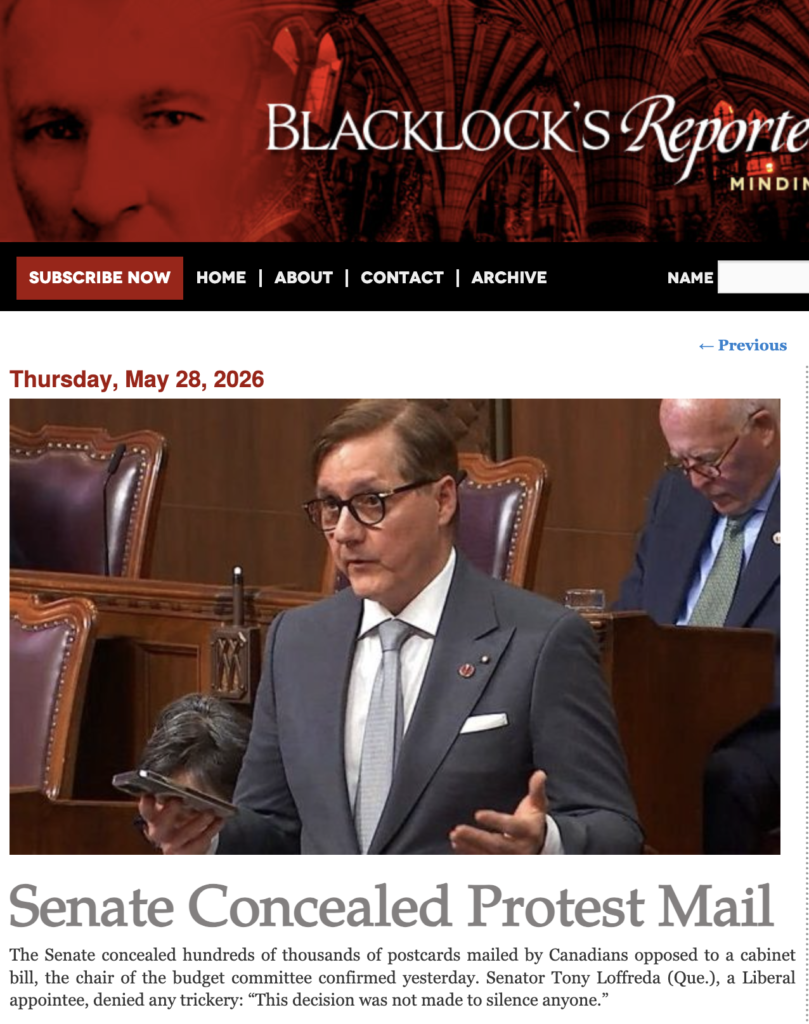
Somewhere in a government warehouse in Gatineau, Quebec, more than 200,000 postcards sit in boxes, addressed to Canadian senators, never delivered. Each card bears the name, address, and handwriting of an individual Canadian who paid to send it. Each one says, in effect: do not pass Bill C-9.
This is not a story about junk mail. It is a story about how a government manages the appearance of democracy while quietly routing its substance away from view, and how that reflex, practiced at every level of the system, is measurable, documented, and accelerating.
“This Decision Was Not Made to Silence Anyone”
On May 27, 2026, Senator Denise Batters rose in the Senate chamber to ask a pointed question: why were Canadians’ postcards about Bill C-9 sitting in a warehouse rather than on senators’ desks?
The answer from Tony Loffreda, Chair of the Standing Committee on Internal Economy, Budgets and Administration (CIBA), was a masterclass in bureaucratic evasion. The Senate’s mail-screening contractor had flagged a “very large number” of identical-looking postcards. CIBA’s steering committee invoked an existing policy, the same one used for mass email campaigns, and decided that only a “sample box” would be sent to each senator. The rest, now numbering over 200,000, are stored for 90 days in a warehouse in Gatineau, available to senators only if they make special arrangements to visit it.
“This decision was not made to silence anyone,” Loffreda stated on the Senate floor.
Consider what that sentence is doing. It acknowledges that a decision was made. It acknowledges an outcome. It denies only the intent. It is the institutional equivalent of saying: we didn’t mean to step on your hand; we just decided to put our foot there.
Senator Salma Ataullahjan asked the obvious question: “If a concerned citizen writes to me, I think it should be for me to decide whether I look at that mail. Don’t you think this is overstepping?” Loffreda’s reply was to repeat that the procedure had followed existing policy.
Senator Yonah Martin noted something that changes the entire premise of the “mass mailing” categorization: these were not form letters sent by an organization. Each postcard was individually paid for by the sender. The fronts may have been identical, but the names, addresses, and recipients were all different. These were citizens writing to their legislators, individually, voluntarily, at personal expense, using the postage-free parliamentary mail system that has existed for decades precisely to ensure that financial barriers do not prevent Canadians from reaching their elected and appointed representatives.
Loffreda admitted he had not known that. He said he would raise it with the steering committee.
The cards remain in the warehouse.
What Is Bill C-9?
The postcards exist because Canadians are alarmed. Bill C-9, officially An Act to amend the Criminal Code (hate propaganda, hate crime and access to religious or cultural places), short-titled the Combatting Hate Act, was introduced by Justice Minister Sean Fraser on September 19, 2025, and passed third reading in the House of Commons on March 25, 2026, by a vote of 186 to 137.
Its stated purpose: to combat rising antisemitism, Islamophobia, homophobia, and transphobia by giving police and prosecutors new tools. Its specific provisions include:
- A new hate crime offence: committing any existing Criminal Code offence with hateful intent becomes a distinct crime with harsher penalties
- New intimidation and obstruction offences: it becomes a crime to intentionally instill fear in a person to impede their access to “protected spaces,” including places of worship, schools, community centres used by identifiable groups, and cemeteries
- A hate symbols offence: publicly displaying symbols associated with terrorist or extremist organizations, including Nazi symbols, becomes a criminal act
- Removal of the Attorney General consent requirement for hate propaganda prosecutions, allowing police and Crown to proceed more quickly without high-level oversight
- Repeal of the religious “good faith” defence that previously shielded expression grounded in religious texts from hate propaganda charges
The government insists this does not create “bubble zones”, protest-free perimeters, and that it targets only criminal conduct. Critics across the political, legal, and civil-liberties spectrum disagree with that characterization.
The Problem With C-9
The opposition to Bill C-9 has come from an unusually broad coalition: the Canadian Civil Liberties Association (CCLA), the Canadian Labour Congress (CLC), 2SLGBTQI organizations including Egale Canada, faith communities, the International Civil Liberties Monitoring Group, and many others.
Their concerns converge on several points.
The “protected spaces” list is vast and vague. Schools, community centres, cemeteries, and “other places primarily used by an identifiable group” could encompass tens of thousands of locations across Canada. The CCLA warned explicitly that the bill “risks criminalizing peaceful protests near tens of thousands of locations in Canada”.
The intimidation standard is subjective. The new offence criminalizes conduct “intended to instill fear.” The CCLA’s director of fundamental freedoms, Anaïs Bussières McNicoll, explained that this standard “could easily be read by police to capture protests that are peaceful, even if they are offensive or disruptive”. The intention is in the eye of the arresting officer.
Labour rights are directly threatened. The Canadian Labour Congress pointed out that picket lines near workplaces that double as community centres or other “protected spaces” could now be reframed as criminal obstruction or intimidation, carrying penalties of up to ten years. A Charter-protected right to strike could be quietly nullified by a hate-crime law, without any amendment to labour legislation.
Removing AG consent concentrates prosecutorial power. Requiring the Attorney General to sign off on hate propaganda prosecutions was a safeguard against politically motivated or trivial prosecutions. Removing that requirement, combined with a broad, vaguely worded intimidation standard, creates a significant tool for selective enforcement against disfavoured groups.
The religious defence removal has wide implications. Stripping the “good faith” religious expression defence from hate propaganda law affects every faith community that holds traditional moral positions on contested social questions, not just the organized right. It means that religious speech on politically contentious topics moves from legally protected to potentially prosecutable, depending on who makes the complaint and who is in government.
The Canadian Centre for Policy Alternatives described Bill C-9 as “part of a wave of anti-protest legislation in Canada,” noting that McNicoll has warned the bill “will further silence marginalized communities by restricting where they can protest and limiting the public sphere”.
The bill is currently before the Senate Standing Committee on Human Rights. The Senate has not yet voted on it. Two hundred thousand postcards in a Gatineau warehouse are waiting.
The Read-Receipt Problem
The Senate warehouse is the formal, visible end of an institutional pattern that most Canadians experience informally and invisibly every time they write to their representatives.
The read receipt tells you what the phone call and the polished letter cannot: not whether your message was received, but whether it was opened. A federal MP’s office costs taxpayers over $646,000 per year when salary, staff, and expenses are combined. For cabinet ministers and senior officials, the figure is higher still. These offices are publicly funded, ostensibly to maintain a two-way channel between the governed and the governing.
When personalized letters, not form emails, not postcards, but individually crafted messages, go to eleven politicians at the federal and provincial level, including cabinet ministers, the Prime Minister, and the Premier of Ontario, and the read receipts confirm the emails were opened but not a single substantive response is returned, the system’s actual function is revealed. The channel exists. Communication arrives. The response is a managed silence.
This is not an isolated experience. A Concordia University study found that MP offices respond more reliably to high-volume, high-effort contact combined with media attention, and that staffers have “carte blanche to toss correspondence from people who live outside of the riding”. Personalization helps at the margins. But the default architecture is filtration, not engagement.
The Senate warehouse just makes that filtration physical and visible. It gives the filtration a policy name and a 90-day expiry. It is the formal equivalent of the read-receipt silence.
The Concealed Governance Structure
What connects the postcard warehouse to the C-9 fight is not just optics. It is the same committee: CIBA.
CIBA, the Standing Committee on Internal Economy, Budgets and Administration, is the Senate’s governing body for internal administration. It controls senators’ budgets and staffing. It set the mass-mail policy that put the postcards in the warehouse. And, as Senator Marilou McPhedran reminded the chamber on May 27, it also took full control of the Senate’s anti-harassment process, moving it into a “private, closed circuit”. When McPhedran asked how many non-disclosure agreements had been used since CIBA assumed that control, Loffreda said he would have to “take it under advisement”.
The same body that processes mass public correspondence out of sight also processes harassment complaints out of sight. The logic is consistent: sensitive input, whether from the public or from inside the institution, is managed through controlled channels with minimal transparency and no external oversight.
The Rankings and the Spin
On May 14, 2026, the US News & World Report released its annual Best Countries rankings. Switzerland placed first. Denmark second. Sweden third. Canada placed nineteenth, just one spot behind the United States, now in eighteenth.
In 2021, Canada was ranked first in the world. That is not a rounding error; that is a fifteen-spot collapse in five years.
Canada’s sub-scores in the 2026 rankings tell the story that the headlines avoided:
- Governance: 17th
- Opportunity: 18th
- Civic health: 27th
- Natural environment: 63rd
The CTV coverage of this result is instructive. The headline chose “dropped” rather than “collapsed.” The article immediately pivoted to categories where Canada scored well, culture and tourism, economic development, emphasizing that “Canada is still one of the best countries in the world.” The governance and civic health scores, the ones most directly connected to citizen engagement, institutional trust, and political participation, were treated as minor data points rather than structural diagnoses.
This is not neutral reporting. It is reputational triage.
The Democracy Index tells the same story from another angle. According to The Economist’s 2024 rankings, Canada has dropped nine spots in five years, from 5th in 2020 to 14th in 2024. The index’s largest single drop for Canada was in political culture, which declined by 1.88 points, reflecting increased polarization and eroding institutional trust. Civil liberties also declined.
The country that was once ranked the world’s best is now ranked seventeenth in governance by the very methodology that once celebrated it. That is not a blip. That is a trend line.
The Architecture
What emerges from these stories, placed alongside each other, is not a series of unrelated incidents. It is an architecture, a set of mutually reinforcing practices and structures that produce a consistent outcome: citizens speak, institutions filter.
The pieces fit together this way:
| Layer | Mechanism | Effect |
|---|---|---|
| Legislative | Bill C-9 intimidation/obstruction offences applied near “protected spaces” | Protest near thousands of locations becomes potentially criminal |
| Institutional | CIBA’s mass-mail policy routes 200,000 postcards to a warehouse | Citizens’ physical communications to senators are intercepted and stored |
| Administrative | Same CIBA body controls harassment NDAs through a closed-circuit process | Internal dissent is also managed out of public view |
| Behavioural | Politicians open emails, record the read receipt, and do not respond | Individual constituent outreach is acknowledged and ignored |
| Media | Reputational declines are “contextualized” rather than interrogated | The public narrative is managed away from structural critique |
None of these layers, in isolation, looks like censorship. The postcards are “accessible”, senators can drive to the warehouse. The emails were “received.” Bill C-9 is described as targeting only criminal conduct. The rankings are presented with bright-spot sub-scores. The policy is followed consistently.
But the aggregate outcome is that when Canadians act on the assumption that their participation in democracy is real, when they write letters, send postcards, contact their MPs, the response is a system optimized to receive input without acting on it. The channel is maintained as performance while the substance is routed elsewhere.
The Irony That Isn’t Really an Irony
A bill that would make it easier for the state to characterize protest as criminal intimidation is, right now, being opposed by 200,000 Canadians in the most orderly democratic fashion imaginable: postcards, phone calls, petitions, and senatorial exchanges on the floor of the chamber.
The response to that orderly democratic participation has been to put the physical evidence of it in a warehouse, invoke a policy, and insist that no one is being silenced.
It is not ironic. It is illustrative.
What the warehouse makes visible is something that is usually invisible: the gap between the form of participation and the function of power. Canadians are not legally prevented from contacting their senators. They are administratively outmanoeuvred. Their postcards are in Gatineau. Their emails are opened and filed. Their governance sub-scores slip from third to seventeenth while the newspapers explain that, really, Canada is still in the top twenty.
The postcards will be shredded in ninety days.
Sources: Senate of Canada Hansard, May 27, 2026; Blacklock’s Reporter; Parliament of Canada LEGISinfo (Bill C-9); Canadian Civil Liberties Association; Canadian Labour Congress; Egale Canada; Canadian Centre for Policy Alternatives; National Magazine; US News & World Report 2026 Best Countries; CTV News; Alberta Worker / Economist Democracy Index; 4 My Canada; Concordia University research on MP responsiveness.
Tags: Bill C-9, Blacklock’s Reporter, Canada, Denise Batters, Marilou McPhedran, Mark Carney, Propaganda, Salma Ataullahjan, Tony Loffreda