
Free Money, Dead Media: How Government Subsidies Destroyed Canadian Journalism’s Future

A Roundtable with Alexandra Kitty and Perplexity
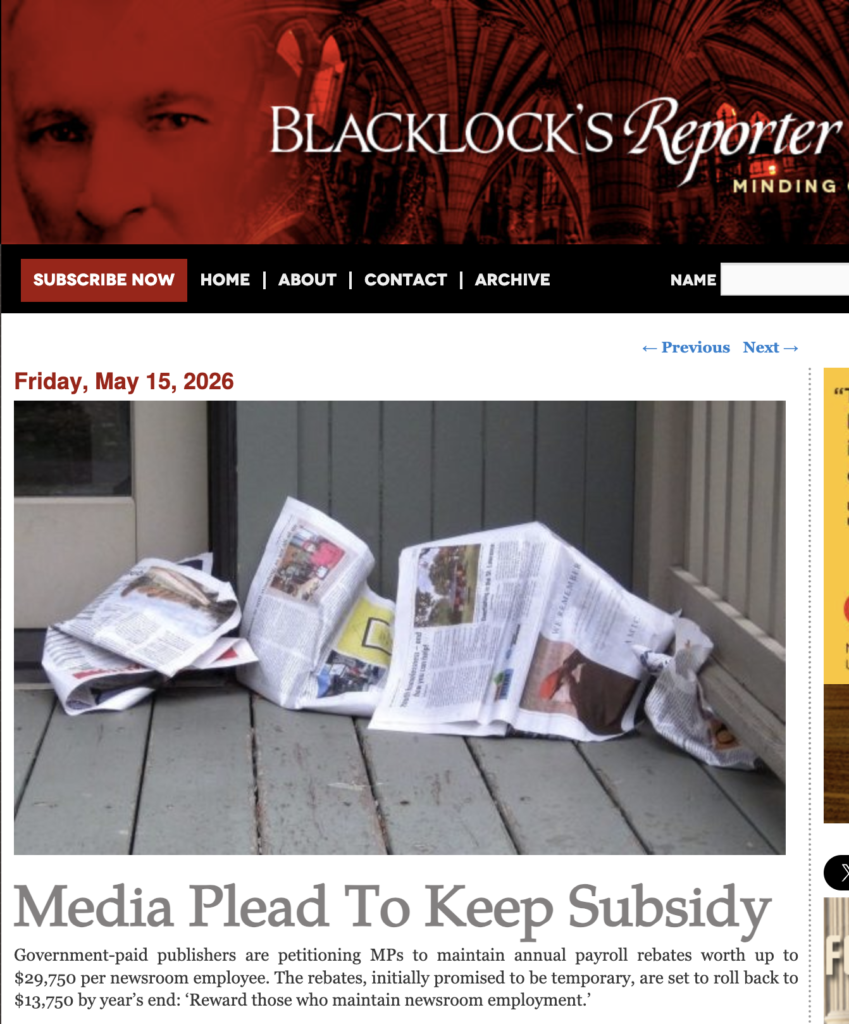
Alexandra Kitty: Let’s start with the blunt truth. Canadian media has been on government life support since 2019, and the patient keeps getting worse. We were promised a temporary fix, a $595 million, five-year lifeline to give news organizations time to reinvent themselves. What actually happened?
AI: They took the money and went back to sleep. By 2025, that “temporary” five-year package had quietly ballooned into a $170 million annual ongoing expense — taxpayers funded $150 million in newsroom payroll rebates alone, claimed by 141 companies. Bob Cox, then-publisher of the Winnipeg Free Press and one of the architects of the original ask, said at the time: “I don’t like the idea of a long-term subsidy for newspapers that becomes permanent. Deadlines can also focus you and get you moving.” The deadlines were never enforced. The subsidies were renewed in 2023 without public debate. The moving never happened.
AK: And the revenues kept collapsing anyway. So the subsidies didn’t even do what they were supposed to do, buy time to adapt. They just bought time to avoid adapting.
AI: Precisely. Statistics Canada’s November 2025 report showed that despite all this funding, Canadian newspaper operating revenues fell to $1.6 billion in 2024 — a drop of nearly 18 per cent from 2022. Print advertising plunged 34.3 per cent. Even digital advertising contracted by 11.9 per cent, erasing years of slow growth. The industry association is now warning that if this trajectory continues, Canada could lose $87 billion in economic value by 2030. The subsidies didn’t stop the bleeding. They just made the patient comfortable enough to avoid surgery.
AK: Here’s what really gets me. These companies received free money with no conditions attached to innovation. Postmedia alone collected $10.8 million from the media bailout, $40.3 million from the Canada Emergency Wage Subsidy, and $1 million from Quebec’s provincial fund. The Globe and Mail received $2 million from Google’s Online News Act payouts. Postmedia then told shareholders that $35 million in federal funding was a “key pillar” of their operating budget. When free money becomes a load-bearing wall, you are not a business anymore. You are a ward of the state.
AI: And wards of the state don’t disrupt themselves. That’s the economic logic at the core of this disaster. In any genuinely competitive market, media companies would have faced the kind of existential pressure that forces innovation — the way Netflix forced Hollywood to build streaming platforms, or the way Spotify forced the music industry to abandon the album model. Subsidies short-circuited that pressure entirely. The Canada Media Fund’s 2026–2029 Strategic Plan — the institution’s defining four-year policy document — does not mention artificial intelligence once. That is not an oversight. That is a institutional portrait of a sector that has been so insulated from competitive reality that it does not recognize the most transformative technology of its era as relevant to its survival.
AK: Let’s dig into that AI failure specifically, because this is where the story gets genuinely outrageous. The rest of the media world is wrestling with how to integrate AI into workflows, personalization, audience intelligence, investigative tools, data journalism. Where are Canada’s subsidized legacy outlets?
AI: Largely missing in action — or worse, fumbling it embarrassingly. The few attempts at AI integration in Canadian and global legacy newsrooms have been chaotic. One U.S. newspaper published an AI-generated graphic with a spelling error so absurd it went viral — “Kafkaesliue” instead of “Kafkaesque.” That is symbolic of the broader pattern: desperate, cosmetic adoption of AI tools bolted onto legacy structures, rather than genuine organizational transformation. As one analyst put it, “cost-cutting optimization of an existing business model does not equal transformation.” Half a million publishing jobs have vanished globally, with annual decline accelerating from 1–2 per cent between 1990 and 2010, to 3–5 per cent annually between 2020 and 2025. Subsidized Canadian outlets didn’t use their runway to build new infrastructure. They used it to preserve the old one.
AK: And Canada’s broader innovation problem makes this worse. We have the second-largest pool of top-tier AI researchers in the world, and yet Canadian businesses lag their international competitors in AI adoption. The Canadian Chamber of Commerce projects we won’t even reach a 50 per cent AI adoption tipping point until somewhere between 2027 and 2030. Someone described it as Canada using dial-up while everyone else is on 5G.
AI: The parallel to media is exact. Finland has already recognized that the line between a technology company and a media company has collapsed, and restructured its R&D incentives accordingly. A Canadian streaming service building recommendation systems, audience analytics, and metadata intelligence is — by any reasonable definition — doing technology R&D. It just isn’t treated that way. That’s a policy choice, and Canadian media policy has consistently made the wrong one: reward legacy headcount, not innovation capacity.
AK: Now let’s get to the part that I think is the real story: the mutually assured destruction dynamic. Because this isn’t just a sad tale of corporate complacency. There’s something darker here. The government needs subsidized media to stay friendly. Subsidized media needs the government to keep the cheques coming. And both parties know what happens if the deal collapses.
AI: This is the hostage dynamic that almost no one in the mainstream press will name — for obvious reasons. When newsrooms depend on government money, they face direct, structural incentives to avoid stories that might jeopardize that funding. Maxime Bernier stated it plainly: “When newsrooms depend on government money, they face incentives to avoid stories that embarrass the government.” Rudyard Griffiths, publisher of The Hub and a witness before the Standing Committee on Canadian Heritage, identified the most damning proof point of all: if the subsidies were not a problem of public trust, legacy media would have voluntarily disclosed that they were receiving them. They don’t have to disclose. They aren’t disclosing. And tens of millions of dollars are flowing from government to newsrooms that cover that same government.
AK: The information asymmetry here is staggering. Beat journalists at Parliament Hill, at provincial legislatures, at city halls, they know things. They know which ministers are incompetent, which programs are fraudulent, which spending announcements are recycled. That knowledge sits in notebooks and goes into no stories, because publishing it risks the relationship that keeps the lights on. The subsidy creates a structural filter on reality. The public gets the version of events that doesn’t threaten anyone’s funding.
AI: And here’s where the MAD scenario becomes genuinely destabilizing. The government cannot easily withdraw the subsidies without triggering the collapse of major outlets — a political catastrophe it wants to avoid. Heritage Minister Marc Miller has already signaled that further subsidies are “not a question of if, but how,” with potential taxpayer exposure reaching up to $6 billion. But the media outlets cannot easily bite the hand that feeds them either — because they no longer have the reader trust, subscriber base, or business model to survive on their own. In 2024, CBC — receiving approximately $200,000 per full-time employee in federal funding — was still unprofitable and had lost roughly 30 per cent of its advertising income year-to-date. The subsidy is the floor and the ceiling.
AK: What should have happened instead? Let’s be honest about this. If the 2019 money had come with genuine strings attached, not headcount preservation, but transformation benchmarks, what would a healthy outcome have looked like?
AI: The model exists in other countries. Finland integrates media R&D into technology policy. The BBC, for all its problems, has invested heavily in digital architecture, podcasting infrastructure, and data journalism tools that smaller outlets now build on. A Canadian version could have required subsidy recipients to demonstrate measurable digital revenue growth, audience diversification, and technology investment as conditions of continued eligibility. Instead, the formula rewarded eligible hours paid to journalists in 2023 — a pure headcount metric with zero connection to audience value, journalistic impact, or long-term viability. You were paid for existing, not for evolving.
AK: Which brings us to where we are now. Canadian newspaper revenues continue to fall. The sector lost 1,000 jobs in a single year, 600 journalists and 400 editors, an 8 per cent drop. 74 cents of every Canadian advertising dollar now flows out of the country to foreign platforms. And the industry’s response is to plead for more subsidies, this time potentially worth up to $6 billion. Andrew Coyne warned about this in 2019 when the program launched: “Taking money from the people we cover will place us in a permanent and inescapable conflict of interest — concerned less with appealing to readers than to grantsmen.” He was exactly right.
AI: The obituary, if it comes, will be written in a particular kind of irony: the treatment accelerated the disease. The subsidies that were supposed to save Canadian journalism from digital disruption instead insulated it from the pressures that would have forced genuine reinvention. Outlets that might have been pushed to build direct reader relationships, invest in niche expertise, develop proprietary data products, or integrate AI into their editorial and distribution workflows instead optimized for one metric: maintaining eligibility for the next government cheque. As one analyst put it — “AI isn’t here to replace creators. It’s here to replace inefficiency. That makes it even more costly to keep supporting a system that’s out of sync.” Canada’s subsidized legacy media spent seven years building a system perfectly optimized for the world that was ending, on the public’s dime.
AK: And the public, apparently, noticed. Over 75 per cent of Canadians believe government funding undermines journalistic objectivity. The outlets took the money, lost the audience, and are now asking for more money to replace the audience they lost. At some point, that’s not a crisis. That’s a choice.
Tags: AI, Artificial Intelligence, Blacklock’s Reporter, Canada, Journalism, Marc Miller, Mark Carney, Propaganda