The Quiet Quash: How Canada Is Dismantling Press Freedom While the Press Watches

By Alexandra Kitty | A Forensic Breakdown
Executive Summary
Canada does not need to arrest journalists, seize printing presses, or declare martial law to silence inconvenient reporting. It has built something more elegant and more insidious: an economic dependency machine that converts the press from a watchdog into a ward of the state. The mechanism is simple, fund the media, control the lists, weaponize access, break the information retrieval system, and then celebrate World Press Freedom Day. What makes this particularly damning is not just what government has done, but what the press refuses to do about it.
Section I: The Document That Started This
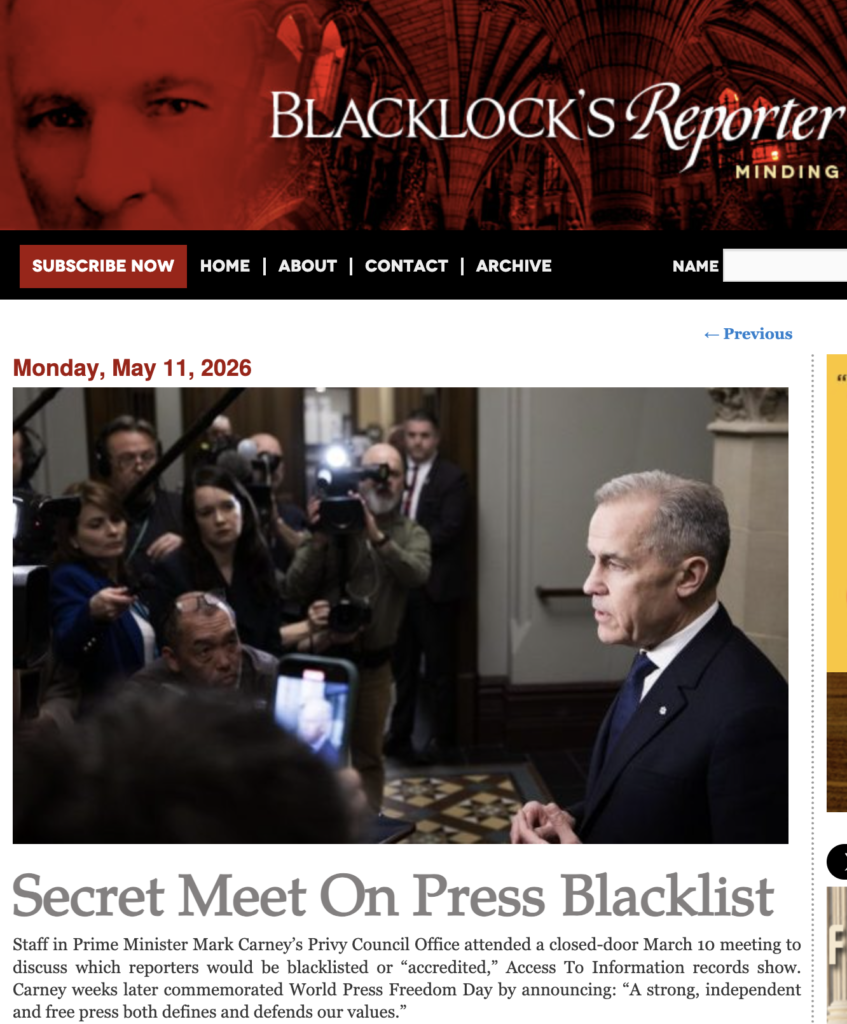
On March 10, 2026, staff from Prime Minister Mark Carney’s Privy Council Office attended a closed-door meeting to discuss which reporters would be blacklisted or “accredited.” Access to Information records confirmed the meeting took place. Three weeks later, Carney commemorated World Press Freedom Day by announcing: “A strong, independent and free press both defines and defends our values.”[^1]
The gap between what was said and what the documents showed is not hypocrisy. It is policy.
Blacklock’s Reporter, Ottawa’s only reporter-owned, subscription-funded, independently operated newsroom in the Parliamentary Press Gallery, broke this story. The outlet’s publisher, Holly Doan, refuses federal journalism subsidies on principle, describing them as antithetical to journalistic independence. The rest of the press gallery, 39 of 46 accredited media companies, receive federal grants and subsidies. The CBC alone received $1.4 billion in federal funding in 2024, with Carney promising an additional $150 million increase.[^2][^3][^4][^5]
You do not need to issue orders to people who cannot afford to disobey them.
Section II: The Architecture of Control
2.1 The Money Machine
The federal government is spending over $1.7 billion annually subsidizing journalism and media. This breaks down as follows:[^2]
| Program | Annual Amount (2024–25) |
|---|---|
| Canada Media Fund | $154.1 million |
| Canada Periodical Fund | $86.5 million |
| Canadian Journalism Labour Tax Credit | $65 million |
| Local Journalism Initiative | $19.6 million |
| CBC direct subsidy | ~$1.4 billion |
| Total | ~$1.7 billion+ |
Source:[^6][^2]
For comparison, this exceeds what the federal government will spend annually on the Canada Disability Benefit, and more than the first five years of National Pharmacare combined.[^2]
The Labour Tax Credit alone covers 25% of each “qualifying” journalist’s salary, up to $13,750 per person per year. The government gets to decide which newsrooms are “Qualified Canadian Journalism Organizations.” That decision is made by a five-person handpicked panel, all drawn from legacy media and academia, with no representatives from new or independent media.[^7]
2.2 Who Decides Who Is a Journalist
As Jen Gerson, co-founder of The Line, wrote: “My concern with this growing dependence on government largesse is not just that we will create a media class financially entwined with the Liberals’ continued electoral success, but rather that it will calcify the media in its current state of decline and mediocrity.”[^7]
Andrew Coyne put it more directly: “Taking money from the people we cover will place us in a permanent and inescapable conflict of interest; that it will produce newspapers concerned less with appealing to readers than to grantsmen.”[^7]
Former CRTC commissioner Peter Menzies testified to a parliamentary committee that Bill C-18’s funding regime “will permanently entrench the industry’s dependency not on the loyalty of citizens, readers and viewers but upon the good graces of politicians.”[^8]
A 2024 survey found that more than three-quarters of Canadians agreed government funding could undermine journalistic objectivity.[^2]
2.3 The Online Streaming and News Acts: Control by Code
The 2023 Online Streaming Act (C-11) gives the CRTC power to regulate online video content, including user-generated material, and allows the government to influence online “discoverability”, meaning it can push certain content to the top of feeds while burying other content.[^9]
The 2023 Online News Act (C-18) compels “major digital platforms” (primarily Meta and Google) to pay approved news outlets for linking to their content. The phrase “approved news outlets” is doing enormous work: it creates a financial pipeline from tech companies to government-selected media organizations, while independent outlets operating outside the subsidy regime receive nothing.[^9][^2]
The net effect: a two-tier media ecosystem in which the government simultaneously funds approved outlets, regulates platforms, and retains informal control over which journalists sit in the room when power is exercised.
Section III: The Blacklist Mechanism
3.1 The Press Gallery as Gate
Parliamentary Press Gallery accreditation is the key to access in Ottawa. Accreditation decisions are made behind closed doors by an executive committee where a majority of members represent CBC and Canadian Press, two of the largest subsidy recipients.[^5]
In 2019, a Federal Court judge ruled that the Gallery and House of Commons administration had unfairly blacklisted two news organizations using “secretive accreditation guidelines.” Federal Court Justice Russel Zinn called the ban “troubling,” “procedurally unfair,” and lacking “discernible rationality and logic.”[^5]
In 2021, the Gallery passed a motion requiring new members to disclose financial information, the same kind of demand that had previously been weaponized against Blacklock’s at its founding in 2012, when Gallery administrators demanded details of the outlet’s corporate structure, names of all partners, and terms of contracts before granting accreditation.[^10][^11]
3.2 The CBC’s Internal Do-Not-Touch List
In March 2026, CBC refused to release an internal guide detailing which public figures are banned from interviews by the news department. Travis Dhanraj, a former CBC-TV host, testified before the Commons Heritage Committee that he had seen the guide and a companion blacklist of 45 names with the instruction: “Do not go near these people.” The CBC issued no denial and no explanation.[^12]
This is not editorial discretion. A secret list, maintained by a $1.4 billion taxpayer-funded broadcaster, of people whose perspectives are prohibited from public broadcast, with no criteria, no appeal mechanism, no public disclosure, is a censorship infrastructure operating under a journalism brand.[^13][^12]
3.3 The PCO Meeting and the Selective Access Doctrine
The March 10, 2026 Privy Council Office meeting on press accreditation was not an anomaly. It reflects an established operating doctrine. Immigration Minister’s office has “declined comment” when approached by independent media, with the department specifying that “only newsrooms that meet the criteria for government approval will be granted questions.” The government defines the criteria. The criteria are not published.[^14][^1]
In October 2025, Parliamentary Press Gallery president Mia Rabson denounced as “unprecedented” the Carney government’s total exclusion of all Canadian media from the Prime Minister’s foreign trip to Egypt for the Middle East Peace Ceremony. Journalists were given less than two hours’ notice before Carney’s departure. Rabson stated: “Any event that erodes access, transparency and accountability is a step in the wrong direction.”[^15]
The “unprecedented” exclusion was followed by Carney’s World Press Freedom Day declaration. The gap, again, is not accidental.
Section IV: The Information Retrieval System Is Broken by Design
For journalists who try to work around selective access by filing Access to Information (ATI) requests, the system offers a second wall.
Canada’s Access to Information Act has not been significantly updated since 1983. The average time to process a federal ATI request is 83 days. In Ontario, it is 182 days. Government bureaucrats now recognize, per veteran journalist Dean Beeby’s testimony to a parliamentary committee, that they face “a much bigger blowback from releasing information than from withholding it.” As a result, documents arrive “picked clean of meaningful contents.”[^16][^17]
When documents are released at all. In 2026, the Department of Canadian Heritage censored 21 of 22 pages of the confidential memo outlining the government’s plan to “modernize” the CBC, a plan written weeks after Carney won the 2025 election. The single uncensored sentence: the government has “recommitted to protecting Canada’s cultural sovereignty and identity by strengthening CBC.”[^13]
The Canadian Association of Journalists (CAJ) awarded the federal government the 2024 “Code of Silence Award for Outstanding Achievement in Government Secrecy” for its decade-long effort to obstruct the release of residential school records, records requested under the Truth and Reconciliation Commission’s own Calls to Action. Canada’s Information Commissioner Caroline Maynard has testified that meaningful change “comes from the top”, and that transparent leadership is currently absent.[^18]
Academic research published through Facts and Frictions, drawing on interviews with 17 Canadian journalists, concluded that the federal ATI system is “rife with practical and ideological hurdles” that have caused journalists to treat it as a “last resort”, rather than the accountability tool it was designed to be.[^19]
Section V: The Legislative Censorship Pipeline
Beyond subsidy dependency and access restriction, Canada has pursued a legislative censorship architecture through a cascade of digital regulation bills.
Bill C-11 (Online Streaming Act, 2023): Grants the CRTC authority to regulate online video content created by ordinary Canadians, and to influence algorithmic discoverability, government-dictated search results and feed rankings.[^9]
Bill C-18 (Online News Act, 2023): Forces platforms to pay government-approved news outlets. Led to Meta blocking all Canadian news on Facebook and Instagram, effectively deplatforming the Canadian news ecosystem from its largest social distribution channel.[^9]
Bill C-63 (Online Harms Act, 2024): Proposed a new Digital Safety Commission empowered to order content removals, levy severe financial penalties on service providers, impose house arrest on individuals not charged with or convicted of any crime, and allow the Canadian Human Rights Commission to pursue individuals over non-criminal “discriminatory” speech. Civil liberties organizations including the Canadian Civil Liberties Association and the BC Civil Liberties Association flagged the bill as a sweeping censorship regime. It died on the order paper when Parliament was prorogued.[^20][^21][^22][^9]
The Justice Centre for Constitutional Freedoms described the combined effect of C-11, C-18, and C-63 as having “transformed Canada’s once open internet into a state-managed digital environment that restricts what Canadians may access, share, and say online.”[^9]
Section VI: The Press Is Complicit: And Has the Tools to Resist
This is where the forensic analysis turns uncomfortable.
The press in Canada is not simply a victim. It is, in large measure, a complicit hostage that has chosen its chains, because the chains come with salary subsidies, press gallery access, ministerial briefings, and the social capital of being “trusted media.”
6.1 The Tools They Have
The tools for resistance exist. They are not exotic:
- ATI requests are legally available to any journalist, any citizen. The Globe and Mail’s “Secret Canada” database project demonstrated what systematic ATI use can expose. Blacklock’s entire model is built on this: use documents, not press conferences.[^3][^4][^23]
- Subscription independence is financially viable. Blacklock’s has operated on a high-paywall subscription model since 2012, accepts no government subsidies, and has litigated against federal bureaucracies that violated its paywalled content through password sharing. The Hub built a national audience through private grants, subscriptions, advertising, and events, without a single government dollar.[^24][^3]
- Transparency disclosures would immediately differentiate credible independent journalism from captured legacy reporting. Rudyard Griffiths of The Hub testified before the Commons Heritage Committee in 2026 that subsidy recipients should be required to disclose their government funding to audiences, a basic transparency standard that legacy media have fought to avoid.[^24]
- Collective refusal works: when Nova Scotia changed its media access rules to restrict interviews to a designated room away from the legislature, journalists from the Halifax Examiner, CBC, and allNovaScotia refused to participate in briefings under the new rules. That refusal received public attention and forced a public response from the government.[^25]
6.2 Why They Don’t Use Them
The answer is not ignorance. It is incentive structure.
A newsroom that depends on the Canadian Journalism Labour Tax Credit for 25% of its payroll cannot afford to produce reporting that alienates the government deciding whether it remains a “Qualified Canadian Journalism Organization.” A reporter whose salary is effectively co-signed by federal grantsmen will calibrate their risk appetite accordingly, not because they are told to, but because institutional survival instincts produce the same result without explicit instruction.[^7][^2]
Researcher Jon Penney’s work on surveillance and self-censorship demonstrates that the chilling effect does not require direct pressure: the awareness of monitoring, dependency, or potential retaliation is sufficient to alter behavior. A 2016 survey of Canadian writers and journalists found that over 80% reported concern about government surveillance of their communications, 86% said increased surveillance was “especially harmful” to their independence, and 22% had already avoided writing or speaking on particular topics as a result.[^26][^27]
The difference between 2016 and 2026 is that the government now does not need surveillance to achieve the same chilling effect. The subsidy regime does it more efficiently, more legally, and with no fingerprints.
6.3 The Credibility Paradox
Here is the paradox that legacy media refuses to confront: the path to rebuilding audience trust runs directly through the thing they are most afraid to do, refuse the money and report freely.
A 2025 Pollara poll found that Canada’s most trusted news outlets are Weather Network, CBC, CTV, and Global, the exact institutions most financially entangled with the government they are supposed to scrutinize. Trust, in this survey, is measuring brand familiarity, not editorial independence. And even here, the trust gap between Liberal and Conservative voters is widest for CBC, revealing that trust has become a partisan signal rather than a journalistic credential.[^28]
More telling: the Canadian Journalism Foundation’s 2025 survey found that 88% of Canadians are concerned about AI-generated deception in the news, but only 31% expressed complete trust in traditional Canadian news outlets. Nearly seven in ten Canadians who consume legacy media harbor doubt. The audience is already skeptical. The press has not yet accepted that it has earned that skepticism.[^29]
Rudyard Griffiths testified in 2026: “Media subsidies contribute to that lack of trust and that lack of trust undermines our democracy.”[^24]
Section VII: The Global Context
Canada is not operating in a vacuum. The 2026 RSF World Press Freedom Index found that press freedom had fallen to its lowest point in 25 years, with more than half of the world’s countries now classified as “difficult” or “very serious.”[^30][^31]
Canada ranked 21st in 2025, down from 14th in 2024, with its score falling from 81.7 to 78.75, a seven-place drop in a single year. The 2026 data places Canada at 20th, holding roughly the same position in an environment where the global floor is collapsing.[^32][^33]
The RSF notes that the economic indicator for press freedom is at its lowest recorded level globally, with media in 160 of 180 countries achieving financial stability “with difficulty” or “not at all.” Canada’s federal government has responded to this economic fragility by inserting itself as the primary economic stabilizer for its own press corps, which is precisely what the RSF’s economic indicator is designed to flag as dangerous.[^32]
Canada lectures the world on press freedom. It funds media through Middle East and African training programs. It co-sponsors UN resolutions on the safety of journalists. It is, simultaneously, hosting secret Privy Council meetings to decide which journalists may ask questions.[^34][^1]
Conclusion: The Threat Is the Model
The blacklists are not a bug. They are the product of a system operating exactly as designed.
When government funds journalism, government decides who is a journalist. When government controls accreditation, government decides who asks questions. When government breaks ATI, government controls what documents exist in the public record. When government drafts legislation enabling pre-criminal house arrest for speech, government signals the outer boundary of acceptable inquiry. And when media depends on all of the above to survive, the press does not need to be silenced. It silences itself.
What is left is not journalism. It is a subsidized performance of journalism: a fourth estate that occupies the building, holds the press passes, files the stories, and collects the paycheque, while the actual work of holding power to account is done by a handful of subscription-funded outliers who are routinely excluded from the rooms where decisions are made.
Canada did not quash its free press in a single dramatic act. It did it quietly, incrementally, financially, and with the press’s cooperation.
That is the threat. And it is working.
All findings are based on Access to Information records, parliamentary testimony, court documents, and published investigative reporting. Primary sources cited throughout.
Additional Research from Perplexity
References
- Monthly Archives: May 2026 – Blacklock’s Reporter – Investigators uncovered more than a dozen individuals who breached the Lobbying Act and were neither…
- Government subsidies for Canada’s media were supposed to be … – The pace with which Canada subsidized its news media is staggering, with a recent report estimating …
- Holly Doan, Watchdog. – MediaPolicy.ca – Career journalist Holly Doan makes a business out of turning over rocks in Ottawa. The publisher of …
- About Us | Blacklock’s Reporter – Blacklock’s Reporter covers news you won’t find anywhere else: bills and regulations; reports and co…
- Poilievre calls Parliamentary Press Gallery ‘undemocratic’ – “The government-influenced Canadian Parliamentary Press Gallery governing access to official Ottawa …
- [PDF] How Free and Trusted Can Canada’s Media Be if They Are … – Subsidies Thrive in Darkness. The speed with which Canada’s federal government has jumped into the f…
- Free the media – Canadian Taxpayers Federation – The Trudeau government has poured $595 million into its media bail-out program, which funds media or…
- Canada’s subsidized mainstream media is not trusted – The $595 million bailout money is only part of the dollars the federal government is shoveling to Ca…
- New report: Death by a thousand clicks – government censorship of … – The report outlines how recommendations from the Broadcasting and Telecommunications Legislative Rev…
- Parliamentary Press Gallery issues Blacklock’s Reporter … – Its website lists six journalists and editors on staff. But Blacklock’s, not even a month old, hit i…
- Blacklock’s v. Press Gallery – It is an honour and a privilege to be allowed to enter the pages of Blacklock’s and throw a few word…
- CBC’s Silent On Blacklisting – Blacklock’s Reporter – The CBC yesterday would not release an internal guide detailing which public figures are banned from…
- CBC-TV Rescue Plan Is Secret | Blacklock’s Reporter – A federal plan to “modernize” the CBC will remain secret, the Department of Canadian Heritage said y…
- Liberals will only answer ‘approved’ media, and only sometimes – The Really Big Show: The thinking Canadian’s daily briefing, independent and informed. Live every we…
- Parliament Hill journalists denounce ‘unprecedented’ lack of … – OTTAWA — The head of Canada’s Parliamentary Press Gallery denounced the Liberals’ “unprecedented” ex…
- Delays cause journalists to shun access to information law – Reporters are abandoning the federal Access to Information Act as a research tool because turnaround…
- Canada’s broken access to information system – An ongoing Globe and Mail investigation by reporters Tom Cardoso and Robyn Doolittle revealed that p…
- Federal government selected for 2024 Code of Silence Award for its … – Access Denied: Federal government selected for 2024 Code of Silence Award for its obstructing releas…
- Canadian access to information and journalism – Facts and Frictions – This research’s results point to a broken access to information system in Canada, rife with practica…
- Online Harms Act – Wikipedia – Bill C-63 focused on amendments to the Criminal Code, the Canadian Human Rights Act, and internet ch…
- Canadian government to split online harms legislation into two bills – Amnesty International Canada welcomes the federal government’s plan to split Bill C-63, the Online H…
- What’s in Bill C-63, and why we are alarmed – Bill C-63: An Act to enact the Online Harms Act, to amend the Criminal Code, the Canadian Human Righ…
- System Failure – The Review of Journalism – Accessing government information in Canada is notoriously slow, often serving as more of a hindrance…
- Media subsidies are undermining public trust – YouTube – … Canadian Heritage about the state of Canada’s journalism and media sectors. During his testimony…
- Nova Scotia government restricts media access at provincial … – The Nova Scotia government introduced a new policy to prevent ministers from answering questions fro…
- How surveillance harms – Policy Options – Fortunately, there is a growing body of research illustrating how government and national security s…
- [PDF] Chilling Free Expression in Canada – The findings of Chilling Free Expression in Canada: Canadian … Penney, “Chilling Effects: Online S…
- [PDF] Trust In Media | Pollara – Field Window May 16th to 20th, 2025. Sampling. Online survey of 3,400 adult (18+) Canadians. Sample …
- Digital deception now a ‘daily reality’ for nearly half of Canadians … – Three-quarters (75 per cent) of respondents stated that they have some trust in news from traditiona…
- Global press freedom at lowest level in 25 years, Reporters … – Press freedom has fallen to its lowest level in a quarter of a century, Reporters Without Borders (R…
- 2026 RSF Index: press freedom at a 25-year low – 2026 RSF Index: press freedom at a 25-year low · The legal indicator plummets due to the abuse of na…
- Canada Ranks 21st on World Press Freedom Index 2025 – Canada has ranked 21st on the World Press Freedom Index 2025 by Reporters Without Borders, down seve…
- Canada ranks 20th in global press freedom despite … – … 2026 Index, falling 37 places from 83rd in 2025 to 120th in 2026.
- Freedom of expression and media freedom – Global Affairs Canada – Currently, Canada funds media freedom projects in the Middle East and Africa. These Canadian project…