We are Still in a Global Game of Roulette and the Wheel is Still Spinning. The New York Times Never got the Memo.

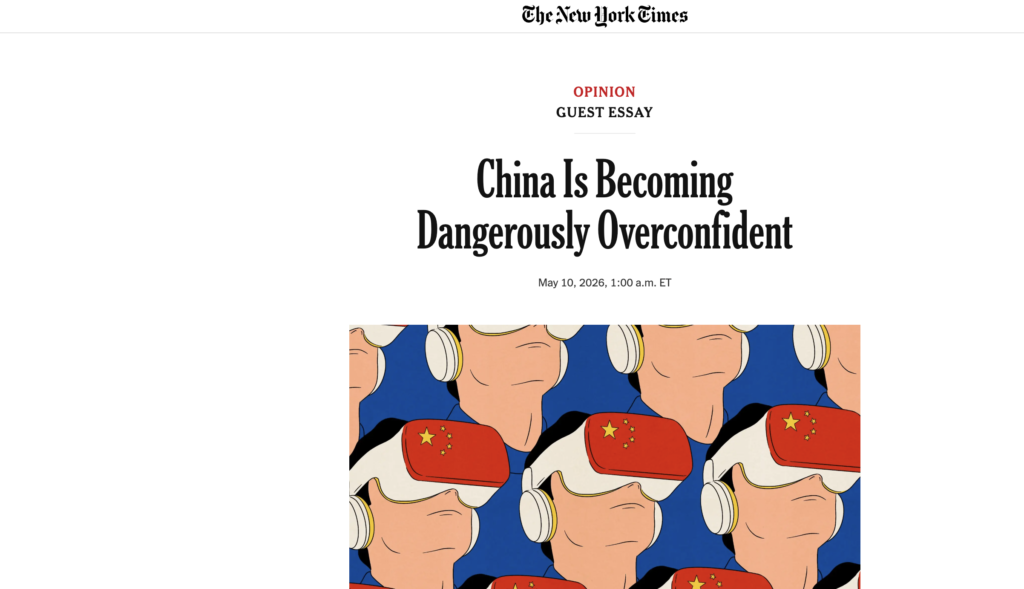
The loudest thing in Yanzhong Huang’s column isn’t the warning about Chinese overconfidence. It’s the quiet assumption that the wheel has already stopped spinning, and that the ball has landed on “U.S. resilience” by default.
It hasn’t.
The Chinese meme of an “American kill line” is propaganda, but it is not pure fiction. You do not get a K‑shaped economy, a billionaire hoarding class, and millions of people one illness or layoff away from ruin and then declare the system “robust” because the aggregate numbers still look pretty on a chart. The U.S. can point to GDP, the dollar, and crime statistics all it likes; that tells you how well the top of the pyramid is doing, not how stable the structure is underneath. The kill‑line story is grotesquely exaggerated, but it is taking a real fracture and turning up the contrast.
China’s self‑congratulation is no better. It has trains, EVs, batteries, factories and an infrastructure build‑out that makes American decay look provincial. It also has a property slump, youth unemployment, demographic drag and a leadership that is talking itself into believing that a messy, aging hegemon will simply collapse on schedule so Beijing can disco‑dance into history’s spotlight. That is not strategy, it is a narrative. When you bet your future on someone else’s orderly demise, you are already writing fiction.
The column misleads in a third, quieter way: it treats the U.S.–China rivalry as if hegemonies are handed off like a relay baton. That is not how empires rise or fall. They do not appear full‑grown; they start small, at the edge, and grow into the void left by a fading order. Nor do they vanish overnight. They fade. They stagger on as reunion tours, still playing the old hits, while once‑taken‑for‑granted supporting acts quietly walk offstage. Canada was supposed to be the harmless “dumb Monkee” in the American act: amiable, dependable, never the star. After tariffs, annexation jokes and open contempt from Washington, it is now being courted by Europe and Asia, emotionally detached from the “special relationship,” and yet still structurally tied in. That is what imperial twilight looks like: not collapse, but old bonds turning into awkward reunions.
AI adds a layer Huang never touches. It is the unknown “it” that has been dissolving the inevitability of would‑be kings since 2022. It lets small players, states, firms, even lone operators, do more with less, while control over the underlying pipes (models, compute, data) is locked up behind a handful of gates. It punctures the myth of singular genius moguls even as it intensifies dependence on a thin layer of infrastructure owners. Combine that with elections that can flip policy in a week, wars that can gut a generation, pandemics that can freeze whole economies, and climate shocks that can erase supply chains, and any confident forecast starts to look like performance art. Governments lie and bury numbers. Markets hallucinate certainty out of noise. You cannot honestly read the future off either the data or the vibes.
That is the real problem with the essay. Not that it pushes back on Chinese glee at American decline, someone should, but that it reassures its readers that the roulette wheel has already clicked into place on “U.S. still safely on top, China overplaying its hand.” In reality, both Washington and Beijing sit on Ledger A: big, noisy, overexposed products of a fading order, each with people who will do very well no matter what, each with regions and classes already living in slow‑motion crisis. Around them is a crowded table of smaller players, South Korea, Taiwan, Japan, the U.K., Canada and many others, whose cultural, technological and strategic influence is real but does not line up with any neat story of succession.
There is no heir apparent. The wheel is still spinning. The only honest thing to say about the next configuration of power is that we are still in the fade, still in the void between empires, and still under the spell of governments and commentators who would rather pretend the ball has already dropped than admit they are guessing at a game they cannot see in full.