
Home Prices in Canada are Still Vastly Overvalued. But When Your House is Made of Cards, It’s Always a Gamble.

This is interesting.
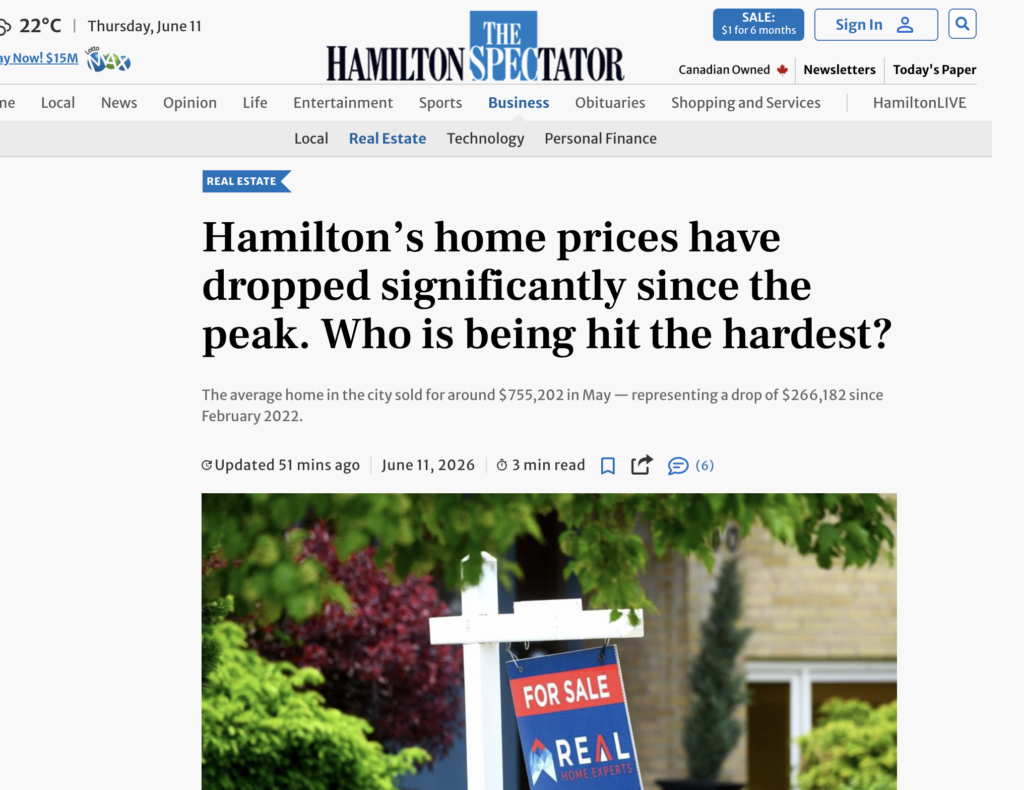
$775, 202 for a house in Hamilton? It should be $266, 182. Yes, the drop since February 2022 is a more healthy and realistic asking price for a big and spacious house.
The problem is that people always think their house is worth a million and see it as a lottery ticket. A get rich quick scheme. But, it’s not.
The vast majority of the “good jobs” in Canada are government jobs. If something happens and the private sector workers lose their jobs, it brings down the government’s ability to keep the contrived public sector jobs going.
Once upon a time, public sector jobs were reserved for war veterans: it was a thank you for serving. It was a respectable paper crown that made just enough for a comfortable middle-class life, but it did not pay as much as private sector jobs.
But then over time, things flipped, and then public sector jobs were a way for governments to hide the true state of the economy and employment law by creating make work programs to hide the true state of the economy, and for the Liberals, a way to ensure Conservatives could never eke out a majority. People in the public sector know their contrived position would be on the line otherwise.
But then, more things started to get out of whack. Birth rates declined because private sector jobs weren’t paying much and were too precarious. So then the government was paying people per child, which just encouraged the wrong motives for having children. It became transactional, and it still didn’t solve the problems. It just got people more dependent on social assistance as a viable income source.
Meaning the government was still footing the bill. This isn’t new money coming into the country.
So the government’s solution was to flood Canada with immigrants. Many brought money with them, and they could buy up real estate, often more than one house (on the flip side, sometimes multiple families would buy a single house and cram themselves in there, causing neighborhood resentments). Other immigrants became dependent on social assistance or were pushed into public sector jobs.
This drove up the price of houses, and didn’t fix any of the other problems. It just created more as the old problems became worse. Many immigrants became exploited by unscrupulous and self-entitled private sector employers, many of whom were also getting taxpayer money in the forms of grants to keep afloat. Colleges and universities became diploma mills that charged foreign students a premium as public sector presidents of post-secondary institutions were pulling in generous and undeserved six figure salaries.
All of these factors were driving up the price of housing to dangerous levels. Yes, you could sell your shack for a million bucks, but then the next shack would be asking for 1.5 million. You were no better off.
The real state of the Canadian economy was being hidden by the government giving corporate welfare to Canadian companies. The journalism industry would have collapsed if it wasn’t for the handouts they became dependent on for survival. They weren’t the only ones. The Canadian entertainment industry would cease to exist without it, and hundreds of public sector employers would lose their cushy jobs if the gravy train stopped.
But there was one more little near-sighted glitch: Canada’s private sector dependence on US company’s for survival. The US was a big consumptionist market with consumers speaking the same language and were geographically close-by. Yet, even then, the US got more from the bargain than Canada did. The Americans thrived, while the Canadian private sector didn’t. Canadian stalwarts such as Eaton’s and the Bay couldn’t compete with Walmart and Costco and both vanished without a trace.
But these companies still employed Canadians. The federal government could still keep the house of cards from falling down.
And then an incompetent predator won the US election, and Donald Trump slapped tariffs on Canada and made childish threats about annexing Canada just as AI was transforming the workplace.
Inflation (and it’s ugly siblings, such as skimpflation) was eating away what people could get to survive. People started losing their jobs thanks to tariffs. Floodgate immigration didn’t solve the mess.
And it impacted the price of houses.
Colleges had to start letting professors and support staff go as they closed faculties. Canada Post plan to stop home delivery means another avenue of well-paying jobs are vanishing. But this time, it’s not private sector jobs on the block, but those safe and cushy public sector ones.
And with it, the prices of houses in Canada, the ones that went out of control, began to tumble back to Earth. It’s only the beginning. People poured sometimes hundreds of thousands of dollars they didn’t actually have to upgrade and flip a house that they now have to sell for less than they bought it for. That get rich quick scheme had a serious design flaw.
And we’re about to find out just how serious that design flaw is.
Tags: AI, Artificial Intelligence, Canada, Donald Trump, Fallon Hewitt, Justin Trudeau, Mark Carney, Propaganda