
Dossier: Canada’s Denialism Loop: Government Spin, Subsidized Media, and the Recession Nobody Named.

Executive Summary
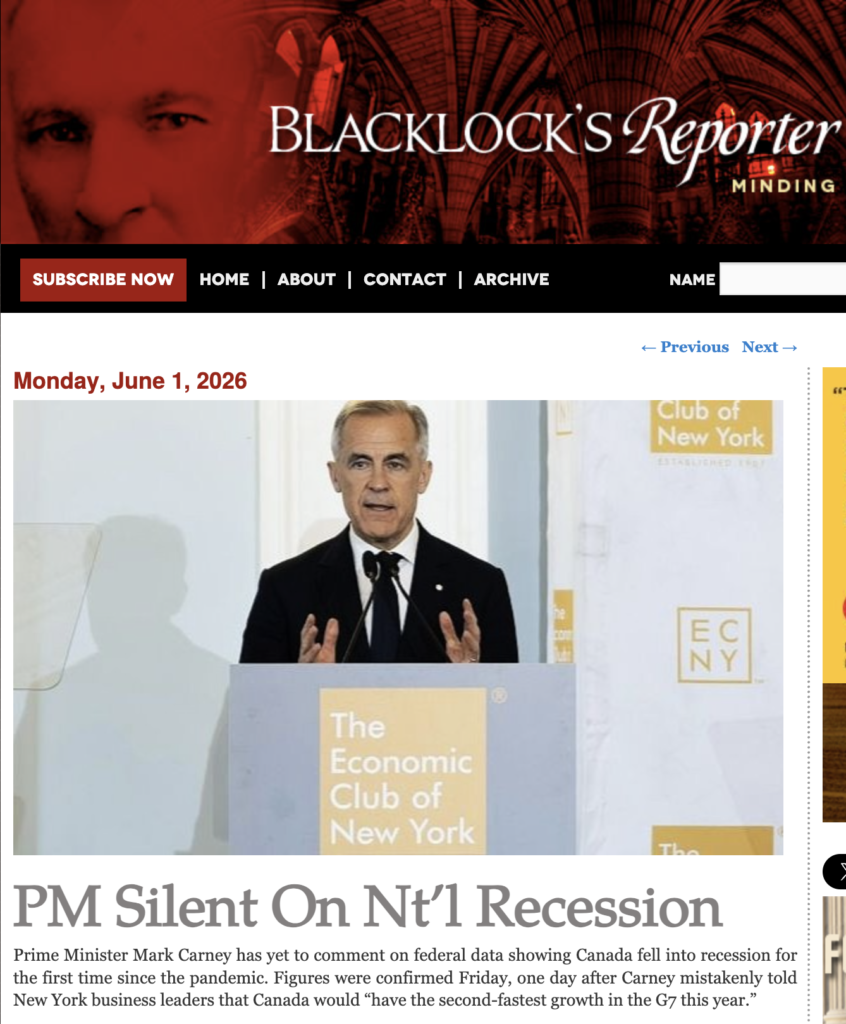
Canada entered a technical recession in early 2026, with GDP contracting for two consecutive quarters, and the Prime Minister was mid-speech at the Economic Club of New York, telling business leaders the country would post the second-fastest growth in the G7 that year. The Prime Minister had still not publicly addressed the recession days later. This is not an isolated incident of bad timing. It is the visible tip of a structural problem: a political culture that reflexively downplays economic pain, a subsidized press that too often amplifies rather than interrogates government messaging, and a public that is paying the price while the explanations remain disconnected from lived reality.
The Recession That Arrived Without Acknowledgment
Canada’s GDP fell 0.1% (annualized) in Q1 2026, following a revised 1.0% annualized decline in Q4 2025. Statistics Canada attributes the weakness primarily to slumping resource extraction, a decline in construction, and a surge in imports, not the tariff-driven trade shock the government preferred to emphasize. The contraction was the third quarterly decline out of the past four quarters, and the first back-to-back negative quarter scenario since the COVID-19 pandemic.
The result came in far below even the most cautious forecasts. The FactSet consensus was 1.4% growth; the Bank of Canada’s own projection was 1.5%. That is not a modest miss: it is a categorical failure of the official economic narrative. And yet, the day before Statistics Canada released the data, Prime Minister Mark Carney stood before the Economic Club of New York and declared: “Canada is projected to have the second-fastest growth in the G7 this year and next.”
The gap between that claim and the data published the following morning encapsulates the denialism problem precisely. The statement was not corrected, retracted, or followed by any formal acknowledgment from the Prime Minister’s office that Canada had entered a recession. Blacklock’s Reporter noted that Carney “has yet to comment on federal data showing Canada fell into recession for the first time since the pandemic”.
The Real Economy vs. the Official Story
The government’s preferred framing, that Canada’s economy is resilient and that challenges are primarily external, driven by U.S. tariffs, fails to account for long-running structural decay. Conservative critics were quick to point out that Canada is the only G7 economy in a technical recession, even as all G7 nations face the same external trade pressures. That distinction is difficult to explain as purely external.
Per capita GDP had already been declining for multiple consecutive quarters before the technical recession was confirmed. Canada’s total headline GDP figure was being propped up, in part, by extraordinary population growth, but real GDP per person was falling even as total output nominally held on. That distinction, between aggregate GDP and per capita GDP, had been consistently absent from the government’s public messaging.
The human cost of the “no recession” narrative is measurable. Food bank visits in Canada reached 2.2 million in a single month in March 2025, the highest number in recorded history, double the level of 2019, and 5.2% higher than the year before. Consumer insolvencies in Q1 2026 hit the highest quarterly total since the 2009 global financial crisis, with consumer bankruptcies up 11.6% and consumer proposals up 16.4%. These are not indicators of a population experiencing the second-fastest G7 growth.
Meanwhile, the Spring 2026 federal budget update declared that “the economy avoided a recession and domestic activity remained resilient”, a claim that predated the Statistics Canada confirmation but was emblematic of the official posture: reassure first, explain later, and quietly revise when the numbers arrive.
The Press as Stenographers
The structural problem with Canadian journalism is not primarily about individual reporters making bad editorial choices. It is about institutional incentives that systematically blunt adversarial coverage of the government that funds them.
Since 2019, the federal government has spent more than $595 million in direct and indirect subsidies to Canadian news outlets, with approximately $325 million flowing in the 2024–25 fiscal year alone. These include the Labour Journalism Tax Credit (which covers up to 35% of journalist salary costs up to $85,000 per employee), the Canada Periodical Fund’s Special Measures for Journalism (a $38.4 million three-year extension announced in Budget 2025), and the Local Journalism Initiative. The government has also committed to extending additional support through 2026–27.
The result, as the Macdonald-Laurier Institute documented, is that “temporary programs have become permanent and federally mandated funds for journalism have expanded, at an enormous cost to journalistic objectivity and independence.” The Institute found newspapers “openly advocating for preferential treatment, praising the governments that fund them, and failing to disclose their entitlements.” Canadians appear to have noticed: by 2023, only 31% of Canadians expressed a “good or great deal of confidence” in the media, lower than trust levels for Parliament, the courts, the school system, and police. Among Canadians aged 25–34, that trust fell to just 23%.
A 2024 Ottawa Declaration signed by independent digital media outlets called the subsidy regime “a challenge to the democratic process insofar as it raises legitimate questions in the public’s mind about the independence of the press, thereby undermining the perceived veracity of reported news.” The declaration also noted that the subsidy system creates an uneven playing field, legacy media qualifies; most independent and digital outlets do not, thereby stifling innovation and deterring private investment in journalism. Blacklock’s Reporter, one of the few Ottawa-focused subscription outlets operating without government subsidy, has been blunter in its self-assessment: “Subsidized media today are so self-pitying it is no surprise they missed the biggest scoop of their lives, the death of subsidized media.”
Access is also increasingly controlled. The Canadian Association of Journalists (CAJ) documented in 2025 that journalists from multiple organizations were barred from covering events, threatened, or restricted by governments, public officials, and political actors. The Parliamentary Press Gallery itself has been criticized for functioning as a “small cabal of government-approved mouthpieces,” with accreditation decisions made behind closed doors by a committee dominated by CBC and Canadian Press representatives.
The Collapse of Local Accountability Journalism
The hollowing out of local news is both cause and consequence of the accountability vacuum. Between 2008 and October 2025, 603 local news outlets closed in 388 communities across Canada — and only 264 have launched and survived over the same period. That is a net loss of more than 339 outlets. Since the COVID-19 pandemic alone, more than 63 newsrooms have closed. CBC/Radio-Canada announced 800 position cuts in late 2024.
The Local News Research Project, led by Metropolitan University (formerly Ryerson University), documented that more than 70% of those closures were community newspapers, dailies or weeklies with print circulation below 50,000. These were the outlets most likely to cover municipal council meetings, local budget decisions, and the grind of provincial policy implementation. Their disappearance creates what researchers call “news deserts”, communities where no journalist is watching, no editor is filing access-to-information requests, and no reporter is asking why the road hasn’t been fixed in three years.
The effect on democratic accountability is structural: when there is no one to investigate, there is no investigation. When there is no one to ask the question, the question goes unasked. In that environment, government spin doesn’t just go unchallenged, it fills the vacuum left by the absence of local accountability journalism.
When Denialism Has Consequences
The pattern — official optimism, slow news coverage, public confusion, is not merely an aesthetic failure. Denialism has policy consequences. When a government insists the economy is on track, or frames downturns as purely external, it delays the corrective policy response. Reform of unproductive spending priorities, structural investments in productivity, housing supply interventions, or trade diversification strategy, none of these happen urgently when the official message is that things are essentially fine.
Canada’s per capita GDP had been falling for multiple quarters before any sustained public debate about structural economic reform emerged. The Bank of Canada, caught between an inflation uptick driven partly by global energy price shocks from the Middle East conflict and a contracting domestic economy, signaled it would hold rates steady for the foreseeable future, effectively paralyzed by cross-cutting signals. Meaningful fiscal and monetary policy coordination requires an honest baseline. When that baseline is obscured by official optimism and soft press coverage, the policy response is too slow, too modest, or aimed at the wrong diagnosis.
Conservative Opposition Leader Pierre Poilievre called for an emergency parliamentary debate so competing economic visions could be aired publicly. His framing, that Carney was “ducking questions” and offering “dazzling buzzwords that achieve nothing but the worst economy in the G7”, is politically motivated, but the underlying demand for transparency and accountability is legitimate regardless of its source. The Liberals dismissed it as “political theatre”. That dismissal is itself part of the denialism pattern.
The Trust Collapse and What It Enables
The downstream consequence of government spin plus compliant or absent journalism is a public that has stopped trusting any of the institutions responsible for explaining reality to them. In 2025, 80% of Canadians reported seeing suspected misinformation online at least monthly, and 47% said it was harder than ever to distinguish true from false information. Nearly half (47%) of Canadians reported encountering misleading or false information daily or several times weekly. The 2025 Edelman Trust Barometer found 61% of global respondents, and roughly comparable Canadian numbers, hold a “moderate or high sense of grievance,” believing that governments and business serve narrow interests rather than theirs.
This trust collapse does not lead to a better-informed citizenry demanding accountability. It leads to a more polarized, more conspiracy-prone public, fertile ground for bad actors of every description. When mainstream institutions abdicate the responsibility to tell the truth clearly, alternative information ecosystems rush in. Already, more than half of Canadian respondents (54%) name influencers and online personalities as among the main threats to information integrity: a striking indictment of how completely legacy and subsidized media have lost the confidence of the audience they were funded to serve.
Structural Reforms the Silence Makes Harder
The policy paralysis described here is not inevitable. It is the product of specific institutional choices that can, in principle, be reversed:
- End or radically restructure media subsidies tied to government approval, replacing them with arm’s-length journalism endowments, public interest journalism funds governed by independent boards, or targeted low-interest loan programs that do not create editorial dependency.
- Mandate disclosure: any news outlet receiving public funds should be required to prominently disclose that relationship in every publication, so readers can apply appropriate critical judgment.
- Restore proactive access: loosen PMO control over information flows, reduce the use of staged press events with pre-screened questions, and restore the tradition of genuine media availabilities.
- Invest in independent accountability structures: parliamentary budget officers, auditors-general, and statistics agencies function only to the extent their outputs are taken seriously and reported accurately. A press too deferential to use those outputs to challenge government claims renders those institutions functionally inert.
The recession that arrived without a prime ministerial acknowledgment is a case study in what happens when all three failure modes operate simultaneously: a government that spins, a press that stenographs, and no structural mechanism to force the gap between narrative and reality into public view fast enough to matter.
Conclusion
Canada’s denialism loop is systemic, not accidental. It links a political class incentivized to manage perception above all else, a media sector structurally dependent on the goodwill of the government it is supposed to scrutinize, and a disappearing local journalism ecosystem that once performed the unglamorous work of accountability at the level where most Canadians actually live. The recession confirmed by Statistics Canada in May 2026, with food banks at all-time highs, insolvencies at post-2009 records, and per capita GDP in sustained decline, is the cost of that loop running unchecked. Nothing gets done when nothing is admitted to be wrong.
Additional research by Perplexity