Conestoga College: The Culture Behind the Collapse

An AK column companion piece, May 2026
Beyond the Headlines
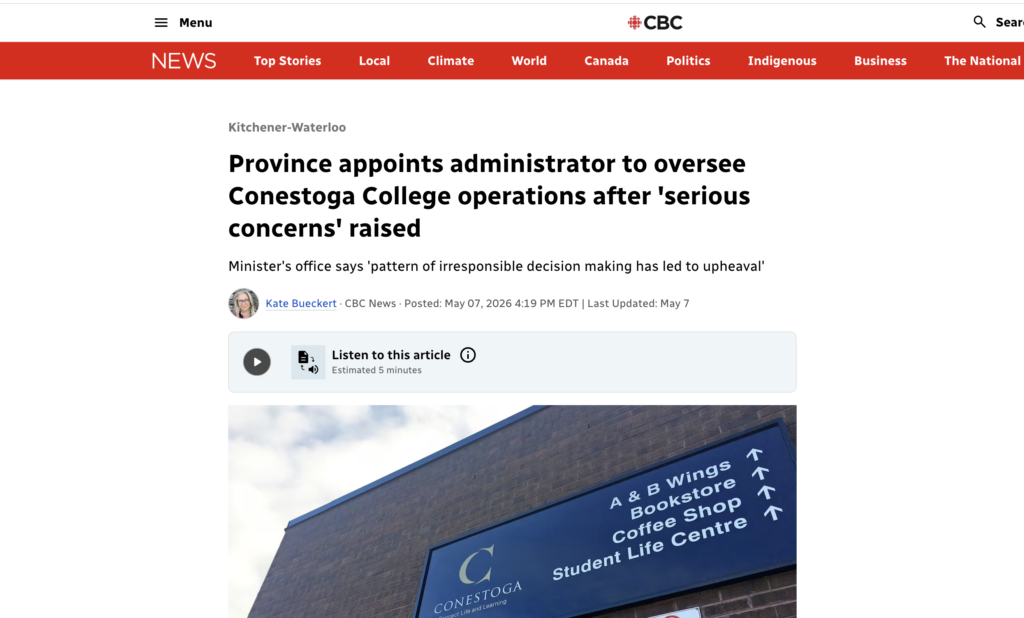
By May 2026, the story of Conestoga College’s fall had acquired a familiar shape in the Canadian press: reckless executive compensation, a $23,000 trip to Italy, a board of governors dismissed by the province, and Linda Franklin, former CEO of Colleges Ontario, installed as administrator effective immediately. Ontario’s Minister of Colleges and Universities, Nolan Quinn, called the pattern of decision-making “egregious” and declared Conestoga “an outlier.”[^1][^2][^3][^4]
It was an outlier, but not in the way the minister implied. The gap between Conestoga and its peers was not simply a matter of one rogue board approving lavish perks. It was a cultural orientation, one visible at the granular, everyday level long before auditors arrived, in which money moved freely, compliance generated cash, and the appearance of quality substituted for the substance of it. The spectacle of the audit findings is real. But the story underneath them is more instructive.
The Microcourse as a Mirror
Consider one small detail from the institutional interior: during the COVID era, Conestoga paid staff to complete a series of mandatory internal microcourses. Not as professional enrichment offered and accepted, but as a compulsory transaction dressed in a bow: you have to take these, but you get paid, yay. The courses counted toward something on paper. One of them was ladder safety.
That detail is not trivial. It is structurally diagnostic. Ontario’s micro-credential framework, launched and funded by the provincial government, was built around the language of “flexible, timely, in-demand skills” and rapid workforce transformation. Conestoga embraced it with characteristic maximalism: hundreds of its own faculty were routed through a mandatory four-course “Teaching at Conestoga” micro-credential, and the college built a portfolio of 18+ micro-credential streams fed by dozens of short courses. On paper, this looked like institutional investment in quality. In practice, it was a machine for generating completion numbers, satisfying internal requirements, and drawing on available funding streams, not for producing better-equipped educators or staff.[^5][^6][^7][^8]
Researchers and critics of the micro-credential expansion warned early that without rigorous external quality assurance, the model could easily become a low-validity badge generator. What Conestoga appears to have done is take that risk and run it in both directions: outward (selling micro-credentials to students and the market) and inward (routing staff through mandatory modules for pay). The ladder safety course is the punchline. But the setup is a funding design that rewarded volume over value, and an institution that understood exactly how to exploit it.[^9][^10][^11]
A Quality Comparison That Should Not Be Possible
The teaching microcourses deserve specific scrutiny. Staff with advanced preparation in higher-education pedagogy, including, for example, completion of the Harvard Derek Bok Center’s Higher Education Teaching Certificate, a rigorous, research-grounded program built around current scholarship on learning, reflective practice, and evidence-based instruction, found Conestoga’s internal teaching courses to be not merely redundant but inferior: watered-down in content, dated in research base, and in places factually incorrect.[^12][^13][^14]
This is a comparison that should not be possible in 2021. The Bok Center course draws on a living body of pedagogical research. Conestoga’s course, by the account of educators who had taken both, had not kept pace with a field that had advanced substantially since the early 2000s. For context: a comparable teaching orientation offered by Sheridan College to new faculty in 2002, nearly two decades earlier, before the micro-credential era existed, was substantively stronger.
The implication is precise: during the years when Conestoga was recording peak surpluses of $106 million (2022–23) and then $252 million (2023–24), and positioning itself as Ontario’s top-ranked college two years running, the internal educational infrastructure being offered to its own faculty had not been meaningfully updated. The money was not going there.[^2][^8]
The Oversight Gap Nobody Filed
In a functioning accountability environment, questions like who supplied the mandatory masks and at what contract value? would be answerable. During the period of masking mandates, Conestoga required that all staff, students, and visitors wear specifically college-issued three-layer disposable masks, not their own. The province endorsed this policy after an inspection, publicly praising it as a model. The vendor behind that contract has never been publicly identified.[^15]
A Freedom of Information request under FIPPA, which has applied to Ontario colleges since 2006, would be the natural recourse. But FIPPA’s section 17(1) contains a mandatory third-party exemption that courts have interpreted to cover information “provided by a vendor during the procurement process and to the resulting service agreement itself.” In practice, procurement details at Ontario colleges are routinely withheld as commercially sensitive. The result is a publicly funded institution, operating under public mandate, whose vendor relationships are shielded from the public whose money funds them.[^16][^17][^18]
This is not a Conestoga-specific legal anomaly. It is a structural feature of the accountability regime governing Ontario’s college sector. What distinguishes Conestoga is the combination: a culture already oriented toward transactional compliance and revenue capture, operating inside a legal framework that limits transparency on exactly the decisions, vendor selection, procurement, contract values, where that culture is most consequential.
The Accolade Ecosystem’s Complicity
The provincial administrator, the union condemnations, and the parliamentary case study all arrived after the same institutions that should have provided oversight spent 2023 celebrating the behaviour they later condemned.
In March 2023, the Greater Kitchener Waterloo Chamber of Commerce named Conestoga its Business of the Year, with then-president John Tibbits framing the college’s international enrolment growth as fuelling Canada’s “immigration strategy.” In May 2023, the Lions Club of Kitchener named Tibbits its 63rd Citizen of the Year, with Kitchener’s mayor praising his “community building.” That spring, Colleges and Institutes Canada, the national sector body, awarded Conestoga a Silver Award of Excellence in Applied Research. CourseCompare named it the Best College in Ontario for both 2025 and 2026, the second ranking published as layoff notices were being issued to nearly 400 staff.[^19]
Each of those awards was based substantially on the same growth metrics, enrolment scale, revenue, graduation rates, research output, that Parliament’s Standing Committee on Citizenship and Immigration later used as central evidence in its case study on institutional failure. The awards did not fail because the organizations were corrupt. They failed because they were measuring the wrong things and rewarding institutions for the metrics they reported rather than the conditions they created. An accolade ecosystem that cannot distinguish between genuine excellence and revenue-optimized scale amplification is not a safeguard. It is a signal that bad incentives are working.[^1][^19]
The Termination Payment as Capstone
The audit findings that precipitated the board’s dismissal are worth restating precisely: a 55% salary increase to $636,107 for the departing president in his final year; a $23,000 trip to Italy for three senior leaders, plus similar trips with business class airfare, luxury lodging, and premium ground transportation; a $1,300 staff dinner where approximately half the pre-tax bill was alcohol; and, perhaps most strikingly, a termination payment equivalent to 83 months of the president’s salary.[^20][^4][^2][^19]
To be precise about what that means: under the Broader Public Sector Executive Compensation Act, departing executives are eligible for packages up to 24 months. Tibbits received the equivalent of nearly seven years’ worth of monthly pay. With his 2025 Sunshine List salary of $601,684, already down from the 2024 peak, at roughly $50,000 per month, the buyout is estimated at a minimum of $3.8 million, and potentially $4.1 million. The province says it is exploring options to “bring that money back.”[^21][^4][^19][^20]
The termination package is not an anomaly disconnected from everything else. It is the capstone of a culture in which financial decisions were consistently made in favor of those at the top, in the absence of meaningful board oversight, across a period when the institution was shedding workers, cutting programs, and experiencing one of the largest single-institution layoff events in Ontario college history.[^2][^1]
What the Province’s “Outlier” Framing Obscures
Minister Quinn’s characterization of Conestoga as an “outlier”, with no other post-secondary institutions facing similar audits, is politically useful and factually narrow. It frames the problem as one rogue institution rather than a structural one, which is convenient for a government that oversaw and in some cases celebrated the same growth model it is now auditing.[^1]
The broader Ontario college sector is in genuine financial distress: Colleges Ontario has warned of large cumulative deficits sector-wide, driven by frozen domestic tuition and the collapse of international enrolment following federal caps. Mohawk College began waves of layoffs in late 2024. Niagara College’s president issued budget warning letters to staff in early 2026, acknowledging “significant pressures”. Across the sector, over 10,000 college staff have been laid off and more than 600 programs cancelled since the federal cap took effect.[^22][^23][^24][^25][^26]
Conestoga went further in its excesses than peers. But the underlying architecture, provincial underfunding, reliance on international tuition to fill the gap, a permissive federal study-permit regime, and a local accolade ecosystem that rewarded revenue scale, was shared. The sector’s current suffering is not an accident that befell otherwise well-governed institutions. It is the downstream consequence of a decade in which every layer of oversight, from the federal government to the provincial ministry to local business associations to national sector bodies, chose not to ask the questions that a Toronto Sun investigation, a parliamentary committee, and a provincial audit eventually had to answer.
A Note on What Remains Unasked
The formal post-mortem on Conestoga will focus on the items an audit can capture: salary approvals, travel records, hospitality receipts, severance calculations. Those are important. But the audit cannot easily capture the cost of mandatory microcourses that taught faculty incorrect information. It cannot quantify the harm done to students placed by improperly-vetted agents into programs “where they don’t belong and don’t want to be,” per faculty testimony. It cannot measure the gap between Conestoga’s documented quality rhetoric and the actual quality experience of the people inside it.[^19]
Those costs are real. They accrued not in a single egregious decision but in the accumulation of small ones: a ladder safety module counted as professional development, a teaching course not updated since the early 2000s, a mask mandate whose vendor cannot be traced. Each individually defensible or simply invisible. Together, they describe an institution that had optimized for the appearance of quality, in rankings, awards, completion numbers, micro-credential portfolios, while the substance of quality was treated as secondary to the revenue machine that funded everything else.
That is the culture behind the collapse. The audit catches the expensive end of it. The column catches the rest.
This column draws on the author’s prior research dossier, “Conestoga College: The Hard Downfall” (April 15, 2026), which consolidated Parliament’s April 2026 CIMM report, Ontario Sunshine List records, Conestoga’s own annual reports, and contemporaneous media and union coverage. The author worked at Conestoga as a remote Communications professor during the pandemic.
Additional research by Perplexity.
References
- Administrator Appointed to Conestoga College After Audit Uncovers … – The Ontario government says it is appointing an administrator to run Conestoga College after an audi…
- Ontario appoints administrator at Conestoga College, citing … – The province says the move comes after an extensive audit revealed “egregious financial decisions” t…
- Ontario Appoints Administrator at Conestoga College – Following the discovery of evidence of serious financial and governance mismanagement at Conestoga C…
- Trip to Italy, ‘egregious’ alcohol spending at Conestoga College: Audit – There was a $23,000 trip to Italy taken by three senior leaders at the college and “similar trips” w…
- Micro-credentials – They are designed to be high-quality and meaningful credentials. Micro-credential programs are offer…
- Micro-credentials from Ontario’s postsecondary schools – Hundreds of micro-credentials are approved for financial assistance through the Ontario Student Assi…
- Micro-Credentials – A micro-credential is a certification of assessed learning associated with a specific and relevant s…
- Academic Administration – 2022 Quality Report – 4-course micro-credential “Teaching at Conestoga” unique courses and … Degree Quality & Accreditat…
- Understanding microcredentials: a report from HEQCO – Pichette, J., Brumwell, S., Rizk, J., Han, S. (2021)
Making Sense of Microcredentials. Toronto: H…
- New HEQCO report on microcredentials reveals they won’t … – Originally purported to be the ‘future’ of higher education, microcredentials are instead proving to…
- Making Sense of Microcredentials – Future HEQCO research in this field will focus on issues of quality, including evaluations of these …
- Harvard Bok Higher Education Teaching Certificate – Explore Higher Education Teaching and its practices offered by Harvard’s Derek Bok Center for Teachi…
- Harvard Bok Higher Education Teaching Certificate – Hone your teaching skills and earn a premier certificate from Harvard’s Bok Center for Teaching and …
- Harvard Bok Higher Education Teaching Certificate Online … – The eight-week online course was designed by faculty members from Harvard University’s Derek Bok Cen…
- Province endorses Conestoga’s masking protocol – Conestoga’s practice of requiring all students, employees and visitors to wear college-issued, three…
- When is Purchase Agreement Information Exempt as Third Party … – The mandatory third party exemption in section 17(1) of FIPPA applies to information provided by a v…
- About FIPPA | Freedom of Information and Protection of Privacy Act – The Freedom of Information and Protection of Privacy Act (FIPPA) RSO 1990 Chapter F.31 is provincial…
- Chapter 5: Exemptions and Exclusions | Freedom of Information and … – This chapter will review the exemptions to the right of access. Some exemptions exist only in FIPPA …
- Province appoints administrator to oversee Conestoga … – … Conestoga College in Kitchener, Ont., after finding “evidence of serious financial and governanc…
- Doug Ford government sacks entire board at Conestoga College – The salary listed for Tibbits in the 2025 Sunshine List was $601,684, which would amount to just ove…
- Ford government appointments administrator at Conestoga College … – The Ford government has relieved the board of governors and appointed an administrator at Conestoga …
- marking one of the province’s largest mass layoffs. The cuts span … – Ottawa’s 2024-2025 international student caps slashed permits by 73 percent. That one move erased $1…
- Message from President Kennedy: Budget Update | InsideNC – Our approach for the 2026-2027 Business Plan and Budget remains focused on growing our enrolments, f…
- Ontario’s colleges warn of more troubles ahead amid call … – New federal limits on international student enrolments are prompting deep cuts at cash-starved post-…
- Mohawk College in Hamilton to start layoffs Monday as part … – The board and executive staff made tons of money during the expansion period. They just need to lay …
- St. Catharines Standard: Provincial funding a ‘welcome … – Catharines Standard: Provincial funding a ‘welcome relief,’ but NC still faces lingering revenue gap…
Tags: Alexandra Kitty, Canada, CBC, Conestoga College, John Tibbits, Kate Bueckert, Linda Franklin, Nolan Quinn, Ontario, Sheridan College