
Manufactured Majorities: When Your Vote Becomes a Rough Draft

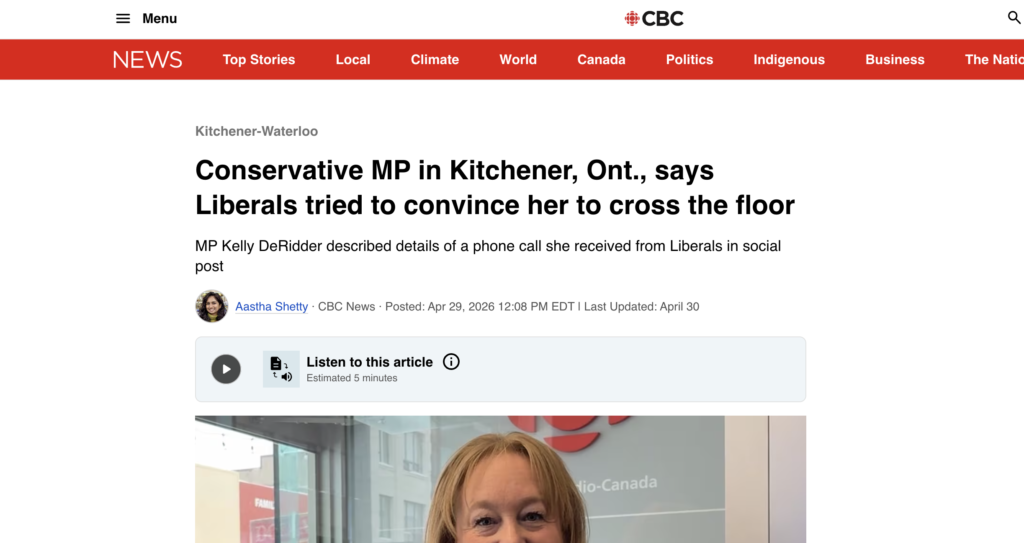
Kitchener Centre MP Kelly DeRidder did something very unfashionable in Ottawa: she described a backroom conversation as if it were evidence. She didn’t release a manifesto or a think‑piece; she told a simple story about a phone call from someone representing the Liberal Party. On the other end of the line, she says, was not a policy debate or a plea for cross‑partisan cooperation, but a sales job: praise, threat, and a convenient exit if she just crossed the floor.
In that conversation, as she tells it, the Liberals laid out her future in Kitchener Centre. A candidate would be running “backed by both the Liberals and the Greens,” she says she was told, and under that configuration she “wouldn’t stand a chance” if she remained a Conservative. The implied solution was as crude as it was effective: switch sides now and you can be on the winning team instead of the target.
If you strip away the spin, DeRidder is not claiming to have uncovered a secret Liberal–Green treaty. She is documenting the content of a recruitment call: the words that were put in her ear to pressure her into helping transform a minority Parliament into something much more comfortable for the governing party. That one phone call is a micro‑lesson in how Canada’s political class now treats election results: not as a verdict, but as a first draft that can be quietly edited afterwards.
Exhibit A: The pitch script
DeRidder’s account follows a very familiar script. First comes the flattery. She says the Liberal emissary praised her performance on committee, particularly on AI and digital policy, and suggested she’d be “a valuable addition” if she took a seat on the government benches. The message is that the other side recognizes your talent and is willing to reward you for it, if only you will stop wasting yourself in opposition.
Then comes the threat. According to DeRidder, the caller painted a bleak picture of her re‑election odds. A candidate would run in Kitchener Centre “backed by both the Liberals and the Greens,” she says she was told, and under those conditions she “wouldn’t stand a chance” as a Conservative. It is a structurally classic shakedown line: nice seat you’ve got there; shame if something happened to it.
Finally, the escape hatch: there is a way out of this doom scenario, and it just happens to align perfectly with the governing party’s ambitions. Join us, and you are no longer the victim of this supposed Liberal–Green juggernaut; you are its beneficiary. In DeRidder’s telling, the call is not about persuasion on policy or conscience; it is about converting one MP’s seat from opposition tally to government property through targeted psychological pressure.
Exhibit B: The actual allegation
Once you separate out the emotional framing, DeRidder’s allegation is narrow and very specific. She is saying: a Liberal emissary tried to pressure me to cross the floor by telling me that a Liberal–Green‑backed candidate would be deployed in my riding, and that I was doomed to lose if I stayed where I was. She is not saying: I, Kelly DeRidder, have independently verified the existence of a Liberal–Green pact and now certify its reality to the public.
That distinction is not a technicality; it’s the difference between evidence and rumour. The first claim is about her direct interaction with another political actor and can be tested using ordinary forensic tools: consistency over time, corroborating patterns of recruitment elsewhere, and the government’s own admissions that they have been “open” to floor‑crossers. The second claim would require hard proof that the Greens have formally agreed to some joint operation, which she never purports to have.
Yet much of the media framing blurs this line into a lazy he‑said‑she‑said. The headline version becomes: DeRidder “claims” Liberals and Greens are teaming up in Kitchener Centre; the Greens say it’s “nonsense,” case closed. That quietly moves her from witness to theorist, and makes it easier to dismiss her as just another partisan spinning a story, instead of treating her as what she is in this context: a sitting MP describing a specific attempt to recruit her into a manufactured majority.
Exhibit C: The Greens’ misfire
Now look at how the Greens respond. Asked about DeRidder’s account, the party leader doesn’t say, “We were never part of any approach to Ms. DeRidder,” or, “We can’t speak to what Liberal representatives may have told her.” She opts instead for a broad factual denial of the supposed pact, declaring that there is “not a shred of truth” to it and dismissing the whole thing as “nonsense,” while affirming she wants former MP Mike Morrice re‑elected in Kitchener Centre.
Forensically, that answer is aimed at a different proposition than the one DeRidder actually puts on the table. The Greens are denying that they have agreed to collaborate with the Liberals to poach a Conservative MP or to jointly back a candidate against her; they are not in a position to deny what a Liberal emissary might have said to DeRidder in a private phone call. Their statement addresses whether a real Liberal–Green pact exists, not whether the Liberals invoked such a pact as part of a pressure tactic.
Those two statements can easily coexist. A Liberal operative may well have waved around a phantom Liberal–Green united front as leverage in a recruitment call, and the Greens may be perfectly sincere in calling that idea “nonsense.” In fact, the more emphatically they distance themselves from the content of the alleged promise, the more plausible it becomes that someone on the Liberal side was throwing their name around in ways they now need to repudiate. DeRidder’s story doesn’t rise or fall on whether the coalition claim is true; it rises or falls on whether the conversation happened the way she describes it. The Greens chose to attack the former, and left the latter essentially untouched.
Exhibit D: From one phone call to a manufactured majority
If this were just about one clumsy operative and one MP who said no, it would be a small story. It isn’t. Taken together with the string of actual floor‑crossings into the Liberal caucus and strategically convenient by‑election wins, DeRidder’s account becomes one more tile in a mosaic: a Liberal government that was handed a minority by voters and has methodically converted it into a working majority without ever going back to those voters for permission.
Canadians went to the polls on the understanding that they were choosing between a minority Liberal government, a Conservative opposition, and several smaller parties. The result reflected that: no single party with enough seats to govern alone. Instead of seeking a fresh mandate, the Liberals and their new leader have pursued what defenders politely call a “majority shortcut”, a strategy of re‑writing the arithmetic inside the House through floor‑crossers, recruitment calls, and opportunistic deals until the minority behaves like a majority.
The public never got to vote on this new configuration. They simply woke up, a series of defections later, to discover that the party they did not give a majority to now has one, courtesy of politicians who decided their personal trajectories mattered more than the partisan outcome their constituents actually chose. This is how a one‑off recruitment pitch turns into something much bigger: a structural method of overriding election results while insisting that “this is how the system works.”
Exhibit E: When party loyalty is optional but voter consent is not
Defenders of floor‑crossing like to talk about “freedom of conscience” and MPs not being “hostages” to party labels. That sounds noble in the abstract, and it’s very convenient language when you’re the one benefiting from the defection. But in a Westminster‑style party system like Canada’s, voters are not primarily voting for Kelly or Michael or Marilyn as individual freelancers. They are voting for the ticket: the party brand, the leader, the platform, and what that seat means in the larger parliamentary equation.
Take that reality seriously and floor‑crossing looks very different. One MP crossing here or there has always been controversial. Several MPs crossing in the same direction, on a scale large enough to flip a minority into a functioning majority, moves you into a different category altogether. It’s no longer about individual conscience; it’s about re‑counting the election without the inconvenience of ballots.
Democracy Watch describes floor‑crossing as “a fundamental violation of the right of voters to make an informed choice,” because it retroactively changes what the ballot they cast actually purchased. The ACE Electoral Knowledge Network warns that intensive floor‑crossing tends to favour ruling parties, distorts representation, erodes accountability, and fuels alienation and lower turnout. The voters of a riding may have spoken clearly, “we want a Conservative MP, in opposition, under this leader”, only to see that seat converted into a government vote after the fact because someone in Ottawa made the right call or accepted the right offer.
From a citizen’s perspective, the question becomes brutally simple: if the party outcome you voted for can be rewritten by private deals among politicians, why bother to vote at all? It’s not that the ballots aren’t counted; it’s that their meaning is treated as negotiable. The formal result says “minority,” but the practical reality morphs into “majority” through a sequence of decisions no ordinary voter was invited to approve.
Exhibit F: When the result you voted for is only a rough draft
This is the real scandal, and it is bigger than any one MP or one party. Voters were told they were picking from the options on the ballot: a minority with checks and balances, or a majority that would control the legislative machine outright. They were not told that a minority result would be treated as a rough draft, something party strategists could quietly revise later by peeling off a handful of MPs and stitching together a manufactured majority inside Parliament.
Democracy Watch and other critics point out that there is essentially no hard constraint on this behaviour at the federal level. There is no anti‑defection law that forces an MP who crosses to seek a new mandate, no automatic by‑election requirement, and an ethics regime watchdogs describe as riddled with “dirty dozen” loopholes. When five MPs cross to the Liberals in one Parliament and ministers blithely explain that accepting floor‑crossers is just “how the system works,” you are witnessing not a bug, but a design choice: a system that has decoupled political power from electoral consent and expects you to applaud the cleverness.
We are often told that Canadian elections are free and fair because the ballots are counted honestly. That is true, and it is also beside the point. The new trick is to leave the count intact but change what the numbers mean: to treat a minority as negotiable and quietly edit it into a majority through floor‑crossers and recruitment calls like the one DeRidder describes. It’s not ballot‑box‑stuffing; it’s mandate‑laundering.
A brief look in the mirror
Other parliamentary systems, confronted with the same disease, at least admitted it was one. India wrote an anti‑defection law into its Constitution in 1985 to curb chronic floor‑crossing, allowing MPs and state legislators to be disqualified if they abandon the party under whose banner they were elected. South Africa experimented with floor‑crossing windows and rules that cost you your seat if you switched outside tightly regulated periods, because opportunistic defections were destabilizing governments and mangling the proportional will of voters. Even inside Canada, provinces have flirted with restrictions that force defectors to sit as independents or face political consequences, acknowledging that citizens did not sign up for post‑election swaps.
Ottawa, by contrast, has chosen to keep the federal arena wide open: no anti‑defection statute, no automatic by‑elections, and an ethics framework that treats floor‑crossing as a matter of political taste rather than democratic integrity. That is not constitutional inevitability; it is a deliberate decision by the same class that profits from manufactured majorities.
The question no one on the ballot will ask you
DeRidder’s refusal to cross the floor does not make her a hero; it makes her a useful witness. She provides a small, concrete example of how a minority Parliament gets slowly converted into something voters never chose: through flattering calls, veiled threats, and the casual use of other parties’ names as leverage: parties that then rush out to deny a pact she never claimed existed, while leaving the recruitment tactics unchallenged.
Manufactured majorities are an assault on democracy not because the count is wrong, but because the consent is missing. Voters said no to a majority; the political class decided they could improvise one anyway, one floor‑crosser at a time. Floor‑crossers and recruitment calls are not just personal dramas or human‑interest stories. They are the tools used to turn a minority into a majority without any fresh mandate, while everyone on the inside repeats, like a catechism, that this is simply “how the system works.”
If that really is how the system works, then the honest thing would be to put it on the ballot. Print it right there, under every party logo: We reserve the right to change the result after you vote. Let’s see how many Canadians are willing to sign that contract once it is spelled out in plain language.