Trying to Rig the Board: How the Trump Administration Keeps Failing to Fix the Outcome

The Trump administration isn’t just governing; it’s trying to pre‑arrange obedience. The goal isn’t policy debate or persuasion, it’s to quietly re‑engineer the conditions under which federal workers think, comply, and dissent. But for all the menace, what stands out right now is how clumsy and failure‑prone the project actually is.
Move 1: Seizing people’s vulnerabilities
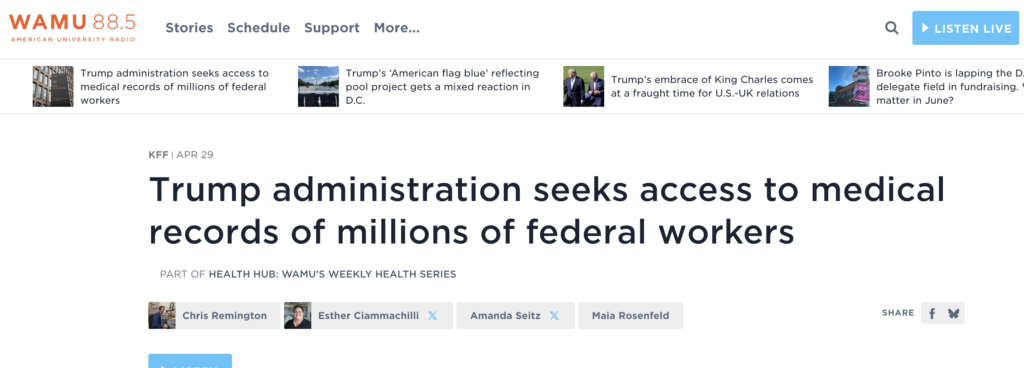
Start with the medical‑records grab.
The administration’s personnel agency has floated a plan to require every insurer in the federal employee and postal health programs to ship over detailed medical data on millions of workers and their families. Not anonymized trend lines, identifiable claims data: diagnoses, prescriptions, mental‑health treatment, reproductive care, the kinds of details that tell you exactly where a person is fragile and how they can be squeezed.
On paper the justification is bland: “oversight,” “cost control,” “program integrity.” In practice, it is a proposal to consolidate the private vulnerabilities of public servants inside an overtly politicized executive branch that already has a record of retaliating against perceived enemies.
You don’t need to spell out every misuse scenario to feel the intent. This is not about helping workers. It is about putting a hand on the pressure points of people the administration already sees as obstacles or disloyal.
And yet: the push has landed with immediate resistance from health‑law experts, privacy advocates, unions, and even the insurers themselves. They’re publicly warning that this would likely violate existing law, that the rationale is vague, and that the architecture required would be a security and liability nightmare. The move reveals the desire to rig the game, but not a lot of competence in actually pulling it off.
Move 2: Decapitating science
Then there’s the purge of the National Science Board.
In one sweep, the administration fired the entire board that oversees the National Science Foundation and is supposed to provide independent scientific advice to the president and Congress. No scandal. No public case that these particular people had failed in their duties. Just an email informing them their services were no longer required.
If you’re trying to rig outcomes, this fits: remove the one body specifically created to give science a measure of insulation from day‑to‑day politics. With no board, there is no institutional memory in the room, no established figures to push back when research funding or scientific judgment collides with ideological convenience.
But again, execution is another story. Emptying the board doesn’t magically give the administration control of science. They still have to find replacements, move them through vetting and confirmations, and live with the fact that the entire scientific community now has a perfect, headline‑friendly symbol of what this administration is trying to do. They’ve shown their hand early.
Move 3: Trying to bend the law, and getting checked
Layer all this on top of the Supreme Court’s ruling yesterday that clipped one of the administration’s more aggressive power grabs. The details of the case matter less here than the pattern: they pushed to expand executive power, to change the legal terrain in their favor, and the highest court in the country said no.
If the project was to build a seamless obedience machine, law bent to their needs, science decapitated, workers’ private lives wired into a federal database, this is not what success looks like. This is a series of attempts, all publicly visible, all generating more backlash, more litigation, more scrutiny than control.
What they’re really revealing
Put together, these episodes tell you two things at once.
First, the intention is clear. This is not random chaos. It’s a pattern of moves aimed at:
- making federal workers governable through their health and private vulnerabilities,
- stripping away independent expertise that might constrain political whims, and
- rewriting rules so obedience is pre‑loaded into the legal and institutional fabric.
Second, they’re not nearly as omnipotent as the horror of each individual move might suggest. Courts are pushing back. Insurers are balking. Scientists are speaking out. Unions and professional bodies are lawyering up. The administration keeps lunging for structural control and discovering that other structures still exist.
Which is exactly why this moment matters. You don’t have to pretend everything is fine; it isn’t. But you also don’t have to treat these moves as evidence of an unstoppable master plan. What they keep exposing, over and over, is a will to rig the outcome colliding with the fact that the board is still full of other players.
In other words, Donald Trump is a perpetual loser trying to cosplay as a winner.
Tags: Amanda Seitz, Chris Remington, Donald Trump, Esther Ciammachilli, Maia Rosenfeld, Propaganda, United States, WAMU