
Since when was Canada joining the EU a thing?

Until very recently, “Canada joins the European Union” belonged in speculative fiction, not on the front page. Yet in the span of about a year, we’ve gone from zero discussion to a flurry of polls, think‑pieces, and TV explainers calmly asking whether Canada should become the EU’s 28th member. The timing, wording, and repetition all have the feel of narrative nudging rather than organic public debate.
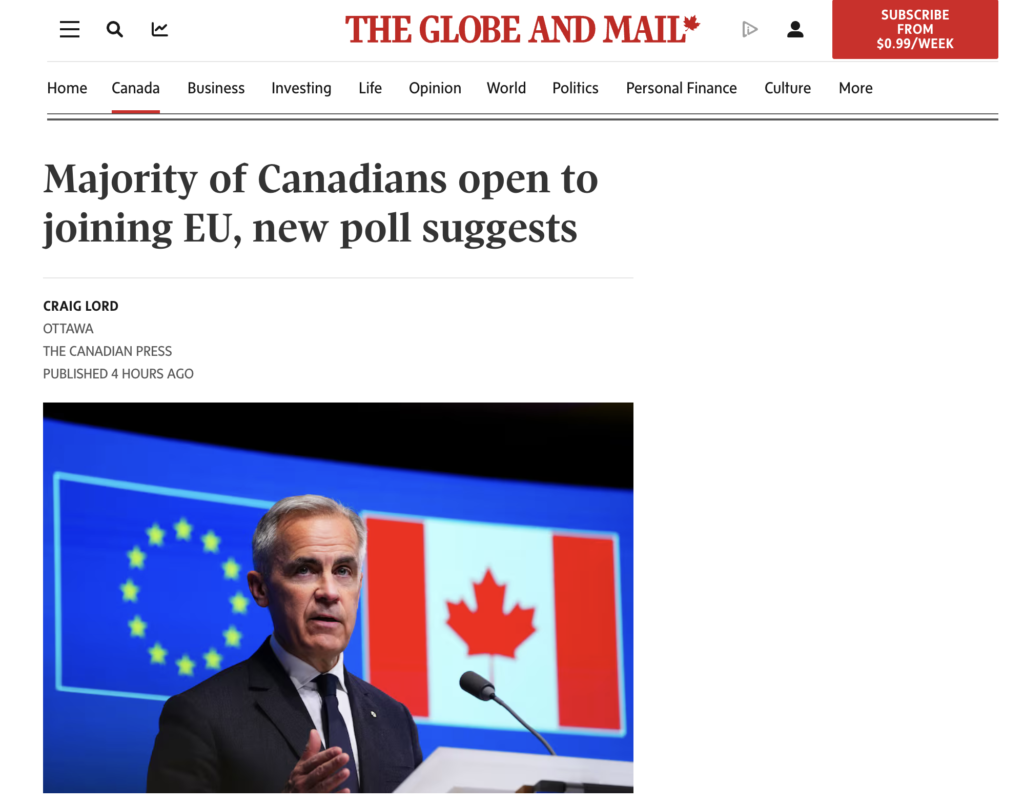
This isn’t about whether you love or hate the idea. It’s about who chose to ask this question, how they framed it, and why this particular fantasy is being treated as a serious option when others, like joining BRICS, are not.
Polls are not math; they’re narrative
Polls are often presented as neutral numbers, as if public opinion is something you scoop up with a measuring cup. In reality, every poll is a story with four authors:
- the people who decide what to ask
- the way they word it
- the media who select the headline
- and the politicians who then point back to it as “what Canadians want”
If you can ask any question, you can manufacture any narrative. You can ask Canadians if Canada should join BRICS. You can ask if we should become the 51st U.S. state. You can ask if we should unite with Australia and New Zealand in a Pacific union. No one does, because those stories don’t serve the right storytellers.
So why this question, at this moment: “Should Canada join the European Union?” Why does this long‑shot scenario suddenly deserve repeated national polling and wall‑to‑wall coverage?
The legal reality: Europe means European
Start from the most basic fact: under the EU’s own rules, membership is restricted to “European countries” that meet the Copenhagen criteria and are accepted as such by existing member states. Canada is not in Europe, and the framework is explicitly designed around a European identity.
Could the rules be changed or reinterpreted? In theory, yes: treaties can be amended, and “European” is a political classification. But those are high bars and long time frames. There is no live accession process, no Council conclusion inviting Canada to apply, and no serious move in Brussels to redefine Canada as “European.”
In other words, Canadians are being polled on a premise that is not actually on the table. They’re reacting to a vibe, pro‑Europe, anti‑U.S. chaos, pro‑multilateralism, not to a concrete policy option.
That disconnect is important. If the scenario is structurally implausible, then the function of the polling is less “Should we pursue this policy?” and more “Can we warm people to this story about where Canada belongs?”
The choreography: how a fantasy becomes “an option”
Once you trace the sequence, the pattern becomes hard to unsee: an idea that barely existed in public life gets seeded, tested, and normalized in a series of steps:
- An imaginative premise is floated
A major international magazine suggests that Canada should join the EU, not as a joke, but as an analytical “what if” about culture, values, and geopolitics. Suddenly, “Canada in the EU” has a respectable origin story, not a Reddit thread. - Opinion polling turns the premise into a question
A Canadian pollster then asks: should Canada “look into” joining the EU, or “initiate a formal process” to do so? Crucially, this question usually appears after respondents have been reminded of Donald Trump, tariff threats, and “51st state” rhetoric. Once people are emotionally primed to be angry and anxious about the U.S., “maybe Europe instead?” sounds less absurd. - Media launder the question into “growing support”
The first poll gets written up as “remarkable,” proof that there is “public opinion foundation” for EU membership. A 44–46% sympathy number becomes the headline: “Nearly half of Canadians support joining the EU.” The fact that the option is speculative and legally remote is buried under the novelty. - Policy moves quietly deepen EU integration
At the same time, Ottawa signs new security and defence partnerships with the EU, joins major EU defence programs, and adopts the language of an “ever‑closer” relationship. We are structurally dragged closer to Europe, not as a member, but as a deeply embedded partner in trade, regulation, and defence. - Successive polls show “openness” inching up
Another poll in 2025 repeats the question; support ticks up by a couple of points. By early 2026, a new survey finds that roughly a quarter think joining the EU is a good idea, and close to 60% think it is “worth exploring further.” The nuance, good idea vs. just explore, collapses into a single headline: “Majority of Canadians open to joining the EU.” - A throwaway elite comment is treated as validation
A European minister, when asked on a panel, jokes that “maybe Canada, at some point,” could be in the EU. The room laughs. Canadian media do not laugh: they run it as a straight news story. The fantasy now has international elite endorsement, however half‑serious. - The latest poll gets saturation coverage
Within 24 hours of the newest poll, major outlets all push variants of the same story: could Canada join the EU; should Canada join the EU; majority open to exploring it. TV segments “just asking questions” walk viewers through the hypothetical, often conceding in passing that it would be difficult, but spending all their time treating the premise as worthy of serious contemplation.
This is how a narrative takes shape: question, poll, headline, policy move, another poll, foreign quote, more headlines. The repetition matters more than any single data point.
The Carney factor: protagonist in search of a plot
This flurry of EU membership talk did not happen in a vacuum. It coincides with Mark Carney’s ascent from central banker to Liberal leader to prime minister. His brand is global technocracy: Davos, central banks, climate finance, and a long history of being treated as the grown‑up in a room of politicians.
It makes perfect sense that any outlet that valorizes technocratic, financial “pragmatism” would fawn over a former banker turned leader. It also makes sense that Ottawa, under that kind of leadership, would be unusually receptive to a story in which Canada is less tethered to a volatile United States and more deeply meshed with European institutions.
So the “Canada joins the EU” fantasy arrives pre‑cast:
- Hero: a cosmopolitan, European‑friendly, ex‑central banker PM
- Villain: Donald Trump and a capricious America
- Plot: Canada escapes dependence on the U.S. by realigning with Europe
- Chorus: polls and headlines telling us Canadians are “open” to exactly that shift
I don’t have to accuse anyone of writing this script on a whiteboard. It’s enough to notice that all the incentives, temperaments, and institutional loyalties line up in the same direction.
Psychographics and nudging: from COVID to geopolitics
We already know this government is comfortable using psychographic data not just to measure opinion, but to target and shape it. Internal research commissioned during COVID carved Canadians into high‑trust rule followers, angry enforcers, wary skeptics, and so on, and then recommended messages tailored to each cluster. The goal wasn’t simply to understand; it was to exploit attitudinal differences to build compliance.
The EU membership polling reads like a geopolitical extension of that logic.
If you know there is a segment of Canadians who:
- are weary of U.S. theatrics
- still trust “rules‑based” institutions
- and have a romantic attachment to Europe
then a poll question that invites them to say “yes” to EU membership is a way of aggregating that disposition and turning it into a talking point. It’s a form of narrative testing: will this story resonate with the right people?
Add to that a political culture that increasingly frames criticism and online backlash as a pathology of “the internet” rather than a legitimate response to policy overreach, and you get a neat dynamic: segments are cultivated for amenable narratives, while more skeptical reactions are pathologized as toxic discourse to be managed, not engaged.
Why BRICS never gets polled
The BRICS example is useful precisely because it sounds absurd. No major Canadian pollster repeatedly asks whether we should explore joining BRICS. They could. Methodologically, it’s just another question. The answer would likely be “no” or “what is BRICS?”
But that’s the point: the choice of which fantastical question deserves repeated polling is itself political.
- Joining BRICS runs against Canada’s institutional alignments and elite preferences.
- Joining the EU, despite being structurally unlikely, flatters those preferences: liberal democracy, Atlanticism, techno‑managerial governance, climate talk, “values.”
When only one fantasy is lavished with polls, op‑eds, and ministerial asides, it stops looking like fantasy at all. It becomes “an option we should consider,” simply because we keep being asked to consider it.
COVID, Trump, and the danger of over‑reactive grand designs
There is another layer here: the sheer volatility of recent history. COVID‑19 showed us how quickly sweeping, “necessary” measures can be imposed, defended as unquestionable, and then quietly rolled back or disowned. Much of what was non‑negotiable in 2020–21 has either evaporated or become taboo to even mention.
Trump is another volatility amplifier. His return to office, his rhetoric, and his Easter message are real and ugly. But building a generational realignment of Canada’s place in the world around a single unpredictable figure, especially one with a proven track record of turning on his own supporters, is reckless storytelling. It treats a momentary spike in temperature as permanent climate.
A government that has already over‑learned the lesson “we can manage people through messaging and segmentation” is precisely the kind of government that will reach for polls and narratives to manage this volatility, rather than leveling with people about uncertainty.
The Economist as narrator, Carney as hero
One last piece of framing is worth noting. The same magazine that first championed “Canada should join the EU” has also lavished praise on Carney as the embodiment of “pragmatism,” and is now partly owned by a Canadian billionaire. You don’t have to believe in smoke‑filled rooms to see the symmetry.
A London‑based outlet rooted in global finance:
- imagines Canada as a future EU member
- blesses a banker‑prime minister as the right person for Canada’s “pragmatic” turn
- and then takes on a large Canadian shareholder
Of course such a magazine would fawn over Carney; he is almost its ideal protagonist. What matters is that its affection, the Liberal government’s psychographic polling, and the sudden media enthusiasm for EU membership are all pushing the same story about where Canada belongs.
You can think EU membership is a terrible idea, a brilliant idea, or a fun dinner‑party thought experiment. That’s not the point here. The point is whether we notice when a long‑shot fantasy is being treated as if it were an organic public conversation, when in fact it was seeded, tested, and repeated into existence.
Polls can be useful tools, but they are not neutral seismographs of the public soul. They’re prompts. They tell people what’s on the menu. When those prompts line up neatly with elite preferences, pre‑existing media fantasies, and the interests of the people who own the microphones, we should at least pause and ask: whose story is this, and why are we suddenly being invited to live in it?
None of this proves a secret plan to sneak Canada into the EU. It does, however, show how easily our political class can use polls and headlines to float a fantasy until it starts to feel normal. We don’t have to accept every trial balloon as if it were a weather report. We can ask who released it, who benefits if it flies, and whether we ever agreed to let them write the script in the first place.
But in the end, I’m less interested in the hypothetical “28th member” than in the very real habit of treating Canadians as an audience as livestock to be managed. If the people who run things believe they can psychographically slice us, feed each slice a tailored story, and then point to the resulting polls as proof of consent, we have a deeper problem than geography. Before we debate which club Canada should join, we might want to decide whether we’re comfortable being handled as farm animals at all.
Tags: Blacklock’s Reporter, Canada, Craig Lord, Donald Trump, EU, European Union, Globe and Mail, Journalism, Mark Carney, Propaganda, United States