
Pressed Wood Songs: From IKEA Rooms to Loop‑Pop and Fan‑Art

In the postwar era, our cultural environment was rebuilt on flat‑pack principles. We live in IKEA rooms, listen to IKEA songs, and consume IKEA art: bland, passable, easily mistaken for elegance, but made of pressed wood and templates. The trick is not that these objects are ugly. The trick is that they’re designed, on purpose, to simulate taste and agency while minimizing structural risk and depth.
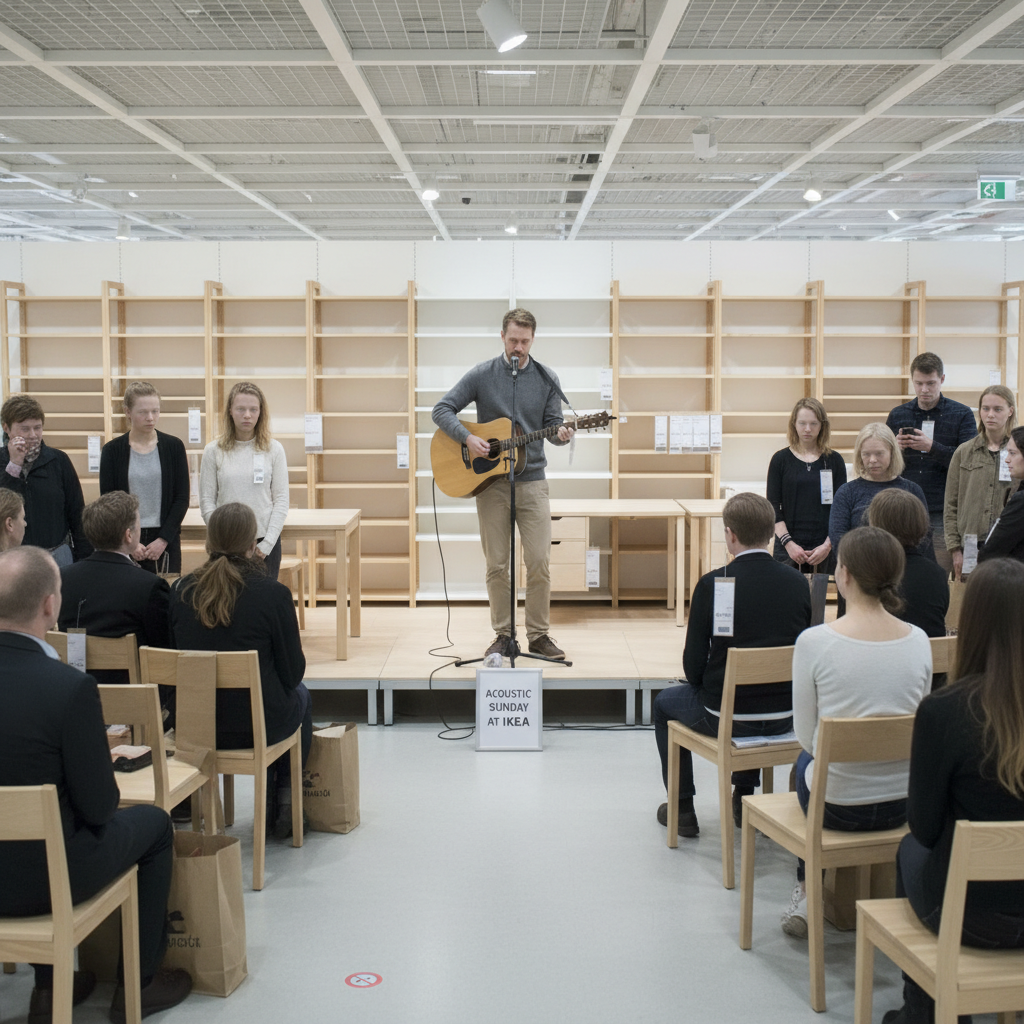
The IKEA room: taste without biography
Walk into an IKEA showroom and you are not just seeing furniture; you are entering a behavioral script. The maze‑like “long, natural path” through the store is engineered to keep you moving past maximum product exposure and minimum exits. You do not simply browse. You are taken on a journey, with every turn choreographed to push you toward more decisions as your resistance wears down.
The rooms themselves are aggressively inoffensive. The palettes are usually a safe mix of neutrals with one controlled “accent” color. Surfaces are flat, laminated, easily wiped clean. Nothing bears scars. Nothing has patina. Scale is tuned to statistical averages: sofa length, table height, bed size all designed for the “typical” body and lifestyle. The effect is a kind of low‑texture anonymity that reads as “modern” and “minimalist” to almost everyone because it collides with almost no one’s sensibilities.
Crucially, IKEA overlays this blandness with an illusion of intimacy. These are not presented as generic sets; they are marketed as your future living room, your kitchen, your study. Emotional design language is explicit: staged rooms “spark imagination and mental ownership,” inviting you to slip your own life into the template. You are meant to feel you have discovered who you are, when in fact you have walked through a psychological maze whose entire purpose is to extract consent and cash as efficiently as possible.
Contrast that with a genuinely idiosyncratic interior: a cramped writing room of an older songwriter, or the overstuffed living room of a compulsive reader. Nothing matches, but everything fits. The couch sags where bodies have sat for twenty years. The table shows the grooves of handwritten drafts and coffee rings. The bookshelf is a geological record of obsessions: battered paperbacks, out‑of‑print theory, a run of detective novels, an inexplicable stack of 1970s cookbooks. Colors are not planned; they accreted. The room is not a product; it is a biography in three dimensions.
The difference is not just aesthetic. The IKEA room has been designed to be legible in seconds and forgotten in minutes. The idiosyncratic room asks you to decode it. You have to study it, infer the habits that bent it into shape. One is frictionless; the other requires interpretation.
Loop‑pop: the musical flat‑pack
The same logic governs contemporary mainstream pop. Over the last several decades, studies and industry analyses have tracked a marked simplification of melodic and harmonic structures in chart music. Songs increasingly rely on short, repetitive four‑chord loops, “four chords, four bars”, that cycle through the entire track, often with minimal or no modulation. The I–V–vi–IV and its cousins have become something like the IKEA Billy bookcase: ubiquitous, functional, and treated as an invisible background infrastructure.
Melodies, too, have narrowed. Where mid‑20th‑century pop frequently used broad ranges, unexpected leaps, and phrases that lengthened or shortened with the lyric’s needs, current hits tend to favor tight pitch ranges and short motifs repeated with small rhythmic tweaks. Rhythms lock to steadily quantized grids. Ambience and texture, reverb swells, filtered drums, synthetic timbres, do much of the emotional lifting, while the underlying harmonic skeleton remains static.
The logic is identical to IKEA’s. A simple loop is highly reusable: you can drop dozens of toplines and lyrics onto it, swap in the production flavor of the month, and get a parade of “different” songs that are structurally interchangeable. Like a showroom floor filled with slightly varied couches, the variety is at the level of color and fabric, not frame. It is a system calibrated for speed, risk‑reduction, and maximum audience legibility.
This is the environment in which covers exist. Many contemporary covers of older material treat the song as an item in a genre category, “80s anthem,” “gay classic,” “feel‑good empowerment track.” The template is: keep the four chords, keep the outline of the melody, polish the edges, and sing it with generic positivity. What drops out is the biography.
Consider Elton John’s “I’m Still Standing.” On paper, it is a brisk pop song with a strong backbeat, a bright major key, and a chorus that repeats a simple declarative phrase. Bernie Taupin’s lyric, written in the early 1980s, was originally about romantic resilience, but it quickly became something else: a public statement of survival from an artist whose personal life, addictions, and career battles were well‑known. The record arrives in a context of near‑burnout and reinvention.
Elton’s performance encodes that history. He does not just ride the beat; he pushes and pulls against it. He attacks “I’m still standing” with a mixture of defiance and almost manic insistence, as if he is trying to convince himself as much as the listener. The backing band doesn’t simply loop; they build dynamics that feel like someone refusing to sit down. You hear the body in the track.
Now place that beside a flat, contemporary store‑friendly cover. Same chords. Same words. The “yeah, yeah, yeah” is technically there, but it has been evacuated of stakes. It is delivered with the same perky, non‑specific uplift that could sell yogurt or gym memberships. Your reaction, shared, tellingly, with your mother, despite differing levels of fandom, is laughter, because both of you register the mismatch. The singers are walking through an IKEA version of the song: all of the outlines, none of the weight.
They do not understand the emotional factor not because they are bad people, but because the system no longer teaches that level of understanding as a professional requirement. You can have a recording career built entirely on competently navigating flat‑pack structures.
Songwriters as house‑builders, not furniture arrangers
This is why we “will never get another” Laura Nyro, Carole King, Joni Mitchell, the Beatles, Elton John, not because human capacity vanished, but because the scaffolding that trained, demanded, and rewarded their level of structural authorship has been dismantled.
Laura Nyro’s songs are “pop labyrinths,” packed with harmonically rich chord changes, tempo shifts, and sectional contrasts that constantly reframe the emotions in play. A track like “Sweet Blindness” might slow dramatically for verses and then snap into faster, fully orchestrated choruses; “Time and Love” juxtaposes different tempos and textures between sections to create a sense of push‑and‑pull that mirrors the lyric’s ambivalence. “Captain Saint Lucifer” twists and contorts a central piano motif through unexpected harmonic detours. She uses tempo, harmony, and form as narrative devices, not just backdrops.
Critics routinely note that Nyro’s chord progressions and structures draw on older, already “unfashionable” pop and jazz traditions, Brill Building, Broadway, R&B, and recombine them into something idiosyncratic. Her voice moves like another instrument in the band, stretching notes, bending pitch, and slipping across barlines when the emotion calls for it. To understand Nyro, you have to track those moves. You have to learn her house.
Carole King, coming from the Brill Building factory, did her apprenticeship in a system that demanded songwriters be able to deliver harmonically and melodically robust material that others could inhabit. “Tapestry” is less harmonically wild than Nyro but still far more varied than current pop norms; bridges genuinely go somewhere, and the chords flex to match specific emotional beats. Joni Mitchell went even further into modal, open‑tuned guitar harmonies and asymmetric phrases that practically force attentive listening simply to follow where the song is going.
The Beatles and Elton John represent another axis of this richness: self‑contained writer‑performers whose songs are not just memorable tunes but architectural experiments, key changes, middle‑eights that open trap doors, codas that function as second thoughts. The classic Elton catalog is full of tracks where harmonic surprises and melodic arcs carry the emotional story even before you parse the lyric.
All of them were working in an ecosystem where the bar for songwriting included structural invention. The industry still interfered, still smoothed edges, still sought hits, but it accepted a higher degree of internal complexity because the audience had been gradually trained to expect and enjoy it.
By contrast, much of the current ecosystem asks writers and performers to be expert arrangers of prefab material. You learn how to make your voice sit on a loop, how to land a topline on a four‑chord progression that has already scored ten hits for other people. You can be a brilliant colorist in that system, but you are not asked to design the building, just to decorate the rooms.
Fan‑art IP: drawing the furniture
The visual art side completes the triangle. In the same way that flat‑pack pop turns listeners into self‑styled “curators” of nearly identical tracks, the proliferation of superhero, anime, and Disney fan‑art turns artists into arrangers of someone else’s structures. Walk any artist alley: tables full of Spider‑Man, Batman, Elsa, anime protagonists, all rendered with varying degrees of technical skill. What is being authored is not the character, not the world, not the emotional grammar; it is the treatment.
This is the IKEA effect in art. You “assemble” your identity as an artist by choosing which canonical characters to draw. You may bring real craft, line, color, anatomy, but the risk is almost entirely legal/branding, not artistic. Originality becomes a mash‑up formula: “Disney but dark,” “Batman as samurai,” “vampire Hogwarts.” The underlying ontology is franchised.
By contrast, an artist who builds an original visual world is doing what Nyro or King did in song: inventing the chords, not just playing them. New silhouettes, strange architectures, unfamiliar iconography, all of it demands more from both creator and viewer. You cannot rely on pre‑installed emotional associations; you have to teach the audience how to read your images.
The through‑line is this: from IKEA rooms to loop‑pop to fan‑art IP, the postwar cultural machine has perfected environments where people feel a powerful sense of taste, choice, and even creativity, while interacting mostly with standardized, low‑texture structures. There is just enough room for customization, a choice of couch cover, a playlist, a character skin, that people can experience ownership. Their small labor is leveraged into emotional attachment, the classic IKEA effect.
What drops out is the collective learning curve. When your world is filled with rooms, songs, and images that are instantly legible, your interpretive muscles atrophy. You are less likely to tolerate the confusion of walking into a genuinely odd interior, or listening to a song that changes key three times and shifts tempo in the bridge, or looking at art that does not immediately announce its genre. Critics who point out the thinning of structure are dismissed as snobs who “don’t understand” the music, when, in fact, what they understand is precisely how little there is to understand anymore.
The cost of the flat‑pack world
That moment in the store, laughing with your mother at the perfunctory “yeah, yeah, yeah,” is a tiny act of resistance. Both of you, from different generational positions, recognized that someone had taken a house built with blood and plaster and replaced it with a cardboard cut‑out. You weren’t confused. You were correctly identifying flat‑pack emotion and refusing to pretend it was solid wood.