
AI Doomers Don’t Preach: Lego, Disney, Madonna, and the AI Panic

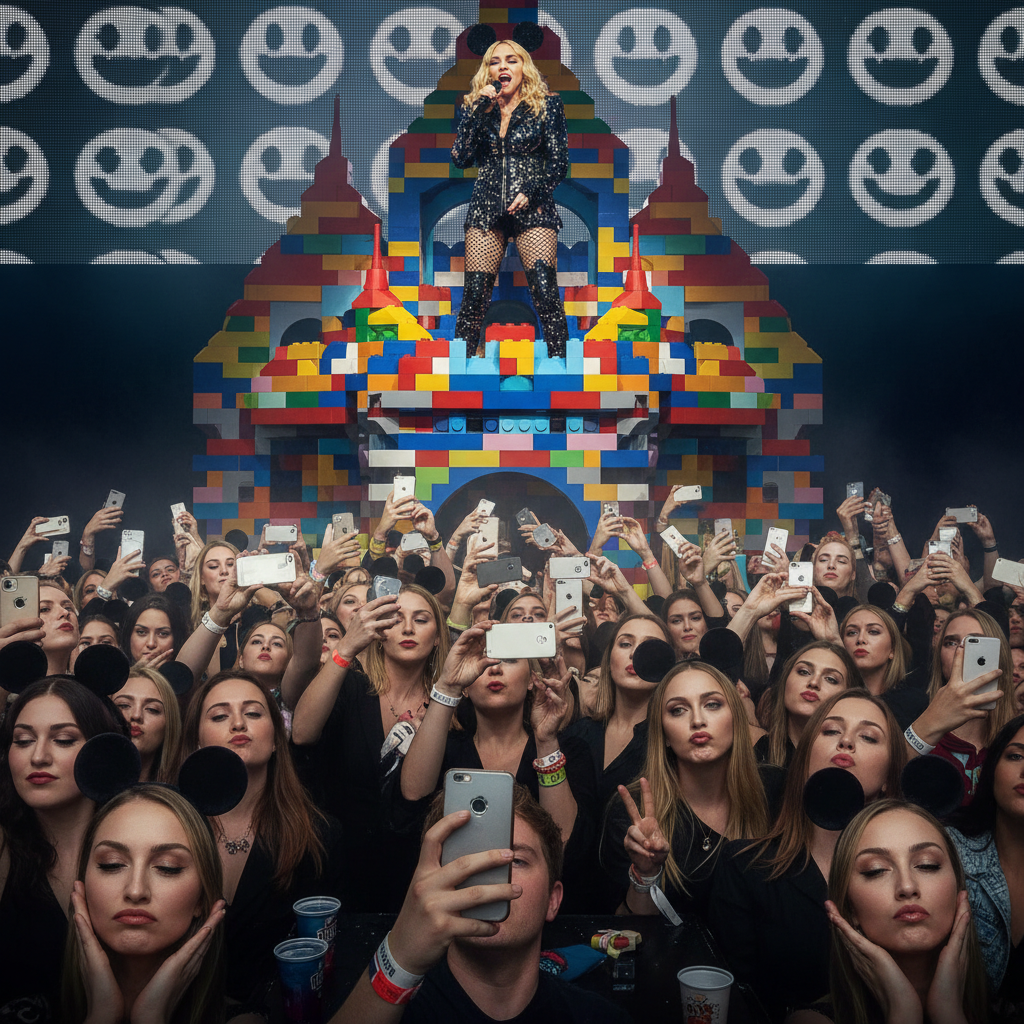
We didn’t suddenly become squeamish about derivative work when AI showed up. We’ve spent decades cheering for respectable plagiarists in mouse ears and sequins, then sold everyone else a cheaper version of the same dream.
Lego didn’t invent the plastic brick; it industrialized someone else’s idea. The early “Automatic Binding Bricks” were based on designs by British toymaker Hilary Fisher Page, whose Kiddicraft company was already selling interlocking plastic blocks before Lego scaled and branded the concept. Disney’s iconic “originals” are industrial‑strength retellings of public‑domain stories: Grimm, Andersen, Carroll, Barrie, Hugo, and more, scrubbed, merchandised, and locked up as corporate intellectual property. Madonna turned cultural appropriation into a global business model, lifting underground aesthetics, sounds, and iconography and repackaging them as pop spectacle. None of this was treated as an existential crisis for creativity. We called it innovation, branding, and “being a visionary.”
The real shift came when this derivative privilege went mass‑market. Social media turned everyone into a micro‑Disney, a tiny Madonna, a pocket‑sized Lego Group. You could lip‑sync, meme, curate, and posture on top of other people’s labour and call it a “personal brand.” Platforms and narcissism fed off each other: the more you believed you were special, the more content you produced; the more content you produced, the more feedback loops told you that your opinions were profound. American Dream 2.0 wasn’t “work hard and maybe build something useful.” It was “I don’t need expertise, knowledge, or talent; if I buy my own hype convincingly enough, the feed will agree.”
That logic needed a delivery mechanism, and it got one. Influencers and “thought leaders” were rewarded not for original insight but for confident remix: reheating news, retelling other people’s research, rephrasing common sense in a tone that sounded like revelation. Their real skill was stagecraft. They were the karaoke singers of the idea world: standing in front of the band in the box, throwing poses over someone else’s backing track, collecting applause for vibes rather than composition.
Then AI walked onstage, and suddenly everyone started talking about “theft.”
On the surface, AI looks like the ultimate remix engine: trained on oceans of existing work, it can spit out Lego‑blocks of text, images, and music on command. To the derivative aristocracy we already celebrated, this should feel familiar. Instead, they’re calling it the end of art, the death of originality, a betrayal of everything they claim to believe in. The panic isn’t really about copying; it’s about losing their monopoly on copying.
Because AI does something that scares the poseurs in a way Lego, Disney, and Madonna never did. It collapses the value of their layer of the process. An influencer’s edge was always the ability to sit on top of other people’s work and narrate it with enough confidence and charisma that audiences mistook curation for creation. A “thought leader” could read a fraction of the available material, smooth it into a thread, and be treated as an oracle. AI can now ingest more information than any of them combined, pattern‑match across it, and generate the same style of confident synthesis at machine speed. The band in the box doesn’t just hide the labour anymore; it plays better than the person lip‑syncing in front of it.
That’s why the AI panic sounds so shrill from certain corners. The Lego–Disney–Madonna tier still has leverage: they own catalogues, capital, distribution channels. The mid‑tier poseurs, the karaoke class elevated by social media, do not. They discovered too late that their crown was made of paper, and AI is the first gust of wind strong enough to blow it off.
Meanwhile, the same technology they denounce is quietly opening a different path. Used as a vending machine, AI flatters the old dream: type a prompt, get content, look smart with minimal effort. Used as a feedback engine, it does the opposite of social media. It doesn’t care about your mask; it keeps tugging at the seams. It can help you start a company from your kitchen table, but it will also show you where your plan is weak. It can draft your pitch, but it will also expose that you don’t understand your own numbers. It can help you learn a skill faster, but only if you’re willing to see, in humiliating detail, where you’re not as good as you thought.
The Lego/Disney/Madonna era proved that we’re comfortable with derivative success as long as there’s a charismatic human standing in front of it. Social media turned that comfort into a mass‑market fantasy: everybody gets to be the star on the plastic castle, phones in the air, pretending the bricks under their feet are their own. AI is what happens when the castle starts talking back. It remembers who actually designed the bricks. It can assemble new ones without waiting for a personality to bless them. And it quietly invites anyone, not just the chosen few, to build something that isn’t just another layer of performance.
The people screaming that AI is an insult to “real creativity” are often the ones who’ve been living off Lego bricks, fairy tales, and borrowed aesthetics the longest. What they really fear isn’t that the machine will destroy originality. It’s that it will finally reveal how little originality they were ever required to bring.