
How the Entertainment Industry Became Legacy

Hollywood has been in a decline long before the WGA and SAG-AFTRA Strikes of 2023.
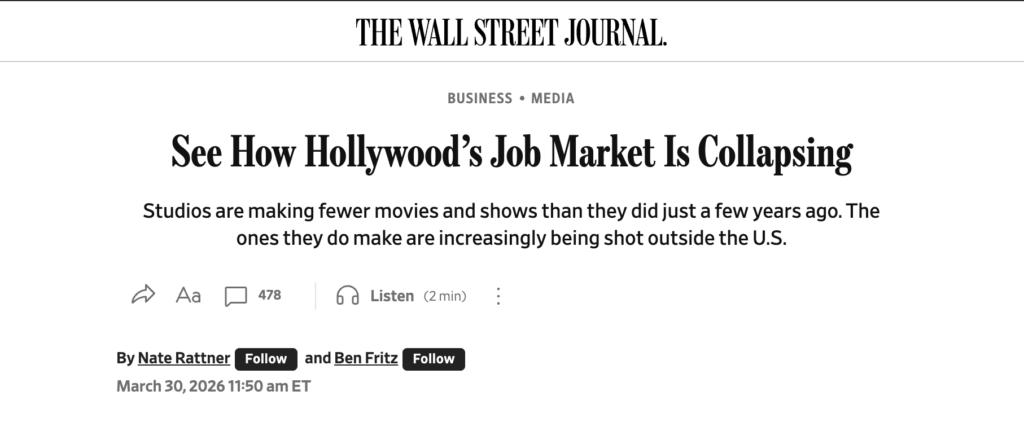
It suffers from the same disease as journalism: ego plus rigidity plus formula plus gate‑keepers builds an empire, but once that empire hardens into intransigence, intransigence equals decline.
The industry’s instinct has been to blame AI for its current crisis, but AI is not the cause. AI is simply the latest evolution of a technological shift the industry refused to understand, adapt to, or absorb. The same pattern destroyed journalism. Entertainment just took longer, because its product was harder to replicate with a smartphone.
Part One: The Empire Equation
Every dominant media industry in history has followed the same arc. A combination of talent, gatekeeping infrastructure, capital, and distribution creates scarcity, and scarcity creates power. In Hollywood’s case, studios controlled everything: who got funded, who got seen, who got paid, and who got discarded. The system was not merely hierarchical; it was deliberately self-reinforcing. Studio and production company executives controlled access to budgets and platforms; showrunners controlled access to writing and acting jobs; agents and managers controlled access to both sides of the transaction. Even assistants, with no formal power, functioned as gatekeepers to the gatekeepers themselves. The system was not just a business model. It was an ideology: the belief that quality could only be certified from within the tower.
This structure built empires. It also built the exact kind of intransigence that makes empires fall. Legacy media no longer commanded audience attention, advertising dollars, or international trade the way it once did, but instead of adapting, studios turned to layoffs, budget cuts, and Wall Street-pleasing maneuvers to protect the old model. The machine had calcified. What had been an advantage, the gatekeeper structure, became the principal obstacle to survival.
Part Two: Journalism Fell First
Journalism offers the clearest preview of what happens when ego and formula collide with a technology that democratizes distribution. The collapse was not sudden. When television went 24-hour and online publishing exploded, over-saturation led to budget cuts; fewer people were asked to do more work, and the rush to publish before competitors introduced a structural corruption of standards. The revenue model was already weakening before social media delivered the killing blow.
When Facebook, Google, YouTube, and then Twitter absorbed the advertising dollars that had underwritten professional journalism for a century, traditional outlets faced an existential reckoning. Newspaper publisher revenue dropped 52% between 2002 and 2020; periodical publishing fell 40.5% in the same period; total U.S. weekday newspaper circulation fell from 55.8 million in 2000 to 24.2 million by 2020. One in four American newspapers ceased operations altogether since 2005.
The crucial detail, however, is not that the audience disappeared. The audience migrated. They followed Joe Rogan, Substack newsletters, Under the Desk News, and thousands of independent creators who gave them what professional journalism failed to: directness, specificity, and a sense that the creator actually occupied the same world they did. Traditional journalism’s response was largely to copy content from broadcast onto platforms like TikTok without tailoring it; replicating the form without understanding the medium. The disconnect between what journalists believed audiences wanted and what audiences actually engaged with was never resolved because the industry’s ego prevented it from asking the question honestly.
Social media did not simply compete with journalism. It made journalism’s audiences into journalism’s competitors. Anyone with a smartphone and an opinion could build an outlet at a fraction of the cost, and many did, successfully.
Part Three: Entertainment Got a Warning It Ignored
Hollywood watched journalism collapse in slow motion throughout the 2000s and 2010s and learned almost nothing from it. The warning signs were identical: fragmentation of audiences, the rise of cheap independent content, the erosion of gatekeeping structures, the shift of advertising dollars toward platforms rather than legacy producers. Hollywood simply believed it was immune because its product was more expensive to replicate.
It was not. Social media weakened entertainment in the same way it had weakened journalism, just more gradually. Audiences scattered. Gen Z attention across media fragmented so thoroughly that no single cable network commanded more than 1.2% of their attention; Netflix held 8.75%, Amazon 7.70%. The New York Times reported that Hollywood’s summer 2025 box office slumped to its lowest point since 1981. October 2025 posted the worst monthly revenue in 27 years at just $425 million, excluding the pandemic. Domestic ticket sales are down nearly 40% compared to 2019, and crucially, that decline began long before the pandemic.
The average revenue per wide theatrical release peaked in the late 2010s and has not meaningfully recovered. Higher ticket prices mask the reality: the number of actual moviegoers has collapsed. Studios compensated by releasing more films (112 wide releases in 2025 versus 94 in 2024) while each film earned less. Hollywood’s response to losing audience density was to increase volume, the same formula journalism tried when it increased article output to chase clicks.
Part Four: Audiences Became Competitors
The most significant structural change, and the one both journalism and entertainment have been slowest to process, is that their audiences are now also their competitors.
Social media gave people global distribution at zero marginal cost. That alone was disruptive. But it did not immediately create a competitive product. A smartphone-shot video, a blog post, or a personal Facebook page could reach the world, but it could not reliably match the production quality of a studio film or a professionally edited broadcast. The gatekeepers consoled themselves with this distinction. The consolation was temporary.
YouTube creators are now building what amounts to a parallel studio system. Dude Perfect secured $100 million in funding; MrBeast is pursuing a $5 billion valuation for his enterprise. Creator studios can test content variants at 1/100th the cost of a Hollywood production, receive real-time audience data about exactly where viewers disengage, and iterate accordingly. Markiplier’s self-financed film Iron Lung earned $20 million going directly to theaters with no studio, no streamer, and no IP owner, using only his existing audience and a 50/50 revenue share with exhibitors. In 2025, YouTube generated $40.4 billion in advertising revenue, surpassing the combined $37.8 billion of Disney, NBCUniversal, Paramount, and Warner Bros. Discovery. The platform has paid over $100 billion to creators, music companies, and media partners.
This is the same story journalism lived through, compressed into a faster timeline. Independent creators, people with no formal credentials, no union cards, no development deals, became more efficient at reaching audiences than the institutions that had built the infrastructure those audiences once depended on.
Part Five: AI Is Not the Cause: It Is the Accelerant
The entertainment industry’s current public posture frames AI as the villain of this story. Studios resisted WGA demands to ban AI-generated scripts during the 2023 strikes, offering only to meet annually to “discuss advancements in technology”. Actors raised alarms about AI being used to store and replicate likenesses without compensation. These concerns are legitimate. But they fundamentally misidentify the timeline.
The decline was already structural and underway before AI became a practical tool. What AI does is accelerate the same dynamic that social media introduced: it lowers the cost and raises the quality ceiling of independent production. Social media gave audiences a global distribution platform. AI gives them the tools to make what they distribute polished. A creator who once needed a professional editor, a composer, a colorist, and a visual effects team can now approximate those functions with accessible software. The gap between what Hollywood produces and what independent creators can produce is narrowing at a rate the studio system has not acknowledged.
The irony is that Hollywood has loved formulas, and AI will only tighten that grip: studios that rely on AI-driven script analysis will increasingly avoid creative risks when an algorithm flags a concept as “unmarketable,” compressing the very creativity that justified their premium position. Meanwhile, independent creators are using the same tools to do the opposite: testing unconventional content cheaply, failing fast, and iterating toward what audiences actually want.
Available gigs for Hollywood writers fell 42% between 2023 and 2024. Amazon’s long-term plan involves replacing approximately 75% of its operational workforce with automation, with cuts already underway across Prime Video, Twitch, and Amazon MGM Studios. The industry’s response has been to use AI to cut costs, not to expand creative possibility.
Part Six: The Symmetry of Two Declines
The parallel between journalism and entertainment is not metaphorical. It is structural, sequential, and instructive.
| Factor | Journalism | Entertainment |
|---|---|---|
| First democratizing technology | Internet/blogging (1990s–2000s) | Social media/YouTube (2005–2015) |
| Audience became competitor | Bloggers, citizen journalists | YouTubers, TikTok creators |
| Revenue model disrupted | Print advertising → platforms | Box office/cable → streaming/creator economy |
| Gatekeeping response | Dismissed, then copied without adapting | Dismissed, then acquired without integrating |
| AI impact | Accelerates reader migration to AI-summarized news | Accelerates creator capability parity with studios |
| Industry explanation for decline | “Misinformation,” “platform algorithms” | “Strikes,” “AI,” “piracy” |
| Actual cause | Failure to treat audience as participant, not consumer | Failure to treat audience as participant, not consumer |
In both cases, the industry that fell did so not because the technology was insurmountable, but because the ego of the empire made it impossible to learn from the institutions that fell before it. Journalism’s collapse was visible in real time. Entertainment watched it happen and concluded it was immune.
The audience was always telling both industries what it wanted. The industries were too invested in the gatekeeper model: too certain that quality was defined by access to their system to listen. Their audiences, consequently, stopped waiting for permission and built their own systems instead.
Conclusion: What Intransigence Costs
Intransigence has a specific price in creative industries: relevance. An industry that cannot adapt does not merely lose market share. It loses the cultural authority that justified its premium pricing, its gatekeeper function, and ultimately its claim on audience attention. When audiences become more sophisticated with the tools of production than the veterans who built the industry the way independent social media creators became more fluent with platform mechanics than legacy journalists, the gate has already been opened from the other side.
Hollywood is not at a crossroads. It passed the crossroads. The choice to absorb new technology and evolve: the path journalism never took, the path entertainment also declined was available at multiple points in the last two decades. What remains is the adaptation that should have begun earlier, undertaken now under far less favorable conditions, by institutions that must compete not with peers operating under the same constraints, but with millions of individual creators who learned, built, and moved on while the empire was busy protecting its gates.