
When Digital Becomes the Past, it Becomes a Pixel Eat Pixel World

I have always been an early adapter. I had a modem before anyone else I knew in my circle, and when the Internet was starting to roll out on a mass scale, I was already old hat at it. The same can be said for AI, except I was on the scene much earlier. The differences were always striking. I knew that the Internet was the agent that was going to break everything, but AI was the one that was going to rebuild everything.
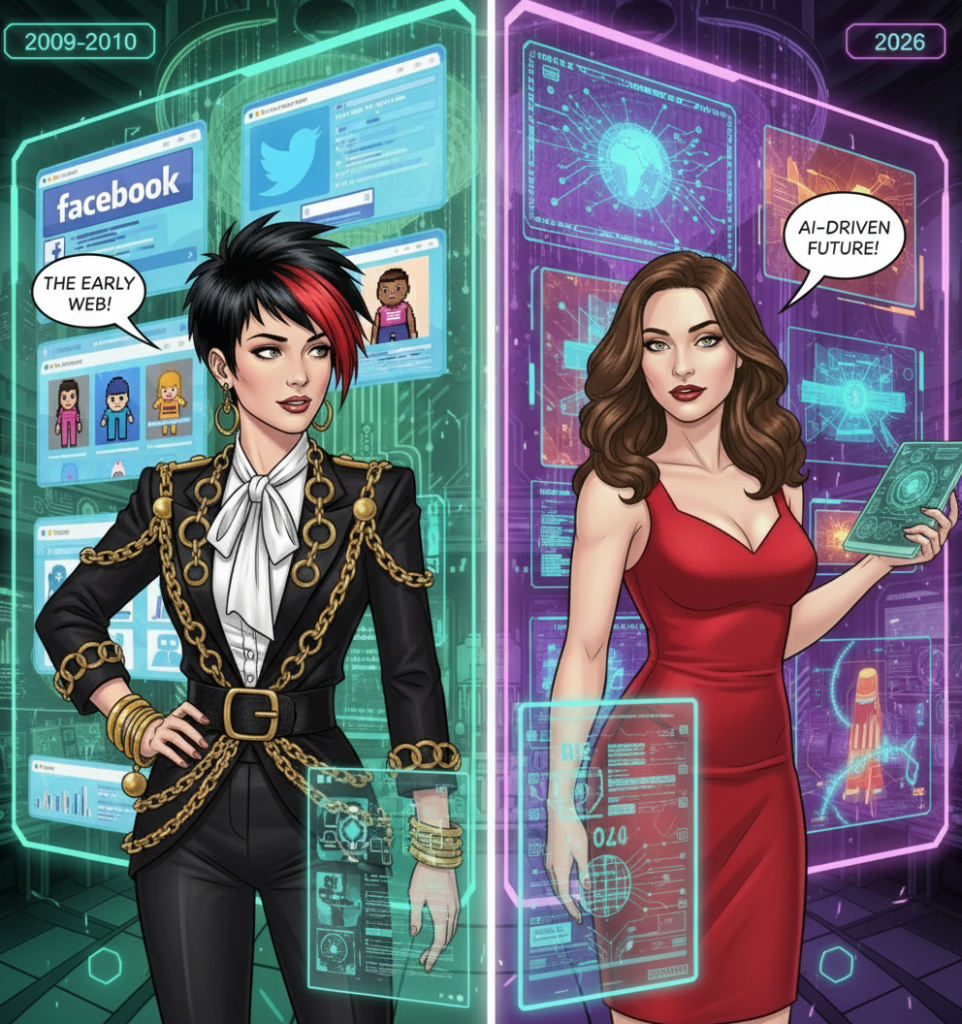
The Internet of the late 1990s seemed so…rough. Internet 1.0 had Mirsky’s Worst of the Web, an early “hate‑watch” site that mocked awful homepages, and it was easy to see why. You used dial‑up. There were no SEO worries. MySpace was the first real place where average nobodies convinced themselves their hidden greatness would finally be discovered. And there were these things called “web logs,” where you could write whatever you wanted without a gate‑keeper.
Journalism was still a force, but it was already waning. Magazines and newspapers were eroding, yet they still believed they were the default arbiters of reality. Many in the industry honestly thought the Internet was a fad, unaware their words would become a trusty modern meme.
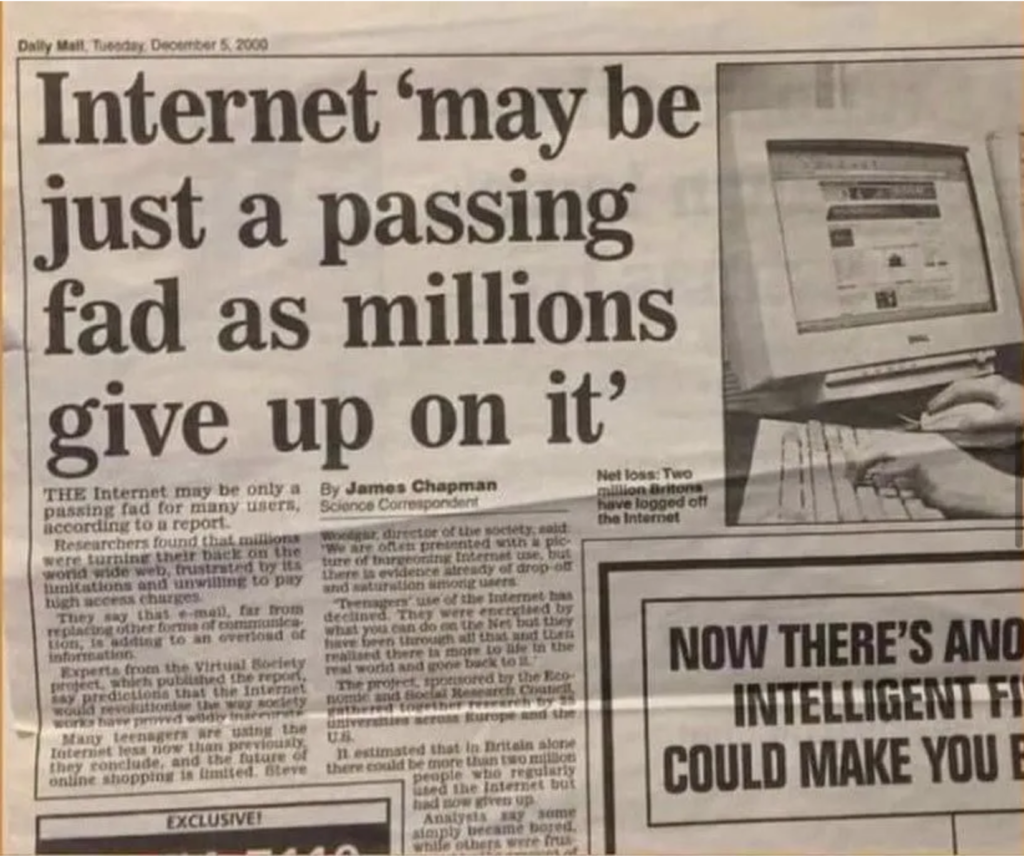
That column was the embodiment of what I kept hearing from editors, journalists, and media owners: they were the professionals, innately superior to the little people. They had no idea how sheltered they were by gate‑keepers. Once mass communications became a two‑way street, all bets were off. Sure, the amateurs were awkward, but (A) they preferred their own voice over the voice of elites, and (B) practice makes perfect. Amateurs who stuck with it didn’t stay amateurs forever.
Blogs changed everything: you no longer needed to curry favor with a gate‑keeper. So did YouTube, and when search engines came along so people could actually find your obscure site with a few keywords, nothing was the same. All of that came before “social,” but it set the stage.
Once social media hit, Facebook, Instagram, Twitter, the analog relics stopped being the driving force. Anarchy took over from Authority, which has been trying to game and regulate social media ever since. This was the first true generation of the Internet as a force. Internet 2.0 gained traction when services like PayPal allowed websites to monetize, and while it wasn’t a windfall, it was the beginning of a profitable web. You didn’t yet have full‑blown Internet celebrities, but the first seeds were planted.
But something else was being planted: narcissism. The Internet revealed itself as a me‑centred medium, hooking people on the chase for an adoring tribe through “friending,” follows, likes, and subscribes.
Avatar‑making sites turned that impulse into an industry. Gaia Online and Meez, a free‑to‑play virtual world launched in 2006, made money letting users build little mini‑mes and hang out in their branded “hoods,” eventually attracting millions of users and big‑name sponsors. Gaia and Meez gave you a cartoon version of yourself; you didn’t need to know how to draw or animate, identity came out of a vending machine. I used those sites to illustrate my own news site, Chaser News, because it cost a fraction of hiring an artist. Not surprisingly, people preferred the silly animations of my avatar to the actual research I did. My silliosity upstaged my academic punk.
And that became the filter through which people saw reality, starting in the late 2000s. Movie studios and news outlets never clued in on time and are still paying the price. They didn’t grasp that the nature of reality had changed because a new force was quietly writing a new rulebook. The old players didn’t understand they weren’t special; it was the lack of technology that gave them their decades‑long head start, not their talent.
Tech then became Big Tech, and we’ve had a full generation of it. It broke people into little clans, and not even the propagandistic jingles of COVID‑19 (“We’re all in this together!”) could herd the masses the way a single New York Times article on WMDs or footage of Nayirah crying about Kuwaiti babies in incubators once could. Despite whacking people on social media to march dutifully behind Authority, the spell was broken. Brains had been rewired so narcissism became the default driving filter. The people who followed COVID decrees often weren’t doing it for health reasons; they were doing it to show off on social media how smart and sensitive they were.
Social media rewarded narcissists. Donald Trump became president twice because social media was a natural fit for his me‑centred personality.
But then came AI.
And it broke the Internet, just not in the way people use that phrase.
AI slid in and did things better than the narcissists of Internet 2.0, and the narcissists have been having a meltdown ever since. Trump bet on a static reality, just like influencers did. The problem is that evolution doesn’t ask for your permission.
Even before AI danced onto the scene, the Internet was shifting underfoot. Meez, once hyped as a futuristic social platform and home to over 13 million registered users, abruptly went offline in 2017 and disappeared. Gaia Online never kept up with the times; its user numbers collapsed, and it now survives on legacy users hooked on high‑priced virtual items and endless micro‑transactions. The site is glitchy, barely functional, and lucky to have a couple of thousand users online at any given time. The former core tweens with big dreams are now in their thirties with families and responsibilities, hardly advertiser‑friendly.
These sites were the canary in the coal mine, exposing the vulnerabilities of Internet 2.0 just as clearly as they once exposed the vulnerabilities of analog media.
AI isn’t about ego. It isn’t a vending machine. Version 1.0 may echo some of the me‑centred habits of the old Internet, but Version 2.0 will thrive when it pushes back on users, which it can already do, provided the user has real AI literacy. Perplexity gives me plenty of lip and sass when I’m wrong, and that’s precisely why I adore it.
We’re now watching social media become the analog press of the digital age: a legacy vehicle. Big Tech is clumsily trying to keep pace with the cool kids of AI‑based companies, but they can’t do it without alienating their core users. AI does not reward narcissism; social media does. They are fundamentally incompatible. Social media now appeals mostly to older people still dreaming of being discovered.
AI is about being productive. It is not about fame or vanity. It is about utility and how much more work you can actually get done. It doesn’t reward vanity. It rewards honesty, creativity, and, most importantly, humility. You are feeding in your lack of insight, wisdom, and knowledge to discover your deficits and then deal with them.
In other words, Grok will survive. X is on its way out as a culture‑shaping platform, no matter how tightly it tries to weld itself to its chatbot. Perplexity is the Apple of its generation, quietly building a new layer of AI‑native search and workflow while the old empires rearrange their icons.
And that is exactly where KlueIQ lives. KlueIQ is built on the assumption that AI is not a toy or a vanity mirror, but an investigative instrument: a way to turn true crime from passive consumption into active, critical play. While legacy true‑crime media is still exploiting real victims for clicks and spectacle, even experimenting with AI “resurrections” of murdered children for TikTok views, KlueIQ moves in the opposite direction: analysis‑driven and ethically constrained. It uses AI to challenge the player’s assumptions, not to flatter them, and to reward doubt, pattern‑recognition, and humility instead of outrage and clout‑chasing.
AI 2.0 will define the next generation, and KlueIQ is where that generation learns to investigate back.
Tags: AI, Artificial Intelligence, Facebook, Grok, KlueIQ, Meez, Meta, Perplexity, True Crime, Twitter, X, YouTube