
The Futures That Didn’t Happen, Part 1: Journalism’s Self‑Rescue Fantasies

Journalism loves to say it doesn’t do prophecy. It deals in facts, verification, and what can be confirmed. But every few years, the industry turns to a new piece of technology, points at it with great authority, and announces: This will save us. When the miracle fails to materialise, the headlines are quietly buried and the next gadget is anointed. The problem isn’t just that those predictions are wrong. It’s that the people making them rarely bothered to understand the tools they were pinning their survival on.
Tablets: the messiah you can swipe
When Apple launched the iPad in 2010, you could practically hear the collective sigh of relief from media executives. At last: a device that looked like a magazine and behaved like a computer. Tech and media coverage rushed to frame it as journalism’s lifeboat. Could the iPad save Newsweek? Would apps be the future of news, finally persuading audiences to pay for slick, interactive editions? Publishers poured money into custom tablet apps, bespoke layouts, and “reimagined” digital magazines, convinced that readers would happily buy issues again if they came wrapped in glass.
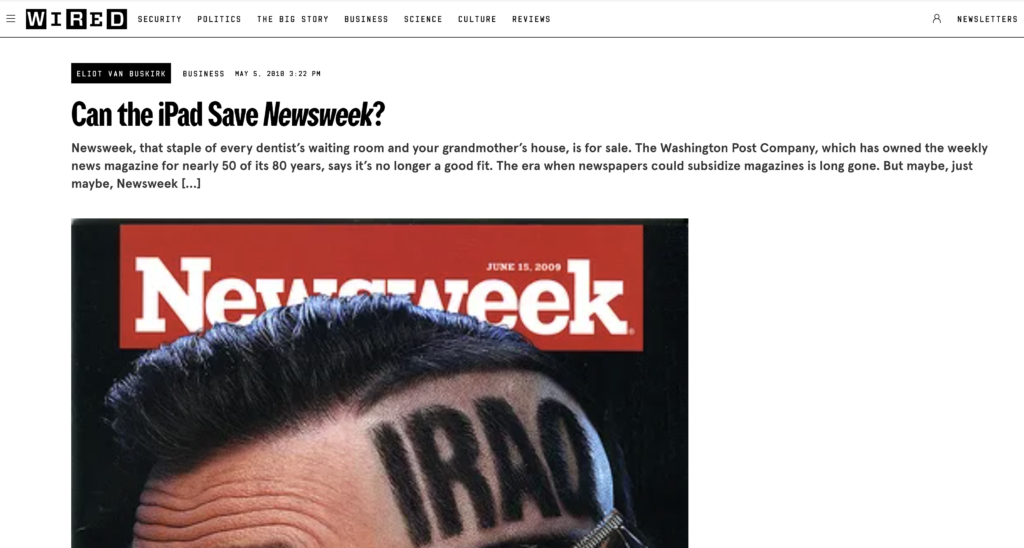
On paper, the story made sense: here was a new object you could sell, not just access to a website. In practice, it ignored two realities. First, tablet adoption was never universal enough to replicate the old mass‑print model. Second, people’s news habits had already shifted toward fast, link‑driven consumption in browsers and on phones. The tablet was treated as a time machine back to the glory days of bundled issues and appointment reading. It was a comfort object, not a structural fix.
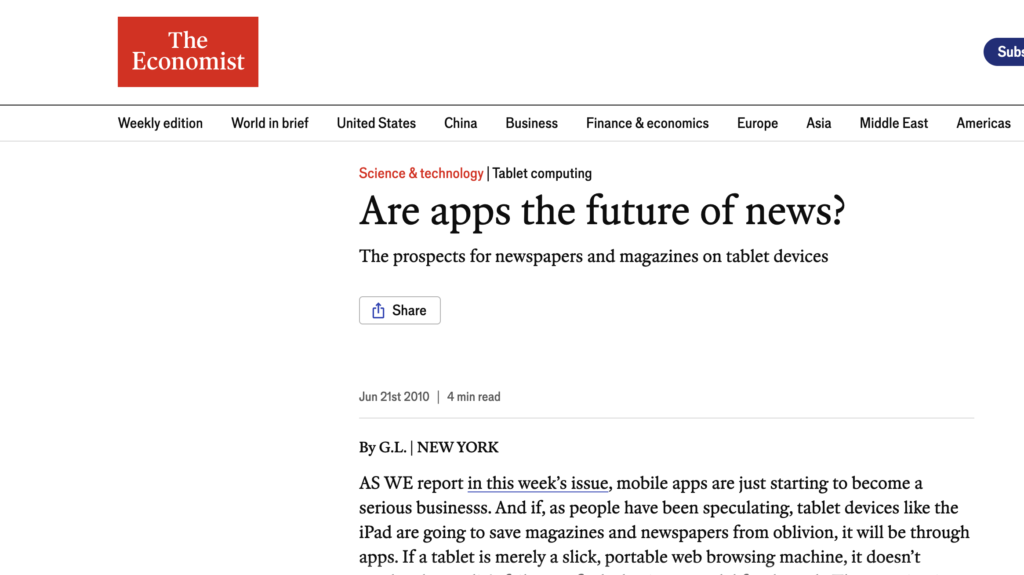
More tellingly, very few newsrooms treated the tablet as something to experiment with beyond the first wave of glossy apps. Once the initial excitement faded and the numbers failed to match the hype, the industry didn’t deepen its literacy: it didn’t ask what kind of tablet‑native journalism might actually make sense. It quietly scaled back and moved the miracle to the next altar.
Paywalls: morality tales with shaky math
When tablets didn’t deliver salvation, paywalls stepped up as the next saviour. “If you care about journalism, you’ll pay for it,” became the line. Metered paywalls, hard paywalls, premium tiers, each new configuration was described as the latest strategy to “save the newspaper” or “save journalism.” Big success stories at national flagships were held up as proof that the model worked. Everyone else was invited to follow.
The reality was more uneven. For a handful of globally recognised brands with unique reporting, paywalls brought in substantial subscription revenue. For many regional and local outlets, they shrank already‑fragile audiences without truly replacing lost advertising. The success of the model depended less on the abstract virtue of “paying for news” and more on whether a particular outlet had the reach, reputation, and product to make the numbers add up. One size did not fit all.
Again, what’s striking is how little literacy developed around the tool itself. Few organisations treated the paywall as an experiment with levers to pull: price points, offerings, community features, different levels of openness. Instead, the wall was installed like a moral monument. If revenue didn’t miraculously rebound, the conclusion was not “we mis‑designed this” but “people don’t value news.” The model was framed as a referendum on public virtue rather than on the industry’s willingness to rethink what it was selling and how.
Social media: engagement as life raft
Next came the era of “engagement will save us.” Newsrooms were told they had to be where the audience was: on Facebook, Twitter/X, Instagram. Journalists were urged to become brands, to cultivate followers, to “join the conversation.” The pitch was that this would rebuild trust and reach; social feeds would drive readers back to the mothership.
Of course, social algorithms were never designed around civic information. They were tuned to reward speed, volume, outrage, spectacle, and stickiness. Stories that provoked intense reactions were boosted; slow, complex reporting often sank. Platforms tweaked their feeds constantly, sometimes overnight, yanking traffic away from publishers who had come to depend on them. The very dynamic that made social media attractive, a river of attention, also made it fundamentally unstable ground to build an institution on.
And again: the industry never really became literate in the systems it had entrusted itself to. Many outlets treated social platforms as magic pipes: paste a link, watch the clicks. Few invested in serious, long‑term experiments to understand how different kinds of content, interaction, or timing actually shaped audience behaviour. Fewer still took seriously the question of what it meant to rely on privately owned, ad‑driven infrastructure as the de facto public square. When the platforms changed the rules or soured on news, journalism acted blindsided, as if platform logic were an act of God rather than the foreseeable outcome of building on someone else’s land.
AI: miracle and catastrophe, sold by the same voices
Now we’re in the AI chapter of the same story.
AI is clearly transformative. Something consequential is happening with large language models and related tools; you can feel it in workflows, search, education, and creative work. But how it will transform those areas is genuinely uncertain. The only honest answer, at this juncture, is that we don’t fully know.
Instead of sitting with that uncertainty, journalism has reached for familiar scripts. On one side, AI is framed as a miracle: it will automate drudgery, personalise news, create new products, and unlock fresh revenue streams. On the other, AI is framed as an apocalypse: it will kill jobs, poison information, end art, maybe end humanity. Both positions are delivered with the same confident tone as the tablet and paywall hype: this time with more existential dread.
AI Doomers are wrong in the same way the Internet Doomers were. They confuse wishful and magical fantasy with prescience. The 1995 fantasy was “nothing will change”; the 2026 fantasy is “everything will end.” Both fantasies let you avoid the harder, more boring work of actually learning the system in front of you, testing it, mapping its limits, and figuring out where human judgment still has to sit in the loop.
And once again, the industry is largely skipping the literacy step. Editors and executives talk about “using AI” the way they once talked about “getting on Facebook”, as a compliance box to tick or a threat to barricade against, not a craft to master. Vendors and consultants become translators, while many journalists themselves remain at arm’s length from the technology. If AI could transform journalism for the better, by freeing time, improving backgrounding, making data easier to interrogate, most newsrooms would never notice. You cannot be transformed by a tool you only touch at the press‑release level.
The real fantasy
Underneath all these cycles is the same self‑rescue fantasy: that a new piece of technology will arrive, ready‑made, to save journalism from the consequences of its own structural decisions. That tablets, paywalls, platforms, or AI will fix collapsing trust, hollowed‑out local coverage, extractive ownership, and a professional culture that still treats audiences as problems to be managed rather than partners in inquiry.
Technology absolutely can change what journalism is capable of. It already has, many times. But it only does so when people inside the craft are willing to become literate in the new medium: experiment with it, understand its logic, and then bend it toward their own values. The newspapermen who dismissed the early web were wrong about what the Internet would become, but they were also wrong about what journalists themselves could have done with it, if they had been curious instead of offended.
Buying your own hype is expensive. It has cost news organizations money, time, and authority they didn’t have to spare. The futures that didn’t happen: tablets as saviour, paywalls as cure‑all, social engagement as trust machine, AI as either miracle or extinction event aren’t just funny mispredictions. They’re case studies in what an evidence‑based profession looks like when it stops treating technology as something to report on and starts treating it as a prophecy to believe in.