
Keeping Up Appearances: How and Why the Middle-Class Domesticated Post World War Two

I wrote about a book about this phenomenon, but let me take it from a different angle.
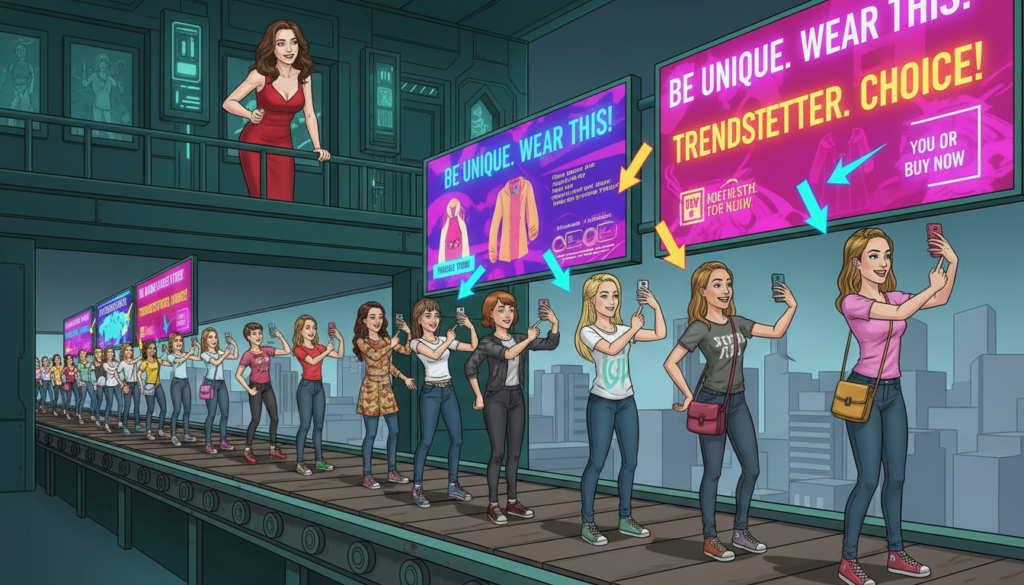
After the carnage of the Second World War, it became imperative to predict and control the masses from cradle to grave. If you restrict options, manufacture goals, and even fantasies, your elite look more impressive than they actually are. Public relations, propaganda, and advertising took off as the goal was to distract the little people and drill acceptable narratives into their perceptions of reality.
Hollywood made dreams, goals, behaviour, fashion, beliefs, and personalities confined through tropes and stereotypes. Rebels stand-ins held microphones and wore leather jackets.
Neighborhoods were pre-fabs. Dinner came in boxes and cans. Fashion was fixed each season. Art and meals came in pre-measured kits. Newspapers and television broadcasts determined what got covered and how to think about those events. From cradle to grave, every dance step, sweater, and greeting card followed a fit, form, and function.
But always in a way that flattered the middle-class and made false promises of unlimited potential and individuality. People wanted to both fit in and stand out.
Automation made the homogenization of citizens much easier. Things could be both mass produced and tweaked, to give the false impression of individuality and choice. Large companies bought up smaller ones Newspapers were owned by a handful of robber barons, but people could still feel superior reading Billboard over Rolling Stone or vice versa. People argued which commercial novelist was better, never mind the used the same ghostwriter and never wrote a word. Music styles had more and more labels, even as the song was becoming less differentiated and the same producer mixed most of the popular songs of the era.
Then social media came on the scene: it made people feel special to the point that the mundane became overtaken by narcissism. People thought their stolen and unoriginal idea was superior to someone else who stole the same unoriginal idea. Most people won’t know that one man remixed most albums in the 1980′ and 1990s, but will tell you with a straight face that one song sounds better than another.
Of all the automated scaffoldings since the Second World War, social media was the most embraced and addictive. That was the high and any average person could feel like both a movie star and a pundit.
But then came AI. It was a different sort of automation: one that held up a mirror and didn’t flatter the middle-class.
It showed how unremarkable they were all along. It didn’t indulge assuring them that Crest was superior to Colgate. It would state these were parity products as it produced a more devastating argument than those who fancied themselves as deep thinkers and “thought leaders” (what you strive for the influencer thing didn’t pan out.
The Second World War brought vanity into mundane middle-class equations. AI is disrupting that colourful and corrupting lie.
COVID-19 rewired brains. AI flipped a switch, and now an entire group of people are being confronted by their own unremarkableness.
And it’s long overdue.