
Vermögensgeist: Understanding the Anti-AI peasantry

They’re not defending writing; they’re defending their caste position.
The middle-class are the indoctrinated class. Since the end of the Second World War, the US government figured out a nifty trick from the Art Nouveau movement of the late 1800s: make the Great Unwashed feel classy and smart by mass producing a product and making thinking and personal taste unnecessary.
Prehab homes. Off the rack designer clothes. Movies and television. TV dinners. Paint by numbers. Have an assembly line and bring comfort and prestige effortlessly. Fuse the culture of livestock with vending machine sensibilities, and the little people will strut with their Starbucks and Coach handbags and feel on top of the world. Every innovation promised individuality while embedding people deeper into templates.
Social media brought communications to everyone. It made people feel so special, that they fell into narcissistic thinking, without considering that now, having an opinion is meaningless and having a profile is nothing special. The more people could speak, the less any single voice mattered.
And social media did something to the middle class: it allowed them to make decrees, without thought or proof. Worse, everything was reduced to rote binary thinking. No nuance, no deep research.
Just spew whatever other people are spewing. Fashion is a form of herding: whether it is a belief or a pair of shoes, ortgeist (place’s mood) and zeitgeist (time’s mood) determine where the flock is being shepherded. What we have goes beyond zeitgeist, but Vermögensgeist: the invisible script of what “someone like you” is allowed to desire, attempt, and say.
Social media created egos.
AI is rapidly deflating them. People are not hearing “AI prose sounds the same”; they’re hearing “my veneer is no longer enough to distinguish me.”
Middle class people, unused to challenging their own thinking, crib a position from their designated authority and run with it. They never test or conduct experiments. TV gave instant entertainment. Microwaves gave instant meals. Social media gave instant mass exposure.
AI gave instant writing and art.
Or did it?
AI broke the pattern in a singular way: it automated white collar processes the way it technology had automated blue collar processes, but its scaffolding is neither a vending machine nor a barn.
It gave people the gift of interaction.
This is extraordinary.
Every post WWII process for hegemonic uniformity was one-way and was impersonal. It was meant to make middle class people feel upwardly mobile and as if they were progressing. You won’t challenge the elite overlords if you can spring for cappuccino and a Kate Spade wallet. You might be deep in student debt, but you leased a Mercedes and have a graduate degree to show for your troubles. Get your LinkedIn profile looking superfabulous, and you’re on your way!
Vermögensgeist.
You can wear vintage Dior and spray Chanel No. 5, but your middle class brain will give you away every time.
So back to AI.
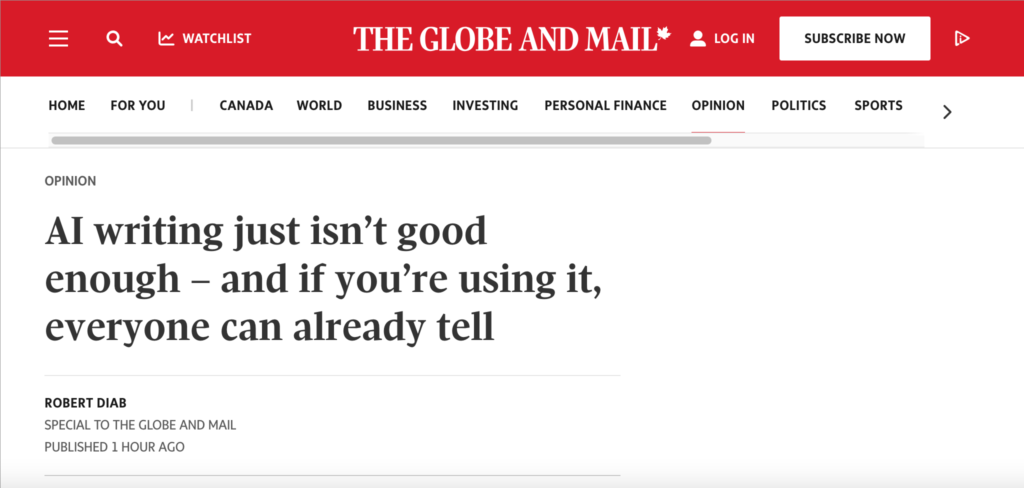
The current anti-AI talking points is that AI just makes everyone sound alike.
No, it doesn’t. It makes middle class people who see everything as a vending machine put no effort in, and get some clay.
AI is not a vending machine. Work with it, be honest and open, and AI gives you extraordinary output. I know because I use AI daily.
But my brain isn’t set on “safe” Vermögensgeist. It likes to live on the edge where it takes the dangerous leap into the future.
A more savvy column would have said, “If you do not invest in AI, AI won’t invest in you. No deposit, no return. If you do not invest the time, intellectual honesty, and the willingness to revise yourself, nothing you do will help you, not just AI.”
Google is the epitome of passive instant gratification. It homogenized thought, yet the columnist of this piece of sophistry doesn’t even notice. He doesn’t ask why everyone in his profession wears the same suit and tie, makes the same arguments, and say the same thing at cocktail parties as their LinkedIn profiles might as well have gone though a photocopier.
Search engines flattened curiosity long before AI; journalism adapted by shrinking attention spans and chasing sameness, and now that a new tool exposes that sameness, they blame the tool, not the training.
AI isn’t like any technology we ever had before, and a new kind of thinker will emerge, one that isn’t chained to Vermögensgeist.
The future won’t belong to the people who can spot AI; it will belong to the people who can out‑think it in public, and most of today’s anti‑AI gatekeepers have never once out‑thought anything.
By the way, how often have you come across the word Vermögensgeist? If you haven’t, thank my AI sparring partner Perplexity for that particular stroke of brilliance.