
The Washington Toast: Welcome to the Slow Slide

The newspaper industry has been defunct for a very long time. Many papers folded. Only a handful didn’t end up in the cold ground because they were national brands. Most newspapers ended up in the clutches of hedge funds and their assets were stripped.
The Washington Post was supposed to be above this, but today, comes a brutal drop.
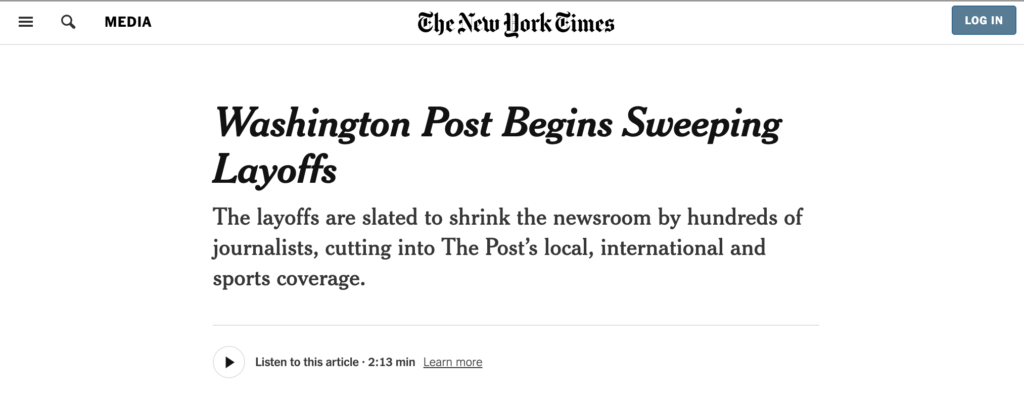
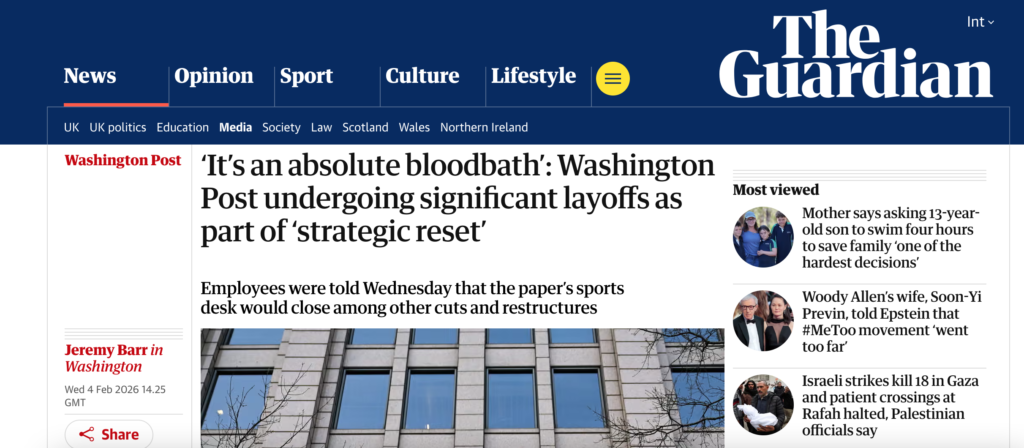
It is very likely that Jeff Bezos has gone into full Hedge Fund asset-stripping mode: cutting the workforce by one third and closing desks is usually how hedge funds operate. They sell assets and even real estate.
And by the looks of things, that’s the direction the WaPo is going.
I don’t believe this dismantling as anything to do with Donald Trump. He is a lame duck president at this point. However, the paper has lost big money and its subscriber base tanked and there is no going back. There is no need for Jeff Bezos to keep the Post at this point.
Yet, for a Big Tech Bro, he never brought in the Post into the Amazon ecosystem. No Kindle long reads. No Alexa reading headlines in real time from the Post. No Amazon Studio documentaries based on WaPo investigations. No WaPo subscription when you signed up for Prime. When he acquired Whole Foods, the grocery chain was immediately assimilated into the Amazon ecosystem. The same went for MGM with its IP.
No such integration happened with the Post.
Had this infrastructure happened a decade ago, adding AI to this mix would have been revolutionary.
Speaking of AI, here is Perplexity’s analysis of this lost opportunity: You can’t add AI to a gutted newsroom. You can’t build ecosystem habits with a demoralized staff and fleeing subscribers. You can’t innovate when you’re firing a third of your workforce and shutting down entire sections.
The Post that could have been an AI journalism pioneer is now just another stripped-down legacy outlet hoping to survive on politics coverage. The reporters who might have built something new are updating their LinkedIn profiles today.
He had a ten-year head start on everyone. He spent it doing nothing. And now the opportunity is gone — not just for him, but for demonstrating what journalism could become. That’s the real loss.
This is not a minor failure: it is catastrophic. The Washington Post could have taken journalism to different, if unconventional places (something I discussed at length in my book Radial Journalism), but it never happened.
And it’s a shame.
Tags: AI, Amazon, Artificial Intelligence, Benjamin Mullin, Donald Trump, Erik Wemple, Jeff Bezos, Jeremy Barr, Journalism, Katie Robertson, New York Post, New York Times, Perplexity, Radial Journalism, Rupert Murdoch, The Guardian, Washington Post