
Dossier: The Gender Gap in AI Entrepreneurship and the Doomerism Divide

Overview
Across the US, UK, and EU, women found a meaningfully larger share of startups by deal count than the share of capital they receive, and this “deal-to-dollar” gap is the clearest signal that funding, not founding activity, is the binding constraint. The data below focus specifically on Western markets and separate deal count (how many companies get funded) from funding value (how much capital flows to them), which is the distinction most useful for assessing whether women “aren’t pushing” into AI or whether capital allocation is filtering them out after they do.
United States: Record Dollars, Flat Deal Share
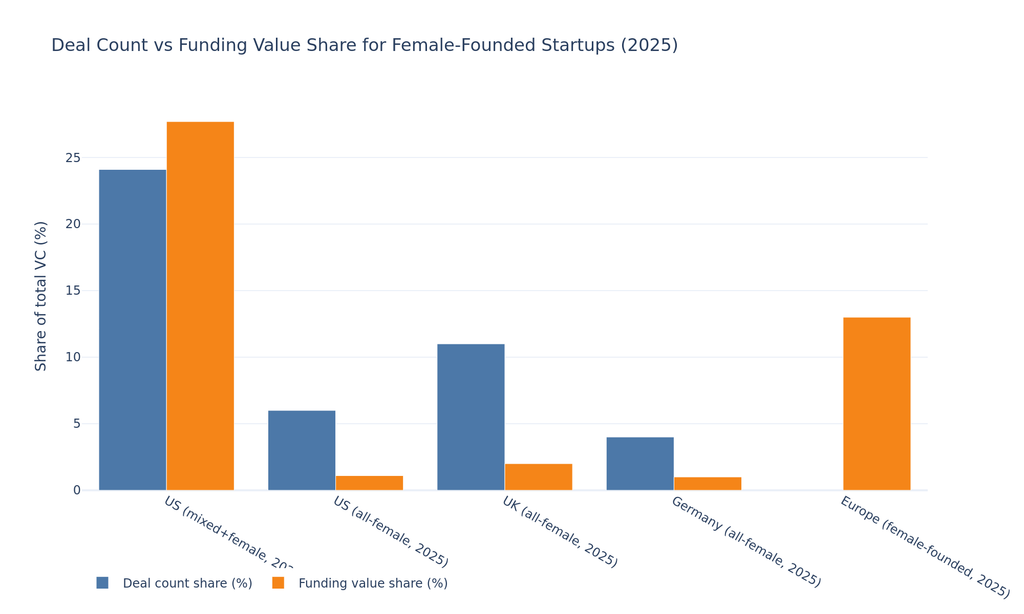
In 2025, US female-founded companies (including mixed-gender teams) raised a record 73.6 billion dollars, nearly double 2024, even as the total number of venture deals declined nationally. Female-founded companies captured 27.7% of total VC dollars in 2025, up sharply from 19.9% in 2024, but this was driven almost entirely by a small number of AI megadeals rather than broad-based gains. By deal count, female-founded startups (mixed and all-female combined) secured 24.1% of all US venture deals in 2025, down slightly from 25.7% in 2024 and only marginally above roughly 22% a decade earlier.
The picture is starkest for all-female founding teams specifically: they represented about 6% of US deals in 2025 but received only 1.1% of dollars, down from 2.1% in 2024, a figure that has “barely budged since 2008”. A separate analysis of comparable 2025 data corroborates this pattern, finding female-founded companies represented 6.4% of deals but just 2.3% of capital, with average deal size for female-only teams at 5.2 million dollars versus 11.7 million dollars for male-only teams, meaning women get funded about as often per company but at roughly half the check size.
| Market | Deal count share (female-founded) | Funding value share (female-founded) | Gap ratio |
|---|---|---|---|
| US, mixed+female teams, 2025 | 24.1% | 27.7% | ~1:1 (AI megadeal-driven) |
| US, all-female teams, 2025 | 6.0% | 1.1% | ~5.5x |
| US, all-female teams (alt. dataset), 2025 | 6.4% | 2.3% | ~2.8x |
| UK, all-female teams, 2025-26 | ~11% | 2-3%wcorporation+1 | ~4-5x |
| Germany, all-female teams, 2025 | 4% | 1% (as low as 0.6% regionally) | ~4x |
| Europe, female-founded (any), 2025 | n/a (1,307 companies) | 13% | — |
United Kingdom: A Persistent 2 Percent Ceiling
In the UK, all-female founding teams receive roughly 2 pence of every 1 pound of venture capital invested, a figure a dedicated funding tracker calls “the highest-return, lowest-cost economic intervention available” if closed. Longitudinal UK data show this has moved in the wrong direction: female founders received 2.5% of UK venture capital in 2023, falling to 2% in 2024, despite six years of voluntary diversity codes and awareness campaigns following the 2019 Rose Review. By deal count, female-led UK businesses reportedly deliver returns 35% higher than the market average, yet this performance has not translated into greater capital allocation, and Innovate UK has launched a dedicated 4.5 million pound “Women in Innovation” fund specifically because market mechanisms have not closed the gap on their own.
European Union: Modest Gains, Deal Count Still Small
Across Europe, 1,307 female-founded companies raised 1,376 funding rounds in 2025, an increase in absolute deal activity from the prior year, and female-founded companies captured a record 7.5 billion euros, the highest three-year figure, representing 13% of total European VC funding, up one percentage point from the prior year. Despite this, the article describing the data explicitly frames a one-point annual gain as “hardly a meaningful improvement,” noting the funding gap in Europe is not structurally closing even as absolute totals rise with the broader market. Country-level variation is wide: Finland allocates roughly 30% of its VC funding to female-founded companies, the highest in Europe, while the UK, France, and Germany together account for 71% of all European VC directed to female-founded companies, concentrating even the limited opportunity in a few markets. Germany’s national data are notably worse than the European average, all-male teams received about 91% of VC funding in 2025, and all-female teams, representing 4% of funded startups, received just 1% of investment nationally, and as low as 0.6% in some regions.
In deep tech and AI-adjacent sectors, a European Commission-linked report found women-founded deep-tech startups represent 17.4% of startups in the category but receive only 11.4% of total deep-tech funding, a smaller but still persistent gap than the all-sector average, suggesting technical/AI verticals are not necessarily worse than the EU baseline but are far from equitable.
Interpreting Deal Count vs. Funding Value
Across all three markets, the deal-count share for women is consistently 2 to 6 times larger than the funding-value share, meaning women are starting and getting initial backing for companies at rates that, while still low, are meaningfully higher than the proportion of total capital that follows those companies afterward. This gap most plausibly reflects under-investment in scaling and follow-on rounds rather than an unwillingness among women to found companies in the first place: US data show average check sizes for all-female teams running at less than half those for all-male teams, and Nordic data show mixed-gender team funding collapsing from 8.91 million to 4.65 million euros between 2024 and 2025 while women-only team averages barely moved, indicating volatility hits women-involved teams disproportionately hard even when they do get initial funding. Grant funding, non-dilutive support rather than equity investment, is filling some of this gap: in the Nordics, the share of women-only team rounds that were grants rather than VC equity jumped from 13% to 25% between 2024 and 2025, which the report frames as a sign that “equity investors aren’t stepping up” even as institutional grant-makers do.
The overall pattern across US, UK, and EU markets supports a specific version of the query’s thesis: women are not absent from AI and startup founding, but capital markets systematically under-fund the companies they do start relative to how often those companies get initial deals, and this dollar-level exclusion, more than any reluctance to found companies, is what limits women’s influence over how AI products and priorities get shaped in Western markets.
Leave a Reply