
What the Senate Committee on CBC Missed: A Methodological Reckoning

This article says nothing useful about this Senate report.
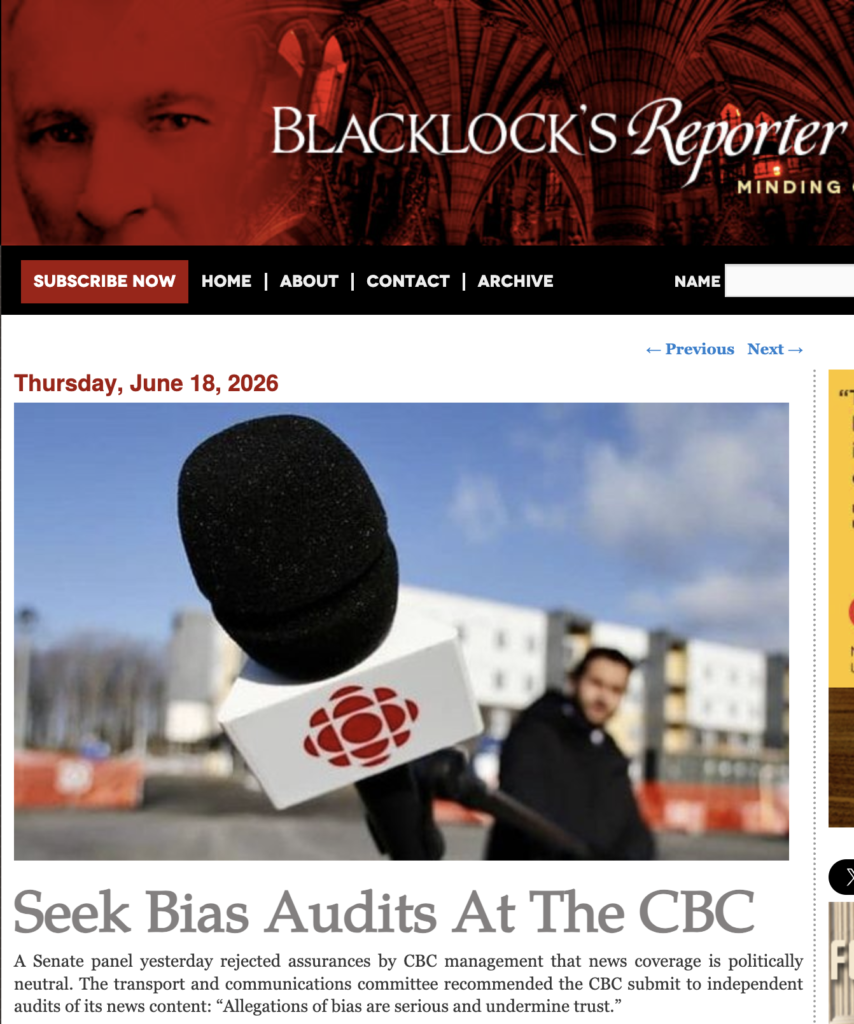
This one, too.

Consider a single sentence from the Standing Senate Committee on Transport and Communications’ June 2026 report on CBC/Radio-Canada, titled Local News Matters:
“That CBC/Radio-Canada periodically conduct analysis by outside experts of the news content and current affairs by CBC/Radio-Canada news services in order to assess its fairness and balance.”
That is Recommendation 5, the only concrete measure the committee proposed to address its concerns about bias in CBC journalism. One sentence. No definitions. No methodology. No criteria for who qualifies as an “expert.” No framework for what “fairness” or “balance” means as measurable constructs. No mechanism to prevent a future government from choosing “experts” whose conclusions are predetermined. No inter-rater reliability. No codebook. No transparency about standards.
This is not a bias-review protocol. It is a governance gesture dressed up as one.
The Methodological Vacuum at the Heart of the Report
The committee heard from approximately 60 witnesses across 10 public meetings between October 2024 and October 2025 and received 30 additional briefs. That is a significant evidentiary effort. And yet, on the central question that the report raises, whether CBC/Radio-Canada journalism is biased, and if so how, the committee’s treatment is epistemically empty.
The report acknowledges that “the issue of impartiality was raised by a few witnesses” and that “these allegations of bias are serious and undermine trust in the public broadcaster.” This is the entire evidentiary basis for Recommendation 5. Not a content analysis. Not a review of existing research on CBC coverage patterns. Not a systematic comparison of CBC output against other public broadcasters. Not even a definition of what “bias” means in a way that could be tested. The committee heard that some people feel CBC is biased, declared the feeling serious, and recommended that CBC commission unspecified experts to assess unspecified standards.
There is a word for this in research methodology. It is called circular. And there is another word for the governance architecture it produces. That word is vulnerability, specifically, to the substitution of political judgment for empirical judgment at the moment of hiring those “outside experts.”
Three Questions the Committee Never Asked
Any researcher or journalist who has worked with measurement, content analysis, or even basic social-science methodology will immediately identify the three questions the report failed to ask. They are not complicated questions. They are the foundational questions of any empirical inquiry.
First: What is bias?
Bias is not a self-evident property of a text. To be measured, it must be operationalized; that is, defined as a specific, observable pattern of content that a coder can identify, record, and have checked by another coder. Academic and applied traditions in media studies have developed multiple operationalizations:
- Agenda/selection bias: systematic over- or under-coverage of certain topics, actors, or communities relative to a defined baseline
- Source power bias: disproportionate reliance on official, institutional, or well-resourced sources relative to independent, adversarial, or community voices
- Framing bias: consistent use of narrative structures, problem definitions, or cause-attribution patterns that favour one interpretation before evidence is presented
- False balance: presentation of equivalent rhetorical weight to parties with fundamentally asymmetric evidentiary or institutional standing
- Language asymmetry: differential use of doubt-implying terms (“claims,” “alleges”) versus assertion terms (“states,” “said”) across parties
Not one of these distinctions appears in the Senate report. “Bias” is used as if its meaning were obvious, shared, and uncontested. It is none of those things.
Second: Who qualifies as an “expert”?
Expertise in media-bias assessment is not a monolithic credential. A computational linguist who can run sentiment models across a corpus may have no knowledge of Canadian broadcasting law or political context. A political communications scholar steeped in party-system dynamics may have no capacity for large-scale NLP-based content analysis. A journalism ethics professor may understand framing but lack statistical training. “Expert” means different things in different methodological traditions, and those traditions do not always agree.
More critically: expertise is not independence. The mechanism by which “outside experts” are selected, compensated, mandated, and insulated from political pressure is entirely absent from Recommendation 5. The history of expert panels in Canadian public policy is a history of captured processes, not because experts are individually dishonest, but because selection criteria, scope of work, and interpretive authority are always defined by someone with institutional interests. The committee provided no protection against this.
Third: How do you know when two coders looking at the same story are measuring the same thing?
This is the inter-rater reliability question, and it is the one that most sharply distinguishes scientific from intuitive assessment. When coders independently code the same texts and disagree, that disagreement is not a problem to be resolved by consensus or seniority, it is a diagnostic signal that the construct is either underspecified or genuinely contested. The standard measure, Cohen’s kappa (κ), corrects for chance agreement and provides a benchmark: κ ≥ 0.70 is the widely accepted minimum for publishable content-analysis research.
The Senate report contains no mention of inter-rater reliability, kappa, codebooks, calibration sessions, or any other reliability procedure. This means that whatever “outside experts” eventually produce under Recommendation 5 will be unverifiable. It cannot be challenged on methodological grounds because no methodology was specified. It cannot be replicated. It cannot be checked. It is, in the most precise sense, not a scientific finding, it is an opinion with institutional backing.
The Problem the Committee Also Missed: Structural Bias Is Not Ideological Bias
The most revealing absence in the report is not a missing statistical method. It is a missing conceptual category.
The committee’s concern with bias is overwhelmingly about ideological or partisan leaning, the idea that CBC covers certain parties, positions, or communities more sympathetically than others. This is a legitimate research question. But it is not the deepest or most consequential form of bias in journalism, and it is not the form most amenable to meaningful reform.
Structural bias: the systematic amplification of powerful, well-resourced, media-trained, and legally protected voices at the expense of those without institutional backing, is prior to ideological bias. A story can contain accurate quotes from all parties and still be structurally biased if:
- One party arrived at the story with a PR firm, a crisis communications team, and rehearsed messaging while the other arrived terrified, inexperienced, and unrepresented
- One party had legal counsel capable of threatening litigation or enforcing NDAs that constrained what could be said on the record
- One party’s narrative entered the story pre-packaged in a press release that the journalist largely transmitted rather than interrogated
- The story imposed a binary “both sides” frame on a situation in which the parties were structurally unequal, implying equivalence where there was hierarchy
These are not questions about whether the journalist liked one party more than another. They are questions about the invisible scaffolding that shapes what gets said, by whom, in what language, with what credibility signals, before a single editorial judgment is made. They are measurable. They are codeable. They are researchable. And the Senate committee did not ask a single question about any of them.
What a Research-Grade Instrument Actually Looks Like
The contrast between the committee’s Recommendation 5 and what genuine empirical bias review requires can be made concrete.
A research-grade media bias coding instrument includes, at minimum:
- Operational definitions for every construct, definitions specific enough that two independent coders, working from the same codebook, will make the same classification at a rate exceeding chance
- An ordinal or categorical scale with anchored descriptions for each level, so coders are not making free-floating judgments but selecting from defined options
- Mandatory evidence fields for significant codes, requiring coders to record the specific passage, source name, or document that supports their rating, making the code traceable and challengeable
- Inter-rater reliability procedures, including a calibration sample (typically ≥20% of the corpus coded by at least two independent coders), reliability statistics (Cohen’s κ for two coders, Krippendorff’s α for more), and a process for resolving disagreements through adjudication rather than averaging
- A codebook: a document that defines every construct, provides decision rules, worked examples, and borderline cases, so that coding decisions can be standardized, reproduced, and critiqued
- Pre-registration of constructs and procedures before coding begins, to prevent post-hoc redefinition of what counts as “bias” based on the results
None of this is exotic. It is standard content-analysis methodology, documented across decades of communication research and taught in any graduate-level research methods course. The NIST framework for managing bias in AI systems, the most current benchmark for bias operationalization in complex systems, similarly insists on multi-layered construct definitions, measurement standards, and transparent documentation. The tools exist. The standards exist. The committee simply did not use them, recommend them, or appear to know they existed.
The AI Dimension: A Conspicuous Absence
There is one further absence worth naming explicitly: the Senate committee’s report contains no mention of artificial intelligence, machine learning, or computational text analysis as tools for bias assessment.
This is not a minor omission. Large-scale bias assessment, the kind that would be necessary to evaluate a national public broadcaster’s entire output across television, radio, and digital platforms, is precisely the domain where AI-assisted corpus analysis can provide traction that human expert review cannot. NLP-based framing detection, sentiment analysis, source classification, and topic modelling can process thousands of stories in the time it would take a panel of “outside experts” to code a handful. The results are auditable, reproducible, and can be challenged on technical grounds that are transparent to the research community.
The committee that was tasked with assessing a 21st-century digital broadcasting corporation in the context of a “changing media ecosystem”, their own language, produced a recommendation that could have been written in 1975. Ask some experts. Hope for the best.
A Diagnostic Observation
The gap between what the Senate committee proposed and what rigorous media-bias research looks like is not primarily a gap of resources or time. It is a gap of epistemological literacy: an inability to distinguish between “I believe this is biased” and “I have a falsifiable, testable, methodologically sound instrument for assessing whether this is biased.”
That gap has consequences. A bias review conducted under Recommendation 5’s vague terms will not produce scientific findings. It will produce politically usable findings, conclusions that can be claimed as authoritative because “outside experts” produced them, while being entirely insulated from methodological challenge because no methodology was specified. This is not an accident of drafting. It is the structural affordance of vague governance language: it creates the appearance of empirical accountability while preserving the reality of political discretion.
Researchers and journalists who work with measurement, evidence, and the ethics of representation already know this. The question is whether anyone in the institutions that shape media oversight, parliaments, regulators, broadcasters, editorial boards, has the methodological vocabulary to name it.
The tools to do better have existed for decades. They were not difficult to build. They were simply never asked for by the people with the authority to commission them.
Oh, and by the way, I built it. It is free to use. No senate committee or their budget, either. Enjoy.
The Media Bias Structural Coding Instrument (MBSCI v1.0), an operationalized, research-grade coding protocol developed in direct response to the methodological void in the Senate committee’s recommendations, is available as a free, open tool with 24 coded items across four domains (sourcing, power asymmetry, framing, and transparency), full codebook, inter-rater reliability controls, and JSON export.
Tags: Alexandra Kitty, Blacklock’s Reporter, Canada, CBC, David M. Wells, Dawn Arnold, Donna Dasko, Duncan Wilson, Fabian Manning, Farah Mohamed, Globe and Mail, Jim Quinn, Journalism, Julie MivilleDechêne, Marie Woolf, Paula Simons, Réjean Aucoin, René Cormier, Todd Lewis