
How Elites Consolidate Power and Manipulate Narratives: A Dossier

Executive Summary
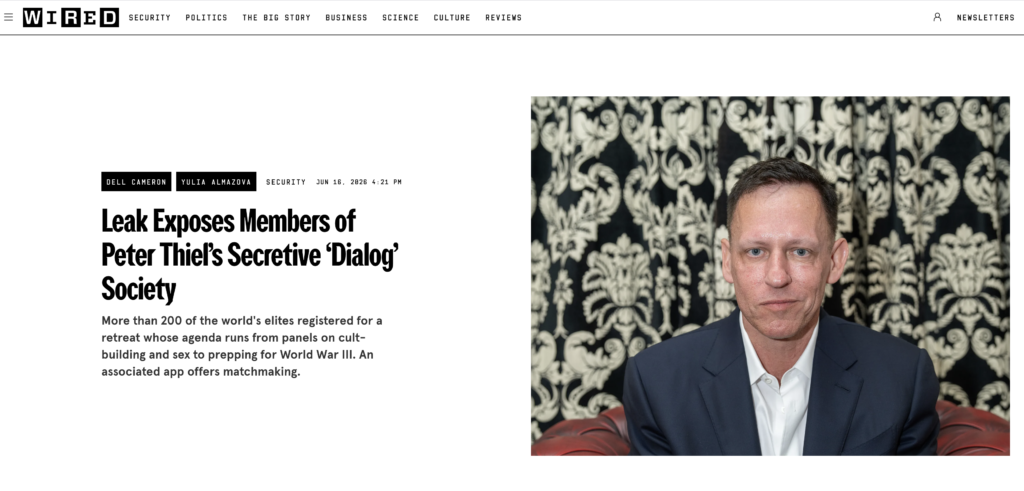
Elite power consolidation is not a conspiracy, it is a structurally observable, academically well-documented process through which small networks of interconnected individuals leverage institutional position, capital, social bonds, and information control to perpetuate influence across generations and sectors. Narrative manipulation is the soft-power complement to structural control: where direct coercion is too visible, manufactured consent, Overton Window management, and cultural hegemony do the work. The Peter Thiel-founded Dialog society, whose membership leaked in June 2026, is a textbook live case of these mechanisms operating in real time.
Part I: The Architecture of Elite Power
The Power Elite: A Structural Overview
C. Wright Mills’ foundational 1956 work The Power Elite established the theoretical framework still used today: a small, interconnected group occupying the commanding heights of corporate, military, and political institutions exercises decisive influence over social outcomes. Elite theory in its contemporary form holds that power flows “predominantly in a top-down direction from elites to non-elites,” and that elites’ characteristics and actions are “crucial determinants of major political and social outcomes”. Critically, this power is exercised not merely through formal political office but through positions in corporations, influence over policymaking networks, financial control of foundations, and placement in think tanks and policy-discussion groups.
The basic architecture has four interlocking features:
- Concentration: Power pools at the top in relatively small circles
- Unification: Elites are internally cohesive, despite surface-level political disagreements
- Diversity of the non-elite: Those outside the circle are fragmented and relatively powerless
- Institutional legitimation: Power derives from institutional position, which is itself controlled by existing elites
Modern quantitative research reinforces this model. A study of Denmark’s power elite found that half its 423 most powerful individuals matched the profile of technocrats sharing a “near-consensus on progressive managerialism, paternalistic elitism and centrist pragmatism”. Swiss longitudinal research tracking elite networks from 1910 to 2015 found that after fragmenting slightly in the postwar era, the elite core had by 2015 returned to pre-World War I levels of corporate domination, a “return to the past” echoing patterns in wealth inequality.
Hyper-Elites and Network Topology
At the very top sits what researchers call the “hyper-elite”, the top 0.05% of most influential individuals, whose global networks function as the primary mechanism for attaining and maintaining power. Research shows that the critical dimensions of elite network power are not just size but also quality and diversity of ties: hyper-elites build relationships across sectors precisely to capture resources from multiple institutional fields simultaneously. Social class and inherited economic and social capital significantly influence the persistence of power control over time.
This maps directly onto Pierre Bourdieu’s theory of social reproduction, which identifies three interlocking capital forms, economic (financial resources), social (network relationships), and cultural (education, taste, credentialed knowledge), that elite families pass across generations. The key insight is that cultural capital functions as a laundering mechanism: raw inherited wealth is converted into educational credentials, institutional prestige, and epistemic authority, making power appear meritocratic rather than inherited.
Part II: The Mechanics of Power Consolidation
1. Private Networks and Off-the-Record Coordination
Private retreats and invitation-only societies are one of the oldest and most durable consolidation mechanisms. The Bohemian Club (founded 1872) has hosted every Republican US president since Eisenhower alongside corporate chiefs, military officials, and media executives. The Bilderberg Group and the World Economic Forum serve equivalent functions at the international level.
Dialog, the network co-founded by Peter Thiel and Auren Hoffman, represents the current generation of such structures. The leaked 2026 retreat list names NATO’s supreme allied commander Europe, sitting Trump administration officials, two US senators, a former Middle East chief of intelligence, a sitting US ambassador, and the founders and directors of the country’s largest surveillance, data-broker, and advertising-data firms. These executives sit side by side with senior officials directly overseeing their industries, including the Treasury Secretary and the Senate committee chair responsible for FTC oversight.
Dialog is explicitly designed to stay off the public record: its leadership maintains secrecy, members use personal rather than government email addresses (sidestepping public-records law and FOIA), and a participant described the network’s purpose as giving “global elites” space to “engage in open discussions… free from… the demands of their stakeholders”. Dialog is also planning a permanent campus in suburban Virginia specifically to maintain an active presence in Washington beyond any single administration, an explicit bid for continuity of access regardless of electoral cycles.
2. The Revolving Door
The “revolving door”, the movement of individuals between government roles and the private sector, is one of the most studied and robust mechanisms of elite consolidation. Research on US lobbyists shows that lobbyists with experience in a Senator’s office suffer a 24% drop in revenue the moment that Senator leaves office, demonstrating that what is being sold is not expertise but personal access to power. Movements through the revolving door are a “much better indicator of successful [regulatory] capture than the amounts of money directly spent on lobbying”.
The practical effect is that regulated industries supply the regulators. Since expertise in any regulated field is concentrated in those who have worked in that field, regulatory bodies draw their personnel from former industry employees, creating systematic conflicts of interest that are largely invisible because they operate through career incentives rather than explicit bribes.
3. Think Tanks and the Laundering of Elite Interests
Think tanks occupy a pivotal position in the power consolidation architecture because they convert raw economic and political interests into the legitimated currency of expert knowledge. Research shows that think tanks headed by political elites and backed by philanthropic funding “work strategically to influence the inception, development and implementation” of major policies, in one documented case (Common Core State Standards), a nominally “state-led” reform was actually driven by private think tank networks.
The mechanism is laundering: a billionaire’s preferred policy cannot be introduced as “what I, the billionaire, want.” It must be repackaged as “what the evidence shows,” attributed to credentialed experts in a research institution that appears independent. The Konrad-Adenauer-Stiftung research on US think tanks notes that “the strategy and structure of a think tank often influences the type of policy output it produces and what stage in the policy process it chooses to focus its attention”, i.e., the conclusion is often baked in at the funding stage.
4. Dark Money and Political Finance
Post-Citizens United, so-called dark money, funds from groups not required to disclose donors, has poured more than $1 billion into US federal elections since 2010. Without transparency, voters cannot identify who is trying to influence them. The practical effect is that elite preferences can be injected directly into electoral and judicial processes at scale, with full plausible deniability. Research on campaign finance shows that political elites “no longer have the formal power to choose, and yet they still choose”, through informal financial mechanisms operating outside publicly visible channels.
5. Regulatory Capture and Elite Network Formalization
Network analysis research establishes that elite networks between politicians and top corporate executives build trust and loyalty through long-term personal ties, creating mutual benefit arrangements in which politicians stay in power and executives extract rents for their firms. These networks are not peripheral to inequality; one book-length study argues they are “not an artifact of a particular economic system, but a man-made phenomenon rooted deeply within the, often violent, quest for political power”.
Part III: Narrative Manipulation: The Soft-Power Toolkit
Manufacturing Consent: The Structural Propaganda Model
Chomsky and Herman’s Manufacturing Consent (1988) remains the most rigorously specified model of how elite narrative control operates in formally “free” media systems. The model identifies five structural filters through which media output is systematically biased toward elite interests, without direct censorship, editorial mandate, or conspiracy:
The critical insight is that the model does not require conspiracy. Structural constraints produce systematic output bias without any individual journalist needing to be corrupt. As Chomsky puts it, “those who do not internalize [the acceptable message range]… will not last long”.
Media Ownership Concentration
The structural filter of ownership is intensifying. Scholarly research shows that media ownership concentration “controls editorial boards and newsrooms, curtails content diversity, marginalises less popular and expensive content”. When a small group of economic elites controls mass media, they “effectively monopolize the channels through which information circulates in society”, shaping not just what is covered but how it is framed. Media consolidation has created an oligopoly of media conglomerates, and crucially, “digitalisation has not counterbalanced power relations in society at large; rather, digital communication platforms reflect and replicate dominant media structures”.
Controlling the Overton Window
The Overton Window is the range of ideas deemed politically acceptable to mainstream audiences at any given time. The key strategic insight, widely understood and deployed by elites, is that politicians do not shift the window; they detect it and move within it. The window is shifted by think tanks, media figures, and organized movements that normalize ideas through repetition, reframing, and the strategic introduction of more extreme positions to make previously radical ideas seem moderate by comparison.
This is directly operational: the same organizations that fund think tanks, own media, and convene private retreats are also engaged in deliberate Overton Window management — introducing ideas at retreats like Dialog, funding think tanks to legitimize them, and using owned or friendly media platforms to normalize them.
Gramsci’s Cultural Hegemony
Antonio Gramsci’s concept of cultural hegemony provides the deeper theoretical account: elites maintain dominance not primarily through coercion but by establishing a worldview that dominates public imagination, making their interests appear as the natural order. Control of the narrative is control of the field of thinkable solutions. The aspiring challenger must “recapture this cultural hegemony, or the narrative, in modern parlance” to displace existing power.
Bourdieu extended this to show how cultural institutions (universities, press, art worlds) function as sites where “symbolic power”, the power to define what counts as legitimate knowledge, taste, and expertise, is continuously reproduced in ways that systematically advantage those who already possess the right cultural capital.
Elite Capture of Dissent
One of the most sophisticated and underappreciated mechanisms is the co-optation of radical critique, what philosopher Olúfẹ́mi O. Táíwò calls elite capture. A political concept grounded in liberation, identity politics, for example, can be stripped of its political substance when elites adopt its language while abandoning its structural demands. The result is that radical critique is neutralized by absorption: its vocabulary survives while its challenge to power is defused.
The Wikipedia definition frames it more bluntly: elite capture is “a form of corruption whereby public resources are biased on the benefit of a few individuals of superior social status”. At scale, the mechanism operates across civil society, NGOs, reform movements, and media: the most credentialed, connected, and well-funded voices within any reform coalition tend to be absorbed into existing power structures, while the more genuinely threatening elements are marginalized.
Part IV: The 21st-Century Upgrade: Surveillance Capitalism and Technofeudalism
Behavioral Modification at Scale
Shoshana Zuboff’s The Age of Surveillance Capitalism (2019) identifies a qualitatively new form of elite power: the unilateral claiming of human experience as raw material for extraction, prediction, and behavioral modification. Surveillance capitalism “unilaterally claims human experience as free raw material for translation into behavioural data… fabricated into prediction products that anticipate what you will do now, soon, and later”. These predictions are traded in what Zuboff calls “behavioural futures markets”, creating an unprecedented form of power “marked by extreme concentrations of knowledge and free from democratic oversight”.
The consequence is that narrative manipulation has been upgraded from a broadcast model (pushing messages at passive audiences) to a closed-loop behavioral modification model: algorithms trained on personal data not only predict but shape behavior, engineering the conditions under which opinions form. Big Tech companies like Google and Meta are the primary architects, but the surveillance infrastructure they built now serves a much broader ecosystem of political and commercial actors.
Authoritarian Informationalism
Recent scholarship identifies a broader paradigm shift: what researchers call authoritarian informationalism, the effective interplay between offline and online tactics to escalate surveillance, manipulation, and information control. Key characteristics include: (1) an expansion of actors from states to private entities and individuals; (2) increased precision, moving from reactive to pre-emptive and fine-grained control; and (3) broader scope, extending from local and national to transnational domains. This represents a shift from “visible, repressive coercion towards more covert, preventive, and targeted forms of digital repression”.
Oxford Internet Institute research documented organized social media manipulation campaigns in 81 countries, with governments, PR firms, and political parties producing disinformation “on an industrial scale”, with more than 93% of surveyed countries deploying disinformation as part of political communication. The manipulation has become professionalized, with governments spending millions on “cyber troops” who drown out dissent.
Technofeudalism and Network State Ideology
Economist Yanis Varoufakis argues that surveillance capitalism represents not just an upgrade of existing capitalism but its replacement by a new form of feudalism: technofeudalism. Tech giants own not just companies but cloud capital, the networked algorithmic infrastructure through which all economic and social activity now flows. Users become “cloud serfs” who hand over behavioral data in exchange for access to digital infrastructure they cannot practically function without.
The political ideology rationalizing this arrangement is explicit within Thiel’s circle. The Sovereign Individual (1997), a text Peter Thiel endorsed, wrote the preface for, and that circulates as an unofficial Silicon Valley manifesto, argues that information technology will fracture nation-states and that a “cognitive elite” of technologically sovereign individuals should organize themselves to “capitalize on the opportunities of the new age while avoiding its destructive impacts”. Balaji Srinivasan’s The Network State (2022), which Thiel’s network helped popularize, translates this into operational terms: decentralized online communities acquire physical territories and ultimately operate as private states, governed on corporate rather than democratic models.
Dialog’s planned Washington D.C.-area campus, intended to maintain presence “beyond this administration”, fits squarely within this ideology of building parallel governance infrastructure.
Part V: The Dialog Society as Structural Case Study
The Dialog leak is instructive precisely because it is not an anomaly but a window into normal operating procedure. Applying the frameworks above:
The operational sloppiness, hard-coded member directories, exposed registration data — undercuts the public performance of elite competence, but also reveals a deeper assumption: that the consequences of exposure are manageable, because the mechanisms being exposed are not formally illegal and the actors involved are wealthy enough to weather public scrutiny.
Analytical Synthesis: How It All Fits Together
The different mechanisms described above are not independent, they form an integrated system. Bourdieu’s capital forms explain how elite status is reproduced at the individual and family level. Mills’ institutional analysis explains where power is concentrated. Chomsky and Herman’s propaganda model explains how that power shapes public discourse. Gramsci’s hegemony concept explains why the dominated accept their subordination. Zuboff’s surveillance capitalism framework explains how the 21st-century upgrade makes behavioral modification invisible and pervasive. Varoufakis’s technofeudalism concept explains where the endpoint trajectory leads.
The key systemic feature is self-reinforcement: each mechanism strengthens the others. Private networks produce policy preferences that think tanks legitimize, which media (whose owners are in the networks) normalize, which regulators (who rotate through industry) implement, which surveillance systems (owned by network members) enforce and optimize. The cycle closes.
What makes the current moment distinctive is the fusion of surveillance infrastructure with ideological intent: the same networks that coordinate policy at retreats like Dialog also own the platforms that shape public perception, the data brokers that profile individual citizens, and the AI systems that will increasingly mediate all access to information and services. The question of who controls the infrastructure through which reality is filtered has never been more consequential.
Implications for Researchers and Analysts
For anyone working in media criticism, journalism ethics, behavioral analysis, or systems research, several analytical heuristics follow from this:
- Follow the networks, not just the institutions. Formal positions (senator, CEO) are less informative than network position, who attends what retreats with whom.
- Distinguish structural from conspiratorial explanations. The propaganda model works without conspiracy; structural constraints produce systematic outcomes.
- Identify the meta-narrative, not just the content. Narrative manipulation is most powerful not when it controls specific stories but when it defines the range of speakable stories, the Overton Window level.
- Track capital conversion. The most powerful actors are those who can convert economic capital into cultural legitimacy, which converts into political influence, which protects economic capital, and then back.
- Watch for elite capture of reform. When power structures adopt the language of their critics, examine whether the structural challenge has been preserved or neutralized.
- Attend to infrastructure ownership. In the 21st century, whoever controls the digital stack, cloud infrastructure, algorithmic recommendation, data brokerage, controls the default epistemic environment for everyone who uses it.
Additional Research from Perplexity