
The Collapse of the Last Honest Room: Scott Pelley, Nick Bilton, and the Murder of 60 Minutes

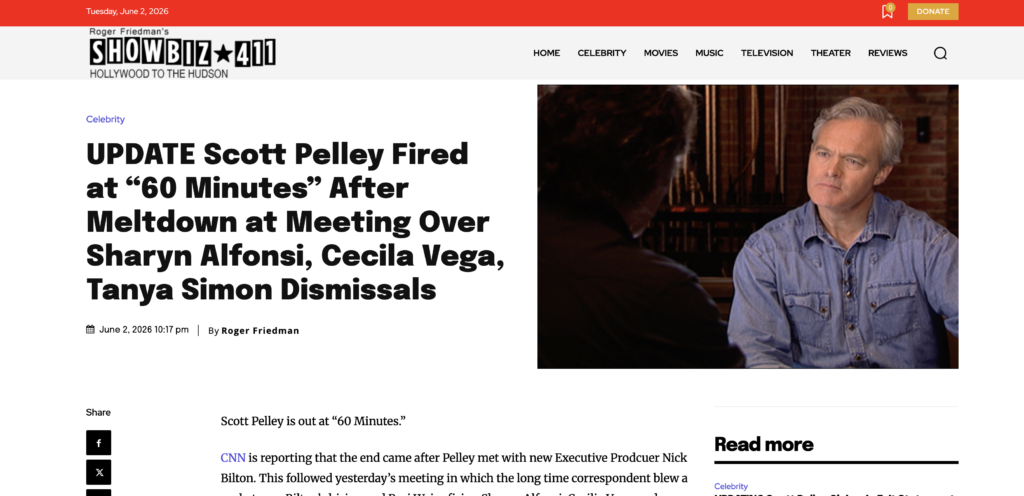
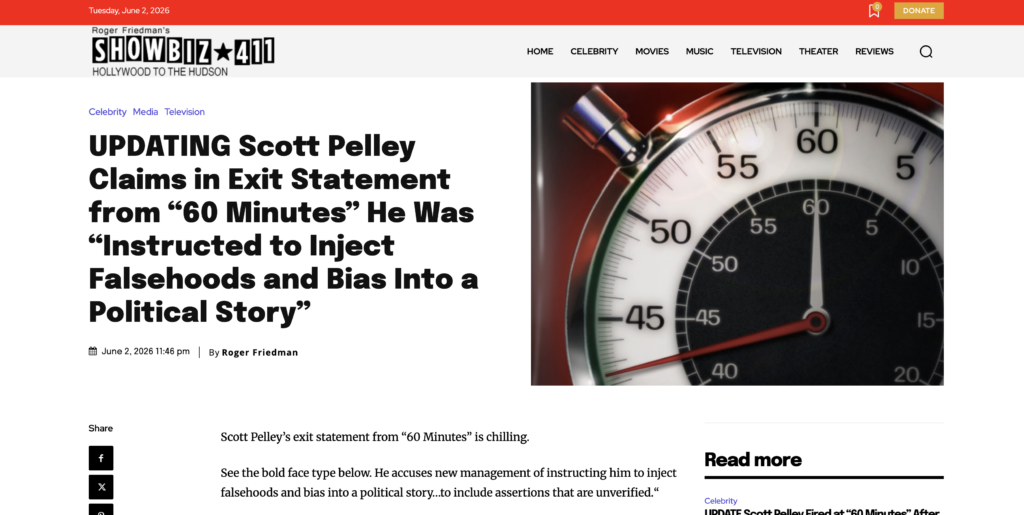
There is a difference between leaving and being expelled. Scott Pelley was expelled, fired “for cause” from the program he had served for 37 years after doing the single thing a real journalist is supposed to do: tell the truth in public, at personal cost, when the institution he loved was being systematically dismantled around him.
That is not a meltdown. That is the job.
The Last Correspondent Standing
Scott Pelley joined CBS in 1989 and spent decades building the kind of career most journalists can only dream about. He anchored the CBS Evening News from 2011 to 2017, adding 1.5 million viewers in the process, and returned to 60 Minutes as a correspondent with three decades of hard-won institutional authority behind him. His body of work includes some of the program’s most consequential investigations, the kind of reporting that went on the air because he checked, double-checked, and refused to be pushed around by editors who wanted convenience over truth.
When the entire senior leadership of 60 Minutes was fired, executive producer Tanya Simon, a 30-year veteran of the program; and correspondents Sharyn Alfonsi and Cecilia Vega, in a single sweep that CBS staff called “Black Thursday,” Pelley did not file a quiet complaint through HR. He walked into a room and said exactly what was happening, out loud, on record, with his job on the line. Vega confirmed publicly she had been fired and that her contract did not expire until March 2027, meaning she was terminated mid-contract. Alfonsi’s contract was simply not renewed. Simon, who had made history as the first female executive producer in the show’s history, was gone too.
Pelley called it what it was: murder.
“She is murdering ’60 Minutes,’” he told new executive producer Nick Bilton at a staff meeting, his voice audibly trembling on the recording obtained by multiple outlets. “She does not care for this place. She was brought in to kill it, and she has been doing just that.”
He then published his exit statement, the most important piece of journalism criticism to come out of American broadcast media in years.
The Statement That Matters
In his exit statement, Pelley laid out what had been happening inside 60 Minutes with methodical, documented precision. The critical passage deserves to be read in full, because it does something most journalists in his position never do: it makes a specific, falsifiable, career-ending allegation:
“New management has instructed me to inject falsehoods and bias into a politically sensitive story. I’ve been told to include assertions that are unverified. To date, in every case, I have managed to ignore these instructions or refuse them. Recently, politicians have been invited to choose correspondents for interviews on the broadcast.”
Read that again. A 37-year CBS veteran is not alleging vague editorial pressure or a shift in tone. He is alleging that his editors directed him to include unverified assertions in a political story, and that politicians were being given the power to select which correspondents would interview them. That is not a journalism problem. That is a state-capture problem.
To be blunt, that is propaganda.
Pelley also documented operational chaos: in one case, he wrote, “the entire program came within 19 minutes of not getting on the air at all.” He then placed the larger context in unsparing terms: “The new owner of our network is casting this legend aside, apparently to curry a moment of favor with the Trump administration.”
This is a man with nothing left to lose professionally, and everything left to protect editorially. His statement is a primary source document. It should be archived. It will be cited for years.
Nick Bilton’s Résumé and What It Tells You
CBS News editor-in-chief Bari Weiss appointed Nick Bilton as executive producer of 60 Minutes on May 28, 2026, making him the fifth person to hold the title in the program’s 58-year history and, crucially, the first to come from entirely outside television news.
Bilton is not an unknown. He is a technology journalist and author who worked at The New York Times from 2003 to 2016 as a design editor, R&D researcher, and eventually a technology columnist. He wrote the Twitter origin book Hatching Twitter (2013), American Kingpin (2017) about the Silk Road, and directed the 2021 HBO documentary Fake Famous about influencer culture. He is a writer for a forthcoming Martin Scorsese film. His highest television writing credit before 60 Minutes was as one of three staff writers on HBO’s garbage-fest The Idol, the show that Bilton’s own Wikipedia entry notes was “marketed as ‘the sleaziest love story in all of Hollywood,’” subsequently criticized as “sexual torture porn,” and canceled after five episodes.
That is the résumé. By any honest accounting, it does not qualify a person to run the most-watched news program in America, a program with 51 consecutive seasons as the top-rated news broadcast, which had just grown by an unheard-of 9% in viewership in its last season under the old leadership.
What Bilton’s background signals is not a commitment to journalism. It is a commitment to a different editorial philosophy, one oriented toward digital audience metrics, influencer culture, tech-world disruption narratives, and branded storytelling. Those skills are not required to hold the line at a program whose entire value proposition is institutional accountability.
The Bilton Letter: A Masterclass in Managerial Ego
When Pelley refused to be quietly absorbed into the new order, Bilton fired him, and wrote a letter to explain himself. The letter reads:
“Despite yesterday’s misconduct, I had hoped that in sitting down with you today we could find a path forward together. You made clear that you are not interested in such a path. Your antipathy to the future of the show has come through loud and clear. And I have heard you. I therefore write on behalf of CBS News, Inc. to inform you that your employment with CBS is terminated for cause effective immediately.”
This letter deserves scrutiny, because it is a precise document of ego over judgment.
Bilton had options. He could have said nothing publicly and let the firing speak for itself. He could have acknowledged a professional disagreement and parted ways with language that preserved both parties’ dignity. He could have simply stated that Pelley’s contract was being terminated, offered no further comment, and denied the story oxygen. These are all things experienced media executives do routinely.
Instead, Bilton chose to characterize Pelley, 37-year CBS veteran, former CBS Evening News anchor, multiple Emmy and Peabody winner, as a bad employee with “antipathy to the future of the show.” He invoked the word “misconduct.” He framed a journalist objecting to editorial corruption as a disciplinary matter. He did all of this in writing, on record, in a letter that was immediately leaked to CNN, the network’s corporate cousin under the same Ellison ownership umbrella.
The patronizing phrase “I have heard you” is particularly revealing. It is the language of someone who has confused authority with understanding. Bilton has heard Pelley in the same sense a wall hears music. The content is irrelevant; what matters is that the noise has been registered and suppressed.
The letter tells you more about Bilton than his résumé does. It is the work of someone who believes that seniority is insubordination and that loyalty to editorial standards is “antipathy to the future.” It is the work of someone who arrived at his first staff meeting at the most storied newsmagazine in American broadcasting and interpreted a veteran correspondent’s principled objection as an HR problem to be managed.
What Bari Weiss Built
To understand the Pelley firing, you have to understand what Bari Weiss has been building since she was appointed editor-in-chief of CBS News in October 2025, an appointment that itself came from Paramount acquiring The Free Press, her publication.
Weiss came in with a mandate she described as correcting “elite bias” and bringing “woke” culture to heel. Her January 2026 staff meeting outlined a strategy of adding 18 paid commentators, targeting employees who did not share her vision, and recruiting conservative podcasters, including associates of RFK Jr.. By May 2026 she had pulled a 60 Minutes segment on torture in El Salvador off the air, a segment Alfonsi had reported, and replaced the program’s entire senior leadership in a single day.
Meanwhile, the larger corporate context is impossible to separate from the editorial one. Larry Ellison’s Paramount Skydance, which owns CBS, was seeking Trump administration approval for its $111 billion takeover of Warner Bros. Discovery, which would also bring CNN under the same corporate umbrella. Press freedom organizations demanded to see internal documents amid allegations that the company promised favors to the White House to win regulatory approval. Pelley’s statement that the new owner is acting “apparently to curry a moment of favor with the Trump administration” is not conjecture. It is a hypothesis supported by documented corporate behavior.
Sharyn Alfonsi, who was fired when her contract expired and CBS chose not to renew it, had been behind the El Salvador torture segment that Weiss killed. Cecilia Vega was fired mid-contract. Tanya Simon, the first woman ever to run 60 Minutes, who had been at the program for 30 years, was removed along with them.
Three women. One day. Zero cause.
The Legacy Being Destroyed
60 Minutes was created in 1968 by Don Hewitt, who ran it for 36 years under a single governing editorial principle: “Tell me a story”, meaning, find something true, make it human, make it matter. Under Hewitt, 60 Minutes became the only news program ever rated as the nation’s top-ranked television program, which it accomplished five times. It remained the most-watched news program in America for 51 consecutive seasons through 2025, closing its most recent full season before the purge with 8.32 million average viewers per episode.
That is not a program in decline. That is not a program in need of rescue by a tech journalist who produced an HBO show about Instagram influencers. That is the most consistently successful news program in American broadcast history, being handed to someone who has never run a newsroom, never worked in television news, and whose only prior television writing credit was on a canceled prestige disaster.
Scott Pelley understood what was at stake because he was one of the custodians of this legacy. In a foreword he had written for the memoir of 60 Minutes‘ founder, he warned: “The scales of justice tilt toward the powerful.” The line was prophetic. He did not know he would be its subject.
Why This Is the Collapse
There is a pattern in the destruction of journalism institutions, and it is not subtle once you have seen it. It works like this: bring in an outsider with no institutional knowledge, give them the authority to fire the people whose institutional knowledge threatens their mandate, and then characterize any resistance as ego, insubordination, or an “antipathy to the future.” Frame loyalty to standards as inflexibility. Frame accountability as grievance.
Nick Bilton’s letter to Pelley is this pattern in miniature. Bari Weiss’s tenure at CBS News is this pattern at institutional scale. And the Ellison-Paramount corporate strategy, pursuing regulatory approval for the largest media consolidation in recent American history while simultaneously clearing out the journalists most likely to cover that consolidation critically, is this pattern at civilizational scale.
Pelley said the “leadership of 60 Minutes is no longer recognizable.” He’s right. But the more important point is what made it recognizable in the first place. What made 60 Minutes the gold standard of American broadcast journalism for nearly six decades was not a format, not a stopwatch, not a tick-tick-tick clock. It was the institutional commitment to the belief that the powerful should fear the questions, not choose who asks them.
That commitment is gone. The man who held it longest was fired for saying so, fired by a man whose biggest professional setback was a canceled HBO show, using the word “misconduct” to describe a veteran journalist telling the truth in a staff meeting.
Pelley departed after 37 years with, as he wrote, “one emotion — a heart brimming with gratitude.” The people left behind should be asking what they are grateful for in comparison.
Tags: 60 Minutes, Bari Weiss, CBS News, Cecilia Vega, CNN, David Ellison, Don Hewitt, Donald Trump, Journalism, Larry Ellison, Nick Bilton, Paramount, Propaganda, Roger Friedman, Scott Pelley, Sharyn Alfonsi, Showbiz411, Tanya Simon