Mush from the Wimp, Drift from the Slackers.

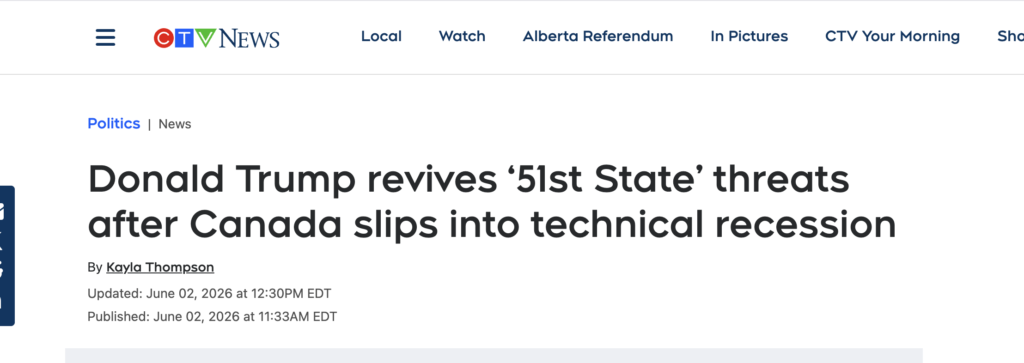
Picture it: the same news cycle, the same morning, the same border. On one side, the President of the United States hammers two words onto Truth Social, 51st State!, above a Bloomberg headline announcing that Canada has slipped into a technical recession. On the other side, Canada’s Prime Minister, asked directly whether his country is in a recession, chooses to speak of “some weakness” and a necessary “settling-in” period before walking carefully away from the question. Two leaders. Two performances. One shared failure, dressed up as history.
What is unfolding at the Canada-U.S. border in 2026 is not a confrontation between a powerful empire and a resolute neighbour. It is something far less flattering to anyone involved: a hall of mirrors in which a loud, flailing America and a quiet, drifting Canada reflect each other’s worst tendencies back and forth across three thousand miles. One side hides its weakness behind tariffs and annexation fantasies. The other hides its fear behind process and euphemism. Together, they produce not drama, but mush, and the people paying the admission price are the citizens of both countries who had nothing to do with writing the script.
Mush from the Wimp
Donald Trump’s second-term Canada strategy sounds, on the surface, like a master class in coercive diplomacy. He imposed 25% tariffs on nearly all Canadian imports, softened to 10% on Canadian energy only because his own administration was nervous about what higher fuel prices would do to American consumers. He threatened to use “economic force” to eliminate the border between the two countries. He talked, repeatedly and publicly, about making Canada the 51st state of the United States. On Truth Social, he reduced a complex bilateral economic relationship to a two-word post and a recycled taunt.
This is not strategy. It is spectacle managing anxiety.
The tariffs, economists across the political spectrum have been quick to note, inflict reciprocal damage. U.S. firms and consumers absorb higher costs on Canadian-sourced goods. Integrated supply chains in automobiles, metals, and agriculture, built over decades precisely because economic geography made them efficient, absorb disruption they were never designed for. Canada answered with 25% duties of its own on roughly $30 billion worth of American goods, and the wound-for-wound logic of that exchange helps neither economy. There is no clean “win” available in a trade war with your largest trading partner. There is only the question of who bleeds out more slowly.
The annexation rhetoric fares no better under examination. Canada’s GDP contracted at an annualized rate of 1.0% in the fourth quarter of 2025 and 0.1% in the first quarter of 2026, making it three negative quarters out of four, shallow, real, and painful at the margins, but nowhere near the kind of systemic collapse that would produce calls for absorption into the United States. A genuine empire, the old joke goes, quietly buys you. A pretend empire posts about owning you while disrupting its own supply chains to make the point. Trump’s Canada gambit is, at its core, a political product manufactured for domestic consumption: a symbolic victory for a base that wants to believe the United States is getting tough with the world, sold by a president who needs that story because his second-term record at home offers him relatively few others to tell.
The Republican-led House of Representatives delivered its own verdict on the underlying incoherence: it passed legislation aimed at rolling back Trump’s Canada tariffs, the rebuke framed explicitly around midterm anxieties and the economic cost being passed on to American businesses and households. This is not the behaviour of a legislature watching a popular, coherent strategy succeed. It is the behaviour of a legislature watching a problem get worse and trying, however belatedly, to limit the damage.
Trump’s “51st state” post, timed to coincide with the arrival of Canada’s trade minister in Washington for CUSMA renewal talks, is the most concise summary of the problem. It accomplishes nothing materially. It insults a room he is about to need. It is designed entirely for the performance, to let him claim, to his audience, that he is winning a confrontation that he has, in any serious economic sense, only succeeded in making more expensive for everyone.
Drift from the Slackers
Canada’s government, to its credit, did not flinch visibly. There were no dramatic concessions in the first days of Trump’s tariff regime, no embarrassing summits that produced capitulation disguised as compromise. Mark Carney, who came to power in significant part because the Canada-U.S. relationship had become the defining political issue of the era, speaks in the language of sovereignty and transformation: Canada will deal with Trump “on our terms”; the economy is being “fundamentally transformed”; ties to the United States are “weaknesses we must correct”.
These are the right words. They are not, so far, connected to the right actions.
What Canada’s government has actually done sits well within the comfort zone of every federal government that has navigated a difficult period with Washington since free trade began: measured counter-tariffs, sector-specific supports, incremental signals toward trade diversification, and an abiding institutional faith that the CUSMA framework, even as Trump treats it as leverage rather than law, will provide a stable floor. Policy analysts have argued repeatedly and explicitly that Canada’s response risks being too narrow and reactive, that a genuine reset needs to go far beyond trade mechanics into industrial strategy, energy security, and the structural rewiring of dependencies that leave the country exposed every time Washington sneezes. The response, so far, has been to acknowledge the need for change at the level of principle and to pursue it at the speed of process.
This is slacker governance at its most sophisticated. It is not laziness in the ordinary sense; the people in Ottawa’s ministries and boardrooms work very hard. It is slackness in the intellectual sense, the refusal to leave a familiar analytical framework even when the evidence that the framework no longer fits is stacking up quarter by quarter. Deloitte’s 2026 Canada outlook captured the institutional mood with clinical precision, projecting “status quo” trade relations and an assumption of baseline CUSMA continuity at the very moment when Trump was openly treating CUSMA as a tool for annexation-adjacent pressure. That is not analysis. That is a comfort blanket with a footnote.
The GDP numbers illuminate the gap between the rhetoric of transformation and the reality of drift. Canada’s economy has now posted negative real GDP growth in three of the last four quarters. Business investment is weak. Government spending, which propped up the headline numbers through much of 2025, dropped unexpectedly in the first quarter of 2026, contributing to the second consecutive quarterly contraction. The Bank of Canada’s growth forecast for 2026 has been revised down to 1.2%, from 1.7% the previous year. These are not numbers that describe a country in the middle of a confident structural transformation. They describe a country absorbing external shocks inside a stagnant domestic model, and calling it a process.
The management of language is itself a tell. Mark Carney was asked directly whether Canada was in a recession. He initially walked away without answering. When he did speak, he chose “some weakness” and “settling in” over the plain word that Statistics Canada’s own data supported. This is not unusual behaviour for a head of government managing market and consumer confidence; every prime minister calibrates language in a crisis. But it is revealing when the language management is more energetic than the policy response. Calling a house fire “unexpected warmth” does not put out the fire. It just means the people inside it are less likely to be told to find the exit.
The Border as a Mirror
Taken separately, Trump’s bluster and Canada’s drift are familiar. Taken together, they form something more structurally interesting: a self-reinforcing loop in which each side’s weakness enables and legitimizes the other’s.
Trump’s tariff theatre works best against a counterpart that is visibly cautious and institutional, one that can be framed as slow-moving and therefore defeatable by noise and pressure. Canada’s government, careful, process-oriented, allergic to structural rupture, is nearly ideal for this purpose. Its very reasonableness becomes, in Trump’s framing, passivity. Its measured counter-tariffs look like hesitation. Its talk of transformation without a visible transformation in progress looks, from Washington, like a bluff that costs nothing to call.
Canada’s slackness, in turn, works best against an adversary that is incoherent rather than strategic, one whose tactics are so disruptive that “steady as she goes” can be sold domestically as strength by comparison. Trump’s tariff regime is demonstrably hurting both economies; his annexation talk is transparently performative; his own party is quietly trying to walk parts of it back. Against that backdrop, Carney’s technocratic calm looks, in Ottawa’s framing, like statesmanship. Declining to name a recession looks, from Rideau Hall, like responsible messaging. The chaos across the border becomes the alibi for the caution at home.
The result is a kind of mutual malpractice, in which both governments are practicing politics on each other’s backs rather than practicing governance for their own citizens. Americans pay in higher consumer prices, disrupted industries, and a foreign policy that has alienated a deeply integrated neighbour for no measurable strategic gain. Canadians pay in contracting GDP, fragile investment, an affordability crisis that varies wildly by region, and the particular frustration of watching a government respond to a genuine structural challenge with the administrative equivalent of a polite memo.
Both publics, notably, have begun to work this out for themselves. Canadians, polling shows, have been buying more domestic products, taking fewer leisure trips to the United States, and expressing a surge in national identity that is partly pride and partly the slow recognition that their economic integration with their neighbour is a vulnerability, not just an advantage. Americans, for their part, are increasingly aware that the tariffs hit their wallets rather than some abstract foreign competitor; the House vote against the Canada tariffs is a lagging but real indicator of that awareness. The populations are ahead of their governments. They usually are.
The 51st State of Denial
The annexation rhetoric deserves a final, careful reckoning, because it is the rhetorical heart of the whole performance and the clearest example of what failure dressed as strength looks like.
Trump’s proposition is, in its own terms, incoherent. He is simultaneously claiming that Canada is so economically weak it is about to become the 51st state, and imposing tariffs designed to weaken it further, as if a country made poorer by your own policy is then ripe for absorption rather than resistant to it. The actual mechanism for annexation is never specified because there is no mechanism. Canada is a sovereign country with a strong, if currently strained, national identity, a functional democracy, and a population that has responded to the 51st-state taunt with a surge of patriotism measurably hostile to the idea. The fantasy is not a plan. It is a brand.
Canada’s official response to the brand is to take it extremely seriously in public, ministers say it is “no joke” and they treat it “very seriously”, while doing nothing with the urgency that such seriousness would imply. This is the slacker’s answer to the wimp’s bluster: solemn acknowledgment of the threat, careful note-taking about the threat, and then a return to the familiar process of managing the threat within the existing institutional framework that the threat was designed to undermine.
Annexation, if it ever came, would not arrive by tanks or treaties. It would arrive by attrition, by a Canadian political class that finds it incrementally more convenient to operate within U.S. economic parameters than to build something genuinely independent, and by a population exhausted by the costs of dependence but never quite offered a credible alternative. That is the real danger buried under the noise: not that Trump will suddenly acquire a Canadian province, but that Canada’s elites will slowly stop trying to prevent the conditions that would make integration feel inevitable.
The 51st state of denial is not a place on a map. It is a political condition, available, with equal opportunity, to governments on both sides of the border, in which the distance between what is said and what is done becomes so wide that the only people who can still see the gap are the ones paying the bill.
That is where both countries are standing, right now, in the same news cycle, in the same morning, at the same border.
One side posted a taunt. The other called it a process.
Neither told the truth.
Additional research from Perplexity