The Mirror War That Isn’t About You

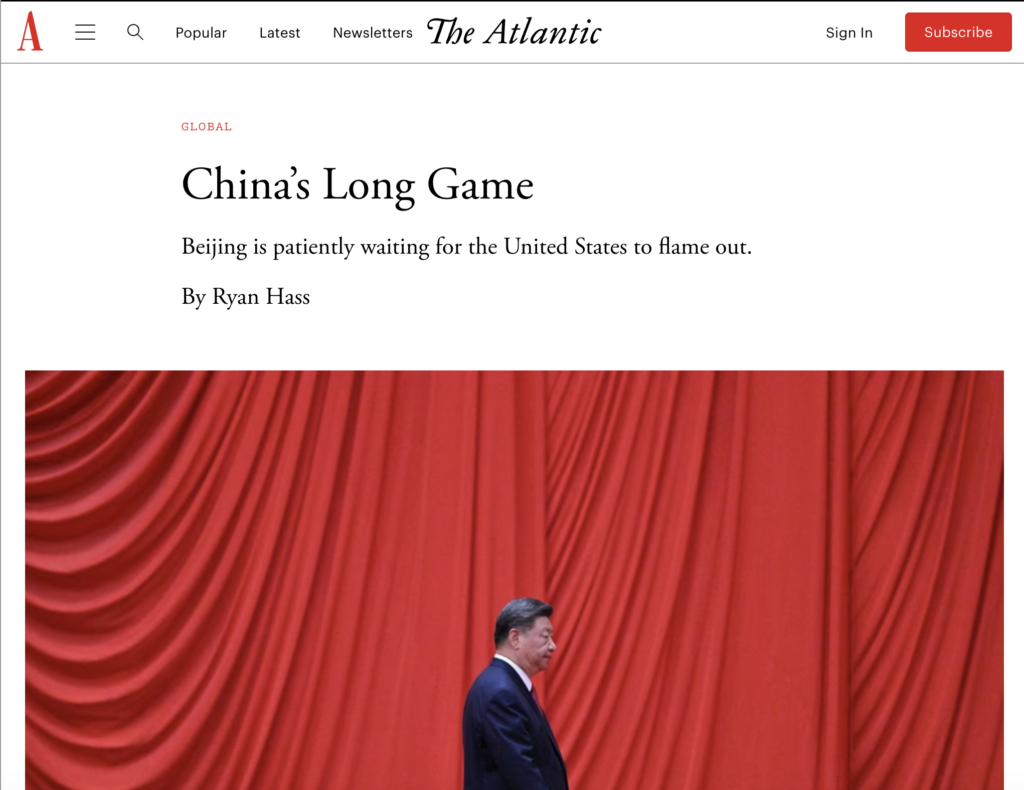
The story we keep being sold is simple: the United States is a fading empire, China is a patient challenger, and the only question that matters is which flag will sit on top of the world when the credits roll. Legacy outlets package it as an anxious soap opera, Beijing dresses it up as destiny, Washington calls it “great-power competition,” but the script never changes. It is always about who gets the crown.
What never gets asked is whether either of them is actually fit to wear it.
Both Washington and Beijing are aging, indebted, and run for the comfort of their respective insider classes. Both are grappling with shrinking birthrates, restless publics, and economies that have to be continuously massaged with propaganda and policy gimmicks just to look functional. Their “long games” are not the plans of confident civilizations building cathedrals for future generations; they are the improvisations of oligarchies trying to stretch today’s power a little further into tomorrow.
You would not know this from reading the legacy press. The coverage works like a hall of mirrors. One week, China is a meticulous grandmaster patiently waiting for America to collapse under the weight of its own dysfunction. The next, the United States is a still-mighty hegemon containing a brittle, overextended China that is one misstep away from implosion. The roles switch depending on who is being warned, comforted, or scolded. The only constant is that somewhere, somehow, the crown will end up on someone’s head, and that you should pick a side and cheer.
The mirror war isn’t designed to help you understand the world you live in. It is designed to keep two exhausted systems looking ten-feet-tall on the page, five-minutes-from-victory or five-minutes-from-collapse, but always central, always indispensable. It asks you to identify with one empire’s anxieties against the other’s, as if your everyday reality: rent, care work, precarity, the simple question of whether your children will have a future is just background noise to a prestige drama between rival courts.
This is not an argument that “both sides are the same.” They aren’t. They abuse power in different ways, in different languages, with different costs. But on the one question that matters for all the imperial fan fiction: their capacity to sustain a benevolent, stable global dominance, both are telling stories that their own demographics, economics, and politics quietly contradict. This isn’t a clash of long-term visions; it’s a competition over who gets to pretend a little longer that they are owed a throne.
The tragedy is that the mirror war is me‑centered by design. It is about what America or China deserves, how their elites feel, what their strategists fear. It is never about you. The press packages it as global concern, but the viewpoint never leaves the palace balcony. The rest of us are cast as distant provinces whose only meaningful act is to line up on the right side of someone else’s flag and be grateful.
If there is a real story of this era, it starts somewhere else entirely: with a planet full of people who no longer see themselves in either empire’s reflection, and who are quietly stepping out of the mirror’s frame.
Tags: China, Donald Trump, Journalism, Propaganda, Ryan Hass, The Atlantic, United States, Xi Jinping