
No, Meta isn’t “dying.” It has become mundane. That’s more dangerous.

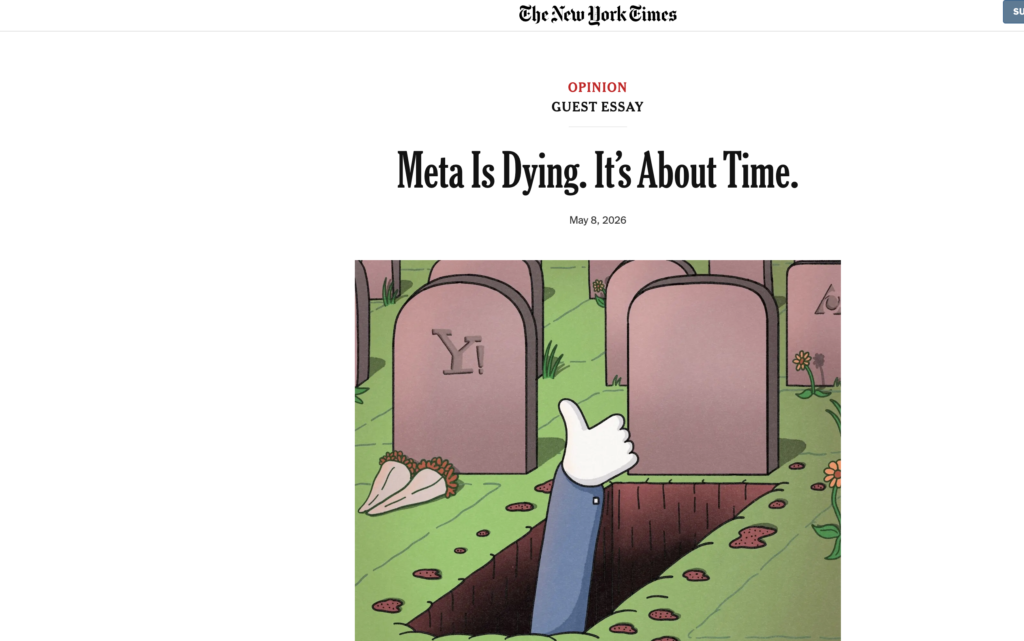
Meta isn’t dying; it’s graduated. It has quietly shifted from “hot platform” to “annoying but unavoidable infrastructure,” and that reality says more about how we misread power than it does about Meta’s health.
The comfort of calling Meta “dead”
There is a particular kind of media fantasy that recurs whenever a tech giant stops feeling exciting: we declare it “over.” Meta, we’re told, is “dying,” “finished,” or “rotting from within.” The evidence offered is always the same: it’s not cool with young people, it’s mired in scandal, its attempts at reinvention look desperate or cringe.
If those are the criteria, though, they apply far more neatly to legacy media than to Meta.
The New York Times, like many newspapers, survived a brutal collapse of its original core business. Print advertising revenue imploded. Print circulation declined. The paper has spent the past decade rebuilding itself as a bundle: news plus games, recipes, audio, and cross‑promoted verticals, all wrapped in a digital subscription model. It’s done a shrewd job of that, in 2025 it reported more than 12 million total subscribers and growing digital revenue, but nothing about it is youth‑driven or culturally “frontier.”
By the columnist’s logic, that should count as “dying” too. The Times is an establishment institution with an aging, affluent subscriber base, a long record of mistakes and manufactured consent, and a business model rebuilt under duress. The difference is not that Meta is decrepit and the Times is vibrant. The difference is that journalists are bored of Meta and work for the Times.
Meta as mundane infrastructure
Meta’s situation is not one of death; it’s one of normalization. It has become part of mundane reality.
Consider Messenger. For years, Meta allowed a kind of side door: people could use Messenger via Messenger.com or a phone number, maintaining some distance from Facebook‑proper. That door is now being welded shut. Meta is shutting down the standalone Messenger website and directing people back into the Facebook interface, effectively making “no Facebook, no Messenger” true again on the web. Even its “Messenger without Facebook” option has been re‑architected so that a Facebook‑linked account exists under the hood; you can deactivate the visible profile, but you cannot meaningfully detach Messenger from Facebook’s identity system.
That is not how a dying company behaves. That is how a utility behaves. Phone companies do not ask if they are cool; they quietly consolidate your dependence.
The same pattern runs through WhatsApp, Instagram DMs, and Facebook groups. Families coordinate holidays and elder care through group chats. Parents share classroom information. Local businesses treat Instagram and Facebook pages as their only customer‑facing presence. Community organizers, churches, sports teams, and informal mutual‑aid networks live in Facebook groups and Messenger threads. To “just leave Meta” is, for many people, to become unreachable by their own social and logistical networks.
This is why the familiar scandals, Cambridge Analytica, Onavo, did not bury the company. Cambridge Analytica revealed that data on tens of millions of users had been harvested and misused for political profiling. Onavo exposed Meta’s willingness to ship a “VPN” that functioned as corporate spyware. In a moral universe, those should have been extinction‑level events. In the actual universe, people briefly expressed outrage, checked their privacy settings, and went back to the same chats and feeds because their families, friends, and communities were still there.
Infrastructure trumps indignation.
Facebook as the world’s scrapbook
Of all Meta’s platforms, Facebook is the easiest to mock and the hardest to leave. That tension is the tell.
When Facebook introduced Timeline, commentators immediately described it as an “online scrapbook,” a chronological record of your life: posts, photos, milestones arranged into a narrative. For many users, especially those who came of age before smartphones and cloud photo services, Facebook quietly became the only comprehensive archive of their personal history. Vacations, baby photos, weddings, notes from relatives who have since died, all of it went into the blue‑and‑white box.
People who try to walk away discover this the hard way. One writer documented the need to literally print their entire Facebook history because it had silently replaced their scrapbooks and photo albums. Deleting the account stopped feeling like “quitting an app” and started feeling like burning the family archive.
Again: this is not what a dying product looks like. This is what entrenchment looks like. A truly dying platform is one you can leave without amputating a limb.
When “uncool” gets mistaken for “decline”
So why is it so important, rhetorically, to declare Meta “dying”?
Part of it is aesthetic. Meta is no longer the frontier. Teenagers and young adults spend more of their creative energy on TikTok, YouTube, and various niche platforms. Facebook‑blue‑app is where your aunt posts minion memes and your high‑school classmates announce pregnancies. Instagram, too, has slid from “aspirational” to “mall”: a place for shopping, ads, and polished brand narratives. It’s gauche, not glamorous.
But aesthetics and power are not the same thing. The railroads were never cool. Electrical grids were never cool. Their power lay precisely in their ordinariness. Once people stopped thinking about them and started simply depending on them, they became extraordinarily hard to challenge.
Another part is moral wish‑fulfillment. Media coverage of Meta’s abuses has been voluminous and, often, damning. The Cambridge Analytica scandal. The Onavo deception. The role of Facebook in amplifying misinformation and contributing to violence and genocidal incitement. The company’s willingness to profit from scam and fraudulent ads, with internal documents suggesting it stood to earn billions from clearly dubious categories. After all of that, many people want Meta to pay a price so badly that any sign of change, layoffs, an unpopular “metaverse” pivot, a dip in one app’s user metrics, gets narrated as “the beginning of the end.”
That narrative is comforting. It lets us believe that the system is correcting itself. We told the truth, the truth hurt, and the bad actor is slowly, righteously fading away.
The numbers say otherwise. In 2025 Meta’s “family of apps” was logging roughly 3.5 billion daily active users, with engagement and revenue still growing. The company is pouring tens of billions into AI infrastructure and data centers to tighten personalization, ad targeting, and content delivery. This is not a slow death; it is a consolidation of power so deep that the company becomes boring to write about even as it mediates more and more of daily life.
The institutions we stop seeing
Here is the deeper problem with the “Meta is dying” frame: it teaches us to look away at exactly the moment when we should be paying more attention.
When a platform is new and exciting, it is subject to scrutiny. Journalists review features, legislators hold hearings, users argue about norms. Once it slides into the background of mundane existence, all of that energy dissipates. We keep using it, and we stop seeing it.
Calling Meta “dead” because it has lost its sheen of novelty is a category error. It confuses the attention span of columnists with the health of the company. It treats boredom as a proxy for decline. In practice, “boring” is where the real power lives. The bills you don’t read. The terms of service you scroll past. The chat app you never think to question because the kids’ school uses it.
Legacy media should understand this intimately. The New York Times is not cool, and it is not dying. It is an entrenched, establishment institution whose value comes from being taken for granted. Meta has joined it in that category. These are not scrappy disruptors anymore. They are furniture.
That is the real story here. Meta has not died. It has settled into the wallpaper. And that is not a happy resolution to the scandals of the past decade. It is the starting point for a less flattering conversation about what happens when a scandal‑soaked company becomes part of the basic infrastructure of everyday life, and why so many of the people who live inside that infrastructure are suddenly so eager to call that death instead of power.