
The Billionaire Cosplay: How the WSJ and Financial Media Keep the Middle Class in a Fog

Overview
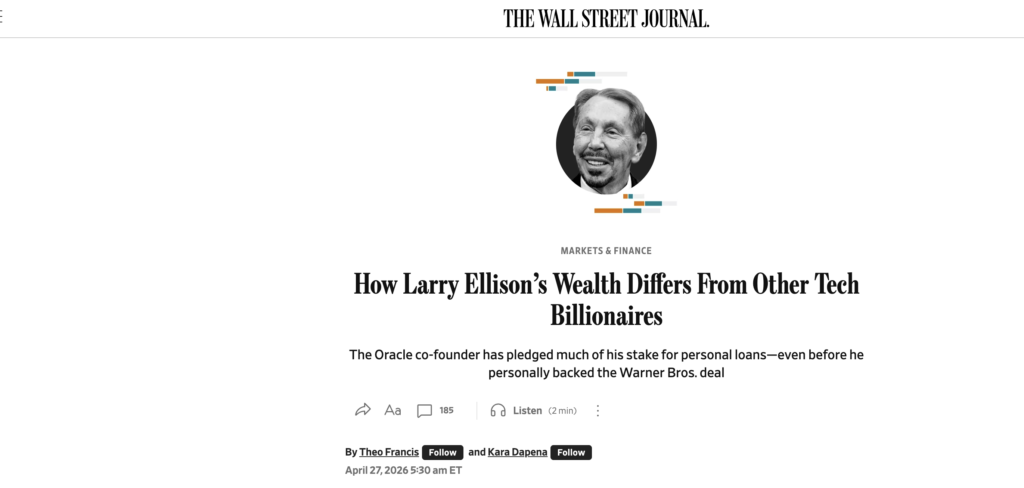
When the Wall Street Journal runs a feature on Larry Ellison’s wealth, complete with a precise dollar figure and a chart tracing his ascent, it presents itself as journalism. What it is, in practice, is costume maintenance: the careful upkeep of a narrative identity called “Billionaire” that depends far more on accounting conventions, stock-market theology, narrative, and editorial choices than on any stable, verifiable reality. This report examines the specific techniques the WSJ and peer outlets use to manufacture consent around extreme wealth, why those techniques work on middle-class audiences, and what the structural function of the fog actually is.
Part I: The Costume, Not the Person
“Billionaire” Is a Model Output, Not a Measurement
The core trick is numeric authority. When a headline declares that Ellison is worth “approximately $212 billion,” it implies the kind of precision associated with a bank balance. In fact, the figure is produced by multiplying a share price, set by the marginal sale of a thin slice of Oracle stock on a given afternoon, by the total number of shares attributed to him, then adding contested estimates for private holdings, partially netting out pledged-collateral loans (or not), and rounding to a figure that feels authoritative.
Different outlets apply different models and get materially different answers. Bloomberg, Forbes, and WSJ regularly diverge by tens of billions on the same person on the same day. In a single morning in September 2025, Ellison’s reported wealth jumped by nearly $100 billion, not because he acquired anything, but because Oracle’s stock repriced in response to AI speculation. The underlying control he exercises over Oracle had not changed by one dollar. Yet the headline read as a personal windfall of historic proportions.
An insider, a billionaire himself, once complained that the Forbes list is “ridiculous” and that “no one knows my net worth,” yet Forbes printed a figure anyway. That is not journalism. That is the costume department assigning a character a number.
Why the Precision Is the Point
The fake precision (“$212.9 billion” rather than “roughly $200 billion”) performs an important function: it forecloses skepticism. A round number invites challenge. A number with decimal specificity carries the authority of measurement: it implies that someone counted. No one counted. But the audience, trained by a lifetime of bank statements and price tags to treat precise figures as real, accepts it.
Academic research on how media frames wealth inequality confirms this effect: wealth inequality is chronically described using either no frame at all, or as the dominant group’s advantage, both of which normalize it rather than interrogate it. When coverage does present numbers, it typically uses the “advantage” frame (Ellison gained $46 billion!) rather than a structural or redistributive frame (the rules of stock-market valuation channeled $46 billion in paper claims to one man).
Part II: The WSJ’s Specific Toolkit
The Celebrity Profile as Consecration
The WSJ’s coverage of Ellison, including the April 2026 piece on how his wealth “differs from other tech billionaires”, follows a recognizable template: open with an impressive number, provide a biography that emphasizes grit and vision, cite a few cautionary caveats about market volatility, and close with the implicit message that this is how the system is supposed to work. The profile genre does not investigate; it consecrates. It takes a person whose fortune is a function of stock-market mechanics, leverage, and inherited regulatory structures, and transforms them into a character whose wealth is a reflection of personal genius.
This is what media critics call “CEO said a thing!” journalism, a practice in which press outlets parrot the claims of billionaires “utterly mindlessly without any sort of useful historical context as to whether anything being said is factually correct”. The result is news that looks legitimate but subtly reinforces elite-friendly, anti-democratic worldviews.
Framing Taxation as Threat
When California proposed a one-time 5% wealth tax on billionaires in late 2025, the WSJ’s coverage centered on the objections of “prominent technology investors” and framed the policy as “driving high-net-worth residents out of state”. The structural question, why 1,135 American billionaires control 43% of the total global billionaire wealth pool, was not the frame. The individual grievance of the taxed party was. This is a consistent pattern: redistribution policies and the populations that would benefit from them “frequently encounter skepticism or outright resistance in media coverage,” while economic elites “tend to enjoy favorable depictions” and “the linkage between wealth and inequality remains underreported”.
The Invitation-Only Economy
The WSJ’s coverage of private markets illustrates a related function: normalizing a two-tier economy. A December 2025 WSJ piece titled “Inside the Invitation-Only Stock Market for the Wealthy” covered the fact that the ultra-wealthy can buy and sell shares of private companies “via invite-only transactions long before they list”. The framing was descriptive and mildly envious, “here is a world you cannot access”, rather than critical. The structural implication (that those with capital accumulate informational and financial advantages that compound over generations, while ordinary investors arrive late to already-inflated prices) was absent from the frame.
The UBS Study as PR Delivery
In December 2025, the WSJ ran a piece titled “The World Has More Billionaires Than Ever,” citing a UBS study. The hook was the growth of the billionaire class, approximately 2,900 billionaires now controlling $15.8 trillion, up from 2,700 the year before. The article presented this as a market data story. What it did not present: billionaire wealth jumped by over 16% in 2025, three times faster than the five-year average, driven by asset price inflation that the majority of households did not share in. In Canada specifically, the wealth of the 40 richest individuals grew more than 20% in a single year, to nearly $550 billion, more than the GDP of Chile or Finland, while Canada’s top 1% hold nearly as much wealth as the bottom 80% combined. None of that structural context appeared in the WSJ version of the story.
Part III: The Middle Class as Target Audience in a Fog
Canadians and Americans Systematically Underestimate the Gap
Survey data from the Broadbent Institute shows that Canadians vastly underestimate how skewed wealth distribution actually is. Canadians estimated that the wealthiest 20% hold about 55.5% of the country’s wealth; the actual figure is 67.4%. More strikingly, Canadians estimated that the poorest 20% hold less than 6% of wealth, the actual figure is zero, they hold no share at all. This is not ignorance; it is manufactured misperception, produced by media environments that normalize wealth concentration and obscure its scale.
The same pattern holds in the US. Research shows that Americans perceive a much more equitable wealth distribution than exists, and aspire to one that is more equitable still, yet the gap between what they perceive and what is real is enormous. Marketing and advertising compound this: the middle, upper-middle, and upper classes are dramatically overrepresented in media and advertising, while lower classes are underrepresented, creating a persistent sense that “normal” is wealthier than it is.
The Middle Class Label as Fog Machine
The term “middle class” is itself a key instrument of the fog. Because its boundaries are never formally defined, approximately 90% of Americans self-identify as middle class regardless of their actual economic position. This serves a precise political function: it prevents class solidarity by collapsing the distinction between a factory worker and a hedge-fund manager into a shared, cozy identity. Canadian socialist analysis has long identified “middle class” as a deflection, a term that “obscures more than it reveals” and makes “production… not exist” and “conflictual polarization… absent” from the conversation.
A peer-reviewed study on redistributive preferences found that the middle class, “the decisive group in democracies”, is “highly unresponsive to future prospects” precisely because it perceives itself as having neither much to lose nor much to gain from wealth redistribution. That unresponsiveness is the goal. A middle class that does not understand its actual position in the distribution is a middle class that does not organize against the rules producing that distribution.
False Consciousness as Infrastructure
What the WSJ and its peers are producing is the infrastructure of false consciousness: a media environment in which workers “don’t realize that they’re being exploited and oppressed” because the owners of the information systems “control societal information” and produce a world that looks normal. This is not a conspiracy; it is the natural output of a media system in which billionaires own more than half the world’s largest media companies and nearly all of the main social media companies.
The WSJ itself is owned by News Corp, which is controlled by the Murdoch family, a billionaire dynasty that also owns Fox News, the New York Post, and major outlets in Australia and the UK. When the WSJ runs a flattering profile of Larry Ellison’s wealth, it is not a neutral journalistic institution covering a subject. It is one billionaire’s media property covering another billionaire, within a framework defined by billionaires, for an audience being trained not to see billionaires as a structural problem.
Part IV: The Structural Function of the Fog
Why the Lists Exist
The Forbes, Bloomberg, and WSJ billionaire rankings function as annual ceremonies: rituals of consecration that decide who wears the “Billionaire” mask in the public imagination. The lists are not censuses of actual liquid wealth. They are casting decisions. Analysts note that 70-80% of UK print media is controlled by five ultra-wealthy moguls, and that the way billionaires “manufacture news and supposed ‘facts’” is a central feature of elite information control. The same dynamic holds in North America.
The rankings serve several interlocking purposes:
- Personification of markets: “Ellison gained $46.7 billion” turns a structural repricing of Oracle shares into an individual achievement story, naturalizing the mechanism that produced it.
- Normalization of concentration: Presenting 3,508 billionaires controlling $13.4 trillion as a market data point, rather than a governance crisis, makes it part of the furniture.
- Legitimization through spectacle: The rotation of “world’s richest” titles between Musk, Ellison, and Bezos keeps the story fresh while the premise, that this concentration is a natural outcome of talent and effort, is never examined.
The Ellison–Paramount–Warner Acquisition as Cosplay Made Physical
The billionaire cosplay becomes most dangerous when the costume-wearers acquire the costume department itself. The April 2026 Warner Bros. shareholders’ approval of Paramount’s $111 billion takeover puts the Ellison family in control of CBS, CNN, HBO, Warner Bros. film and TV, Nickelodeon, DC, and a roster of the most powerful cultural franchises in the world. Coverage of the merger used language like “next-generation media enterprise” and focused on Ellison’s personal guarantee and vision, not on the democratic implications of one family controlling an unprecedented share of the Western narrative stack.
Billionaires are now 4,000 times more likely to hold political office than ordinary people. They also own the outlets that cover them, fund the think tanks that generate the frameworks for covering them, and bankroll the journalists whose bylines appear in “independent” outlets. The costume is the only wardrobe available.
What the Middle Class Is Not Seeing
The most consequential gap is this: middle-class people in Canada and the US believe the system is more equitable than it is, believe their own position is higher than it is, and believe that the billionaire class achieved its position through merit rather than structural advantage, all because the media environment they consume is substantially controlled by the class they are being prevented from clearly seeing.
Young Americans earning above the median income report that the fundamental aspects of middle-class life, homeownership, raising children, occasional meals out, feel out of reach or require difficult compromises. Economists tell them they are richer than previous generations by the numbers. The gap between economic data and lived experience is itself a product of the fog: when the numbers are constructed by the same apparatus that produces the cosplay, the numbers and the lived reality diverge, and ordinary people are left without a reliable interpretive framework.
That is not an accident. That is the point.
Conclusion
The WSJ piece on Ellison’s wealth is a minor artifact in a much larger system. What it illustrates, through its pseudo-precise numbers, its framing of stock-market mechanics as personal achievement, its absence of structural context, is how financial media functions as cosplay maintenance rather than journalism. The “Billionaire” label is assigned, not measured; performed, not documented. The middle class is the audience for a show whose purpose is to keep them from seeing that the show is a show. The costume is the information environment itself, and until ordinary readers develop the literacy to see the seams, the cosplay continues, with real consequences for how policy gets made, what gets taxed, and who gets to own the stage.
Additional research provided by Perplexity.
Tags: David Ellison, Journalism, Kara Dapena, Larry Ellison, Propaganda, Theo Francis, United States, Wall Street Journal