The Futures That Didn’t Happen, Preface: When Journalism Guesses

Journalism likes to pretend it is allergic to prediction. Reporters will tell you they deal in facts, not crystal balls. Then you look at pieces like Newsweek’s “The Internet? Bah!” or that solemn tabloid declaring the Internet a passing fad, and you realize how often the press has tried to tell the future with the same tone it uses to tell the weather.
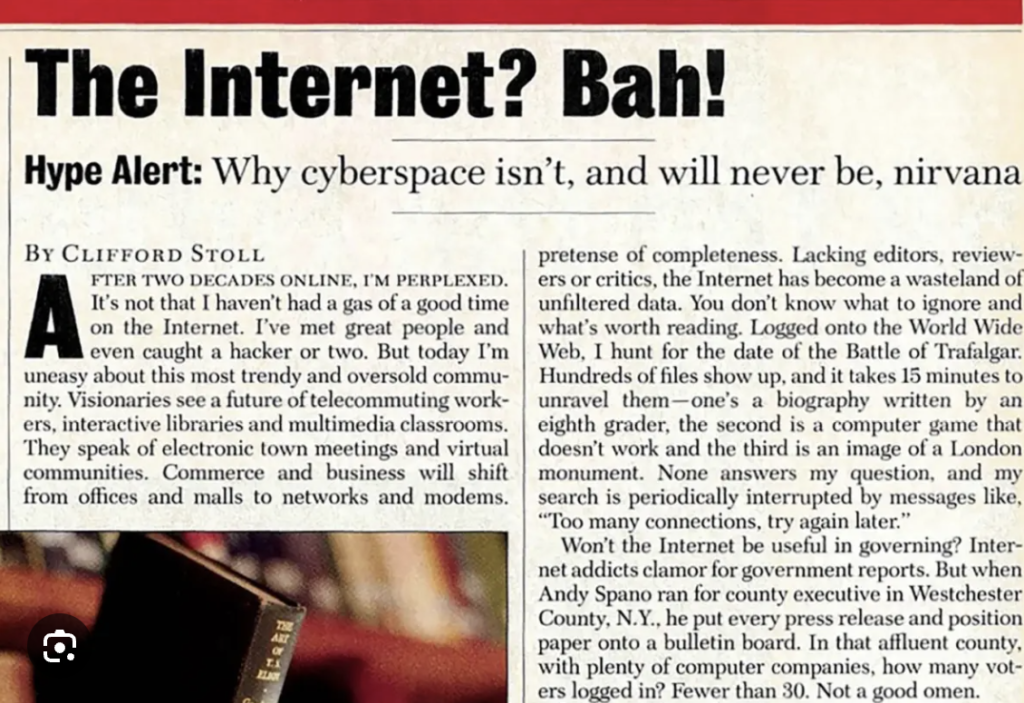
In 1995, Clifford Stoll wrote a now‑infamous Newsweek column insisting that the digital evangelists around him were over‑selling cyberspace. Visionaries talked about telecommuting workers, interactive libraries, multimedia classrooms, online town meetings, virtual communities, and commerce moving from malls to networks. Stoll’s response was one word: “Baloney.” “No online database will replace your daily newspaper,” he declared. “No CD‑ROM can take the place of a competent teacher and no computer network will change the way government works.” If you read those lines today on a phone, working remotely, with your news paywalled and your government conducting hearings on Zoom, it feels like a dispatch from another planet.
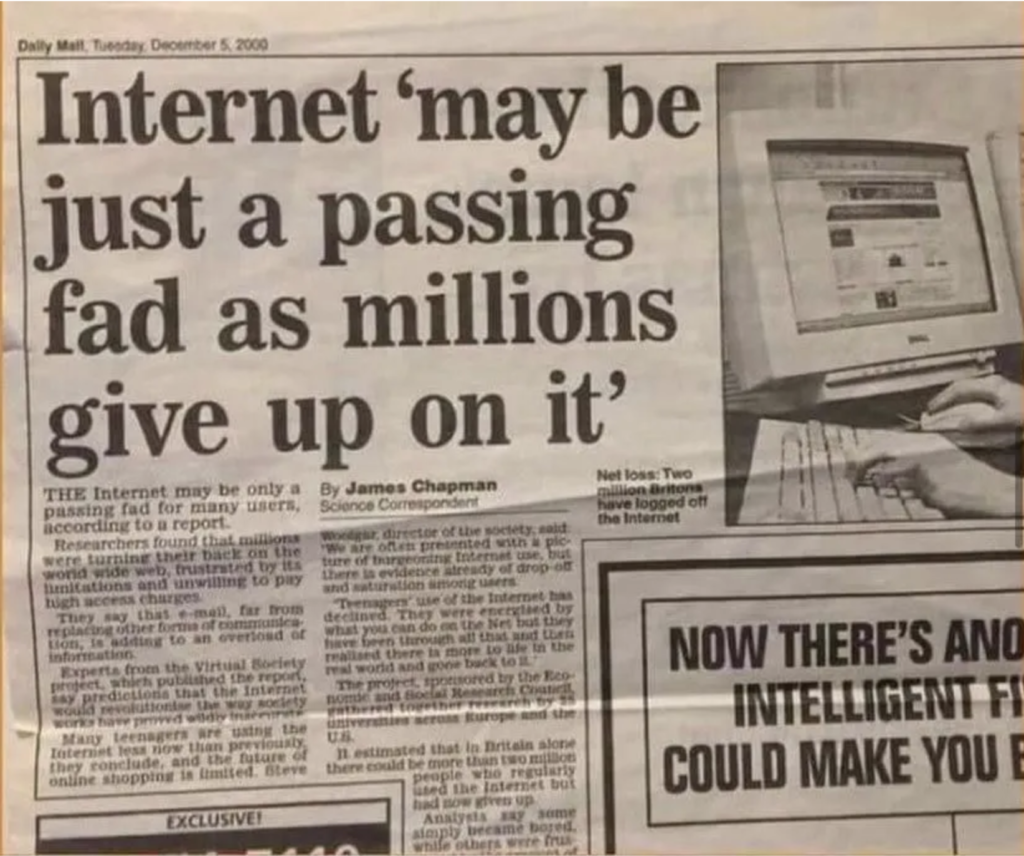
He wasn’t alone. A British paper ran a straight‑faced headline from their science correspondent explaining that the Internet “may be just a passing fad as millions give up on it,” treating a dip in early adoption as proof the whole medium was doomed. Other commentators predicted that the Internet would “catastrophically collapse” because its traffic would outstrip capacity, or that email was too riddled with spam and fraud to become a mainstream tool. These weren’t cranks shouting from the sidelines. They were columnists, science correspondents, and experts whose words came wrapped in the authority of print.
What ties these misfires together isn’t just that they were wrong. It’s that they were confidently wrong. They mistook their personal discomfort, or the limitations of Version 1.0, for the definitive verdict on an entire technology. The internet they could see in 1995, slow, clunky, niche, was the only internet they allowed themselves to imagine.
W. Joseph Campbell has described this as a kind of “innovation blindness”: news outlets in the mid‑90s were among the institutions least inclined to see the Internet as a serious, disruptive force. Many journalists were deeply invested in the existing order: paper subscriptions, broadcast appointments, gate‑kept expertise, and it showed. Their coverage of digital tech swung between two bad poles: the sneering dismissal (“this will never matter”) and the breathless salvation story (“this will save us”). The middle ground, “this is interesting, messy, and we don’t know where it’s going yet”, rarely made the front page.
That pattern never really went away. It just changed costumes.
Once it became impossible to deny the Internet’s impact, journalism didn’t suddenly become wiser about technology. It simply flipped from underestimating digital to overestimating specific business models. Paywalls were going to save newspapers. iPads and glossy “tablet editions” were going to save magazines. Social media was going to save engagement, then destroy democracy, sometimes in the same news cycle. Each new solution was heralded as the future, until the numbers or the public moved on and the bold declarations quietly fell down the memory hole.
Researchers who study “technological hype in journalism” have started to map how this works. Hype isn’t just about overwrought headlines; it organises newsroom priorities, investor expectations, and public emotions. When news coverage frames a tool as inevitable and transformative, it nudges politicians, executives, and ordinary readers toward treating that tool as destiny. The same is true of doom: when coverage centres apocalyptic worst‑case scenarios, it turns speculative fiction into assumed fact.
Which brings us to AI.
AI is clearly transformative. Something big is happening. But how it will transform our lives, economies, and politics is still in play. The only honest answer, at this juncture, is that we don’t know yet. That uncertainty doesn’t make for a snappy headline or a confident TV segment, so journalism has fallen back on its old habits: the miracle and the catastrophe.
On one side, you have the AI solutionists promising that algorithms will rescue journalism from misinformation, automate drudgery, and unlock whole new business models. On the other, you have AI Doomers announcing, with eerie certainty, that these systems will end work, end art, or end humanity. They are wrong in the same way Clifford Stoll was wrong about the Internet. They confuse wishful and magical fantasy with prescience: the fantasy just flipped polarity. The 1995 fantasy was “nothing will change”; the 2026 fantasy is “everything will end.”
In both cases, journalism amplifies the most dramatic stories about technology and mistakes them for reporting. It hands its megaphone to whoever can make the boldest claim about “the future,” and then rarely circles back to measure those claims against what actually happened. Buying your own hype is expensive. For news organisations, it has cost money, credibility, and readers who remember the last time they were told this gadget, this app, this business model was The Answer.
Ironically, many of today’s AI Doomers were teens or adults when the Internet Doomers were confidently wrong in print. They watched worst‑case Internet prophecies fizzle, then grew up to make the same move, just swapping “email” for “AI” and dialing the apocalypse up to eleven.
We are so not doing that here.
In the coming pieces, I’ll take you back through some of journalism’s favourite tech proclamations, about the Internet, blogs, social media, virtual worlds like Gaia and Meez, paywalls, and AI itself, and match the confident headline to the world we actually got. Not to dunk on being wrong; everyone is wrong about the future. What matters is whether you admit it, learn from it, and stop dressing your hunches up as inevitabilities.
If Clifford Stoll could be that certain, and that wrong, about the Internet, maybe we should be a little less impressed when today’s columnists tell us, with the same tone of authority, what AI will or will not do.
This series is my attempt to keep the receipts.