
The Spectator’s Bad Math on Donald Trump

The biggest problem with people’s perceptions of Donald Trump, whether pro or con, is that there was always less than meets the eye. In 2016, there were over 7 billion people on Earth, yet the political, media, and cultural gaze narrowed down to a single man who was, at best, unremarkable and often subpar. He coasted on narcissism, bombast, kitsch, hyperbole, chaos, betrayal, and insult. That is not a strategy; it is flying by the seat of your pants and mistaking turbulence for genius.
As I argued in my book When Journalism was a Thing, the real reason Trump received such obsessive media attention was not that he was extraordinary, but that journalists discovered too late that their clout had migrated to social media. They told the “little people” to vote for Hillary Clinton, and millions ignored them. That was the moment newsrooms realized they no longer functioned as high priests of public opinion but as one feed among many competing feeds. Trump became their bogeyman, and instead of cutting off his oxygen, they hooked him up to their entire life-support system and dragged millions of credulous middle-class viewers along for the ride.
So journalists’ perceptions of Trump have always been skewed. They keep mistaking their own loss of power, and their own misread of the audience, for some grand ideological epoch called “Trumpism.”
Which brings us to The Spectator.
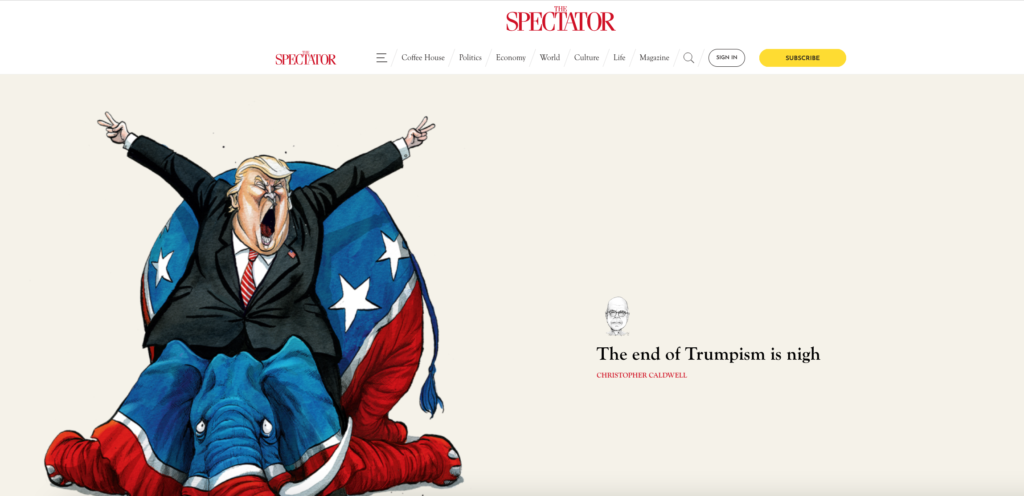
Christopher Caldwell writes as if “Trumpism” is a serious, traceable ideology and its delegates are its cleanest expression. He talks about Trump’s Iran adventure as a dramatic rupture with “the wishes of his own base,” the moment when leader and movement finally diverge. It sounds weighty, but there is a basic problem: he is trying to locate depth in a puddle.
Caldwell doesn’t understand the Trump delegates because there is no there there. What he calls a “movement” is a decade of vibes and grievances packaged and repackaged by different courtiers, influencers, and media entrepreneurs. Trump 2016 and Trump 2026 bear so little resemblance to each other not because of some ideological betrayal, but because you cannot betray a philosophy you never had in the first place. You only change scripts.
A man built on hype and propaganda doesn’t leave behind a school; he leaves behind a paper trail. Trump is not going to be an American of lasting importance in the way Hamilton, FDR, or even Reagan are; he will be a curious artifact of a media system that temporarily mistook noise for history. Once he is gone, people will remember the chaos, the memes, and the wars more than the man, the way we remember disco and Watergate more vividly than the individual studio executives and bagmen who drove them. Caldwell keeps trying to carve a marble statue out of wet cardboard, then declares the “statue” has cracked.
1. “End of Trumpism” and the mythical base
Caldwell’s centerpiece is that the Iran war is “so wildly inconsistent with the wishes of his own base” that it “is likely to mark the end of Trumpism as a project.” That assumes there is a stable, policy‑coherent Trump “base” with a shared, durable foreign‑policy doctrine. There isn’t. What he calls a movement is a rolling coalition of people who wanted catharsis, disruption, and validation more than a white paper. The same crowds that cheered “no more stupid wars” also cheered “bomb the hell out of them” depending on the night, the target, and the clip circulating on social media.
Because there is no fixed doctrine, Trump 2016 and Trump 2026 don’t represent a “betrayal” arc; they’re just two different branding cycles slapped onto the same hollow core. Caldwell keeps treating noise as if it were scripture and then writes an obituary for a theology that never existed.
2. “Democratic restoration” and deep‑state fan fiction
Caldwell insists “Trumpism was a movement of democratic restoration,” centered on a heroic struggle against the “deep state,” credentialocracy, and a class of “philosopher‑kings” in the nonprofit sector. This is myth‑building, not analysis. If this were genuinely about restoring democratic control over unaccountable power, you would expect the movement to build durable institutions, transparent rules, and replicable procedures. Instead, it built parasocial relationships, merch, and podcasts.
Even on his own evidence, Caldwell undermines himself. He admits Trump “never has a president so availed himself of the public trust to line his own pockets,” embraced personal gifts like a Qatari jet, and launched a memecoin for supplicants to dump millions into. That is not “democratic restoration.” It is clientelism plus influencer marketing, draped in constitutional cosplay.
3. The “world‑historical” great man with no successor
Near the end, Caldwell approvingly cites John Judis and Hegel to call Trump “somehow a world-historical catalyst” and “already… one of the half-dozen most important Americans who ever lived.” Then he immediately concedes that this supposedly world‑historical figure cannot keep his own movement alive. This is bad narrative math: if your “great man” leaves no institutional infrastructure, no school of thought, and no credible successor, what you are describing is not a world‑historical figure but a ratings spike.
This is where your “curious artifact” point lands: Trump will be the artifact historians handle with gloves when they want to study how media systems, social platforms, and decayed parties produced the illusion of a giant where there was only a man with a microphone and a feedback loop.
4. The base’s “acute betrayal” and the foreign‑policy red line
Caldwell claims “there has always been a red line: Americans did not expect Trump’s character flaws to endanger them in the realm of foreign policy,” and that Iran crosses it, creating “acute” betrayal in the base. But that red line existed mostly in pundits’ heads. Trump’s rise was fueled by people willing to accept almost any risk as long as the right enemies were punished at home and abroad.
Caldwell himself notes that Trump’s Iran policy is effectively subcontracted to Jared Kushner and Steve Witkoff, two unelected real‑estate cronies acting as “special envoys for peace” while raising billions from Gulf monarchies and fronting a “New Gaza” mega‑development at Davos. That is not a sudden deviation; it is a continuation of how this operation always ran: vibe‑based, patronage‑soaked, and structurally indifferent to public consent.
5. Delegates as moral barometer
He treats figures like Joe Rogan, Tucker Carlson, Megyn Kelly and security officials like Joe Kent as authoritative proxies for “the movement,” pointing to their incredulity and resignations as evidence of a deep moral rupture. But these are not delegates from a coherent ideology; they are content producers and operatives whose own brands depend on occasionally positioning themselves as shocked conscience‑keepers.
Their move now isn’t proof that some Platonic Trumpism has been violated; it’s proof that the Iran war is bad for theiraudiences, their risk calculations, and their future bookings. The “base” here is an audience segment, not a demos.
6. The deep‑state frame flips on itself
Caldwell’s deep‑state story is that insulated bureaucrats and credentialed elites hemmed in the presidency to protect democracy, and that Trumpism tore away those constraints in the name of popular sovereignty. But his own account of the Iran decision shows the opposite: not the people versus the state, but one faction of elite patrons out‑gaming other elite structures using the presidency as a vehicle.
7. “End of Trumpism” as comfort story
Caldwell concludes that “Trumpism is about democracy or it’s about nothing,” and that after Iran “his revolution is essentially over.” But by his own description, Trumpism is already “about nothing”: a personal enrichment scheme, a foreign policy run by real‑estate friends for their investors, and a media ecosystem that still treats Trump as a “world‑historical catalyst” while documenting his gullibility.
Calling Iran “the end of Trumpism” is less a forecast than a coping mechanism. It reassures readers that this was all a grand ideological experiment that has now run its course, rather than admitting it was an attention economy distortion that will reappear in new costumes as long as the underlying systems stay the same.
The comfort story of “the end of Trumpism”
Caldwell concludes that “Trumpism is about democracy or it’s about nothing,” and that after Iran “his revolution is essentially over.” By his own description, Trumpism is already “about nothing”: a personal enrichment scheme, a foreign policy run through real‑estate cronies, and a press corps that still insists on dubbing him “world-historical” while listing his gullibilities. Calling Iran “the end of Trumpism” is less an insight than a lullaby for a readership that wants closure.
Trump is not an epoch; he is an artifact. Once he is gone, people will remember the chaos, the memes, and the wars more vividly than the man. The real story is not that some grand ideology rose and fell with his Iran misadventure, but that journalism, politics, and social media combined to inflate a small, erratic figure into a world‑historical hologram, and then believed their own projection. That is the bad math that produced Trump, and it is the bad math that keeps producing pieces like Caldwell’s.
Tags: Christopher Caldwell, Donald Trump, Propaganda, The Journalism was a Thing, The Spectator, United States