It’s Not the End of US Power: Just the End of Its Most Antiquated Form

Empires don’t die on cue because a headline needs drama.
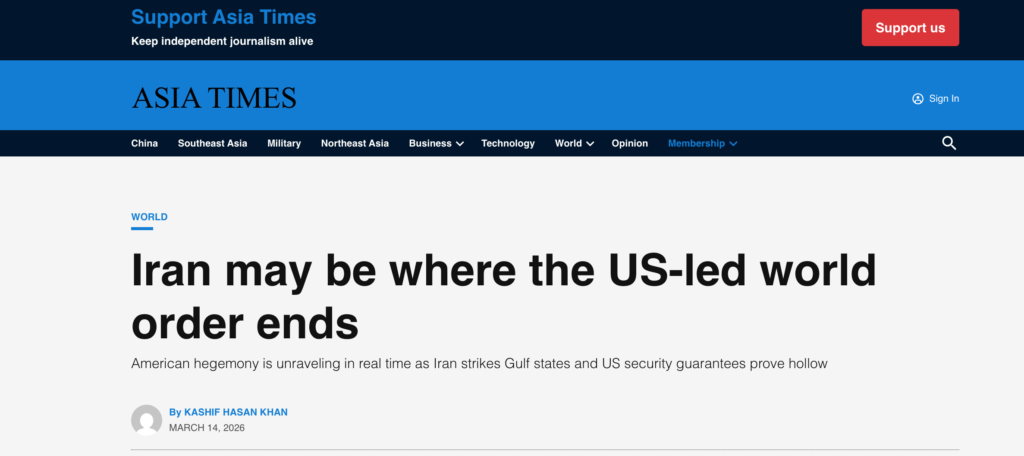
Asia Times warns that “Iran may be where the US‑led world order ends,” arguing the 2026 Iran strikes exposed hollow security guarantees and accelerating multipolarity. That is not the end of US power; it is the beginning of the end of a dated, Trump‑era mode of power that mistook online fandom for strategy.
The United States has always cycled through formats of hegemony. Post‑1945 America built order with institutions, alliances, and economic rules; in the Trump years, that scaffolding was treated as a stage set for one man’s social‑media‑fuelled performance. The Iran fiasco is not proof of terminal decline, but evidence that this performative format is structurally exhausted.
Trump’s rise was inseparable from Twitter’s golden age. Scholars tracking 2016 show how his feed bypassed traditional gatekeepers, dominated news cycles, and converted self‑promotion and insult into political capital, often with little policy content underneath. But the attention economy that made him “our first Twitter president” is already passé: in 2026, AI systems curate, filter, and summarize the noise, lowering the premium on narcissistic spectacle and raising the premium on coherence.
This matters because Trumpian power and MAGA‑style fanboy exploitation are design flaws, not the operating system of the republic. They are what happens when a superpower confuses a leader with a nation, a movement with a civilization, a zeitgeist or ortgeist with a durable strategic culture. The US system, for all its pathologies, retains what I call a “Phoenix failsafe” baked into its scaffolding: the ability to burn off a dysfunctional political format and regrow legitimacy in a new one.
The Iran war debate exposes that failsafe in real time. Even as critics rush to declare an imperial death spiral, the policy, military, financial, and civic mosaics inside the US are openly contesting the wisdom, legality, and cost of escalation. This is not a monolith marching dutifully toward collapse; it is a quarrelsome mosaic arguing over how to reconfigure power in a world where China brokers Gulf deals, BRICS flirts with dollar alternatives, and regional states hedge rather than obey.
History is crowded with premature obituaries for American power. From Vietnam to stagflation to Iraq to the 2008 crash, each “final crisis” was treated as an indelible scar, only to recede as the system adapted just enough to stumble forward. COVID‑19, once framed as a civilizational break, is already fading into the background of public consciousness, its lessons absorbed into institutional muscle memory far more than into daily discourse. Political infections work the same way: the body politic develops antibodies, not permanent open wounds.
The real watershed in 2026 is not that the US has been fatally weakened by Iran, but that the Trump‑social‑media fusion that once amplified American power now actively sabotages it. A country that thrives as a mosaic cannot allow a single personality cult, algorithm, or platform to dominate its discourse without sacrificing resilience. The more AI filters out the performative excess and the less central Twitter‑style narcissism becomes, the less viable Trumpian politics will be as an organizing principle.
So no, Iran is not where the US‑led world order ends. It is where one obsolete, personality‑driven version of that order begins to fail in public. The question is not whether American power survives, but whether Americans use this crisis to retire a broken format and build the next one before their Phoenix failsafe is tested to destruction.
Tags: AI, Artificial Intelligence, Asia Times, China, Donald Trump, Iran, Kashif Hasan Khan, Propaganda, Twitter, United States