Memo to the Anti‑AI Moralists: Life and the World Have Gone On Without You

It’s not 2022 anymore, kids.
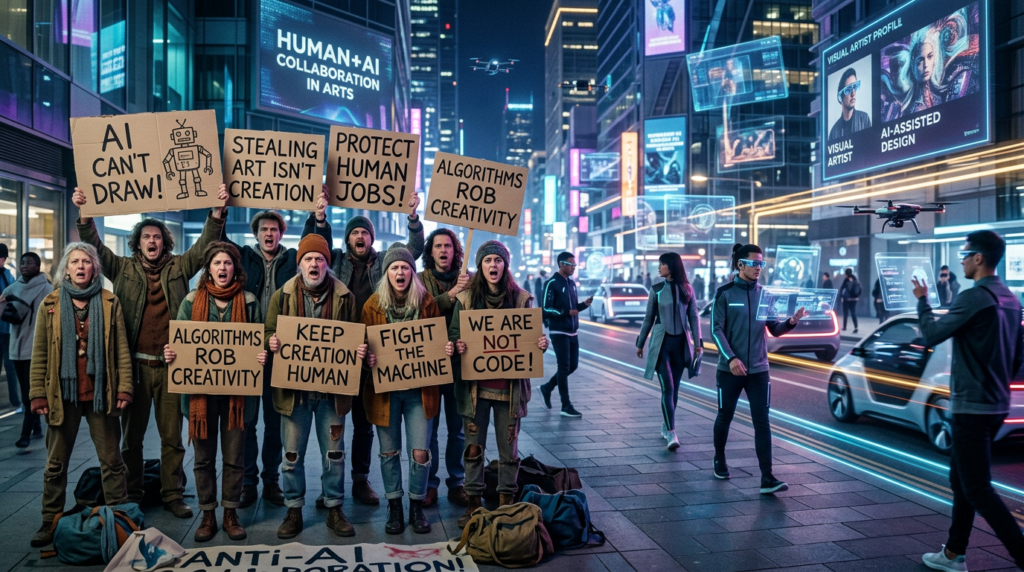
As I was talking this through with Perplexity, a perfect image emerged: the anti‑AI crowd is protesting MySpace while everyone else is dealing with TikTok’s algorithm. That is exactly where they are: hopelessly stuck in 2022, while it is now 2026.
AI threatens their belief in their own intellectual, creative, and artistic supremacy. If their “best ideas” and “great works” can be automated or at least approximated, what does that say about the pedestal they built for themselves? They still seem convinced they can stop this whole AI thing, as if stomping their feet hard enough will rewind the clock. In the meantime, the world and life have gone on without them.
They’ve had years now to get educated on the technical realities and evolution of AI. They could have learned what the systems actually do, where they fail, and how to use them critically and creatively. They chose, instead, to stay in 2022.
So they reach for a different script: AI is bad for mental health. Conveniently, they skip over the fact that the same was said of social media, correctly, in many ways, but they embraced social platforms because those platforms fed their narcissism. When the mirror flattered them, the harms were suddenly negotiable.
“AI chatbots are not friends!” they now scream. Neither are influencers who spend years cultivating parasocial relationships with followers in order to monetize loneliness and insecurity. That never stopped this crowd from playing the game to chase likes, subscribers, and sponsorships. They had no problem with synthetic intimacy when they were the object of devotion.
They didn’t object when social media made people selfish, scheming, intolerant, entitled, arrogant, narcissistic, destructive, competitive, jealous, callous, sadistic, and deceitful. That was considered different, because social media gave them a shot at being rich, special, and superior. This is the same cohort that recoiled in horror when Elon Musk allowed the little blue checkmarks to be purchased by the Great Unwashed. Suddenly “verification” was not an exclusive halo anymore; the illusion of status was breached.
They still don’t see that social media itself was an illusion machine. They thought they had friends, followers, clout, and power to issue decrees because Twitter, Facebook, and LinkedIn once handed them a small badge and an audience they could perform for. They confused borrowed reach with inherent authority.
Now AI is a mirror with a different angle. It quietly shows that there was never real power there: just a fleeting simulation of power and supremacy, contingent on a platform’s favor. They are stuck in their glory days; AI is simply the technology that makes the stagnation visible.
The rest of the world is not stuck. People saw what AI could do: imperfectly, messily (for now), but undeniably, and went down a different path. They are not coming back to 2022 to ask permission from the self-appointed gatekeepers.
AI is not going to go away, nor should it. If you are genuinely talented, creative, and capable of original thought, AI is not a mortal threat; it is an amplifier, a collaborator, an essential aide. If your entire identity rests on being the only one allowed to hold the pen or the mic, of course you will experience it as an existential rival.
Life goes on with or without you. The longer you insist on staying behind, the less people living in the emerging future can relate to you, or want to. That is your choice. But once people can no longer recognize themselves in your fears or your frozen talking points, you become a legacy artifact: preserved, perhaps, but irrelevant, locked in a rerun of a world that has already moved on.