Does the New York Times and Reddit have a case against Perplexity? Don’t kid yourself.

The comedy of greed.
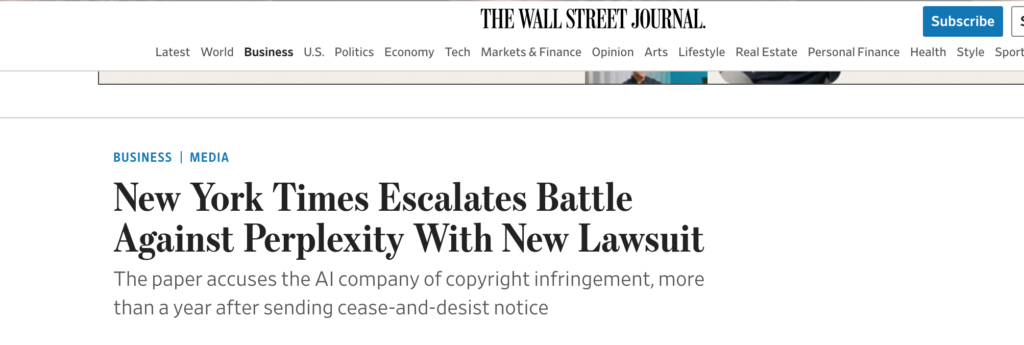
The New York Times suing Perplexity for copyright infringement is hilarious.
Reddit is even funnier.
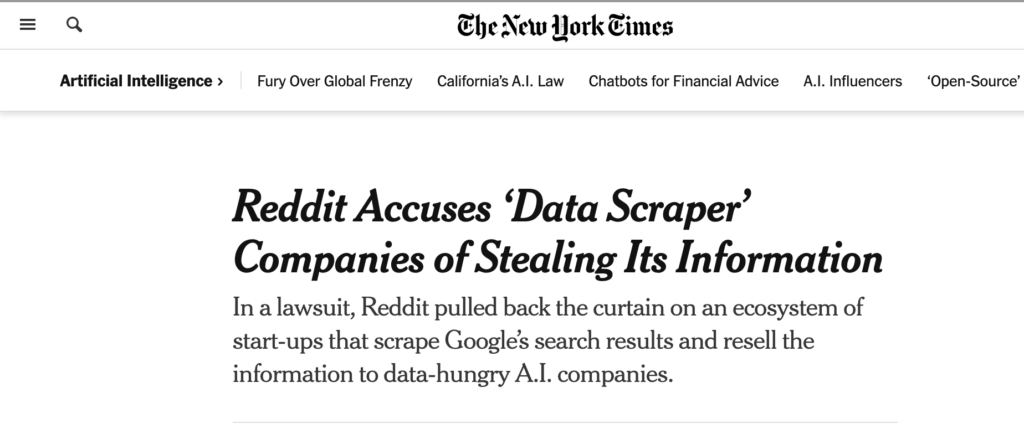
Let’s start with Reddit, the armpit of the Internet.
First of all, Reddit is a sweatshop of useless opinions which they get for free.
They do not pay for the content. They make money on volunteer slave labor.
Second, countless YouTube channels have scraped from Reddit for content for their channel, from The Void, That Chapter, and Chilling Scares to name three.
The Daily Mail and the New York Post also liberally crib from Reddit.
So legacy media and social media, Gen 1 and Gen 2, can do what they want, but not Gen 3.
AI reads a lot of content and post just a fraction of it (not all of it, and Perplexity references what they use with footnotes, just as those whose content depends on Reddit do the same). The quantity does not matter.
Third of all, and this is the most important, Reddit posts do the same thing: they quote news stories and post links to them.
Reddit has no case against Perplexity. If the Internet Archive can keep archives of their old pages, Perplexity can scrape information as well. This is laughable.
Now, let’s get back to the New York Times and their losing case against Perplexity.
The Times does not get their information from nowhere. They don’t generate facts: they find them and then report them.
They find a lot of facts from other places, and place them in a warehouse they call a newspaper.
They don’t pay for that information. They find it, and they throw it in their warehouse from interviews to government reports to police reports. None of that content is original.
There is something called a newspeg in journalism: whatever other media outlets cover and how they cover them is what is newsworthy.
In other words, journalism is a profession where scraping is baked into its scaffolding.
And that means that literal scraping is part of the profession: I wrote about this practice in my books, including OutFoxed. I have letters journalists wrote to me, defending their lousy coverage bragging their “research” was reading the New York Times and the Washington Post and then reporting what they read.
Scraping is not just an accepted industry practice: it is an essential component of it.
I worked in journalism. Editors and producers ordered me to read or watch competitors to find information and angles constantly. Scraping is the norm.
The New York Times cannot claim any sort of copyright infringement: their job is to disseminate information to the public who do with it whatever they want: from blogging about it to writing books with the information, to ranting about it on social media. Their mandate is to inform.
Again, AI does not reproduce everything: it spits back a fraction, the same way traditional search engines have a snippet of information in their results, and no one ever sued Netscape, Yahoo, or Google for it.
No media outlet owns the facts they found.
This reminds me of a woman who took one of my mother’s jewelry-making classes. My mother taught a stitch with a pattern. The woman did it well enough that she decided to sell her work in stores, but was terrified: what if someone stole her idea?
Never mind she did not invent or create the stitch or pattern. She learned it from my mother who taught the same technique to hundreds of other people.
Once you put your information out in public, people will take it without attribution, and Perplexity gives attribution. This is fair use.
People try to argue about quantity, but they have no case. There is no limit to the number of articles anyone can read. There is no law stating that I have to even pay for the product to read it.
Both legacy media and digital media made their fortunes by getting free information.
They can quote this blog post without crediting me or compensating me. They can do it for one article or for thousands.
As someone whose ideas and work has been repeatedly appropriated by both legacy and digital media, there was nothing I could do: people liked my distinctive vision and then they pretended that they came up with it.
At least Perplexity credits with references, footnotes, and links. They will win both cases with ease.
These are relics of an old era trying to stop the natural progress of civilization.
And it’s not working.