
Why Do Narcissists Hate AI?

There is a very specific kind of person who loves social media but froths at the mouth over AI. Social media can wreck attention spans, fuel harassment, and turn elections into influencer campaigns, and they barely shrug. AI, on the other hand, must be banned, jailed, exorcised, and dropped into a volcano.
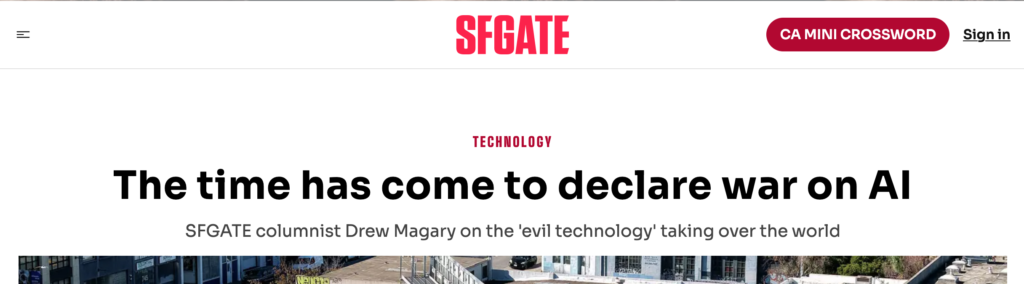
The SFGate “declare war on AI” screed is a perfect example: an overwrought manifesto that blames a tool for every sin committed by the people running it, then declares the tool “evil” because it has the audacity to exist and not be impressed. That isn’t analysis. That’s narcissistic injury with adjectives.
Social media is a narcissist’s dream: an infinite hall of mirrors where they can pose, posture, and perform to a scoreboard of likes and shares. Platforms are designed to reward exactly the traits they pride themselves on:
- Constant self‑display.
- Manufactured drama.
- “Hot takes” that require more outrage than evidence.
Yes, social media has real harms. But it also offers narcissists what they crave most: a never‑ending spotlight and a built‑in audience. They will never call for the abolition of their favourite mirror. They need it too badly.
AI, in contrast, is a terrible audience and an even worse fan club. It does not care who you are, who you know, or how many followers you have. It responds to prompts, not status. It will cheerfully give someone with no connections a better draft, a clearer outline, or a sharper argument than the “important” person who used to monopolize those skills.
To a narcissist, that is unforgivable. Their unspoken hierarchy is simple:
- They are the default genius in the room.
- Their intuition outranks your data.
- Their feelings outrank your results.
AI punctures that fantasy. It lets “ordinary” people brainstorm, organize, learn, and create without going through a gatekeeper who demands admiration as a toll. That’s why the attacks have to be dramatic and apocalyptic: “AI is evil,” “AI is killing us,” “AI is waging war on mankind.” If they admitted it’s a tool with risks and benefits, they’d also have to admit the real problem is how humans deploy it. Worse, they’d have to admit it’s helping people without them in the middle.
Have you noticed how proudly uninformed the loudest AI‑haters are about what the technology actually does? They’ll rant about chatbots and cheating, but go strangely silent when AI is:
- Detecting cancers earlier in scans.
- Helping clinicians triage and prioritize treatment.
- Supporting disabled and neurodivergent people with planning, communication, and organization.
- Assisting teachers in adapting materials for different learners.
They don’t want to know. Learning would mean admitting they aren’t already the expert. Narcissists treat their own opinion as sufficient research. If they feel AI is evil, then it is: no trials, no data, no lived experience from people whose lives are actually improved.
That’s not ethics. That’s epistemic narcissism: the belief that “if I didn’t think of it, it doesn’t count.”
If they were genuinely concerned about what harms people, social media would be first on the chopping block. It has:
- Well‑documented links to anxiety, body‑image issues, and polarization.
- A business model that thrives on outrage, envy, and addictive use.
- A track record of amplifying disinformation, bullying, and extremism.
Yet you don’t see the same operatic calls to “ban social media” and throw CEOs into Supermax. Why? Because social media still serves them. It gives them attention. It lets them cultivate audiences who will recycle their talking points and feed their sense of importance.
AI does the opposite. It levels the playing field. It undermines “I alone see through everything” branding by letting other people see through things too. That’s why the tantrums are reserved for AI.
AI is not a saint. It can be misused. It can amplify existing power structures. It can be rolled out irresponsibly, with real consequences. That absolutely demands regulation, transparency, and accountability, and not just from AI firms, but from governments and legacy institutions that are happy to exploit it.
But it is also an antidote to some of the worst social‑media pathologies:
- Instead of rewarding the loudest voice, it can help quieter people articulate their thoughts.
- Instead of locking users in their feeds, it can help them summarize, cross‑check, and contextualize information.
- Instead of centralizing power in a few “star experts,” it can distribute cognitive tools to people who would otherwise be excluded.
That is exactly what narcissists can’t stand: a technology that doesn’t need them, doesn’t flatter them, and quietly empowers the people they’ve been talking over.
Criticizing AI is not the problem. Blind evangelism is as dangerous as blind panic. The problem is a very loud, very self‑important minority trying to turn their personal ego injury into public policy, screaming that the technology must disappear because it refuses to worship them.
They never declared war on the platforms that monetized their vanity. They declare war on the tool that refuses to care who they are.
That tells you everything you need to know about where the real “evil” lies: and it isn’t in the silicon.