The Telescope · Chapter One

"You have been successfully convinced that nothing can be done."

Once you see this pattern here, you will see it everywhere. An investigation into the world's most elaborately constructed illusion of inevitability — and the real cracks already forming in it.

By Alexandra Kitty
Published June 2026
Subject: Elon Musk

The most effective form of control is not the iron fist. It is the settled feeling that the person holding the fist is so big, so entrenched, so woven into the infrastructure of daily life, that resistance is not just futile — it is naive. You are not oppressed. You are simply being realistic.

Elon Musk has achieved something remarkable: he has constructed a presence so total — controlling a dominant communications platform, holding billions in government contracts, inserting himself into the machinery of the federal state through DOGE — that many observers treat his dominance as a fact of nature rather than a political and financial arrangement that can, and does, have vulnerabilities.

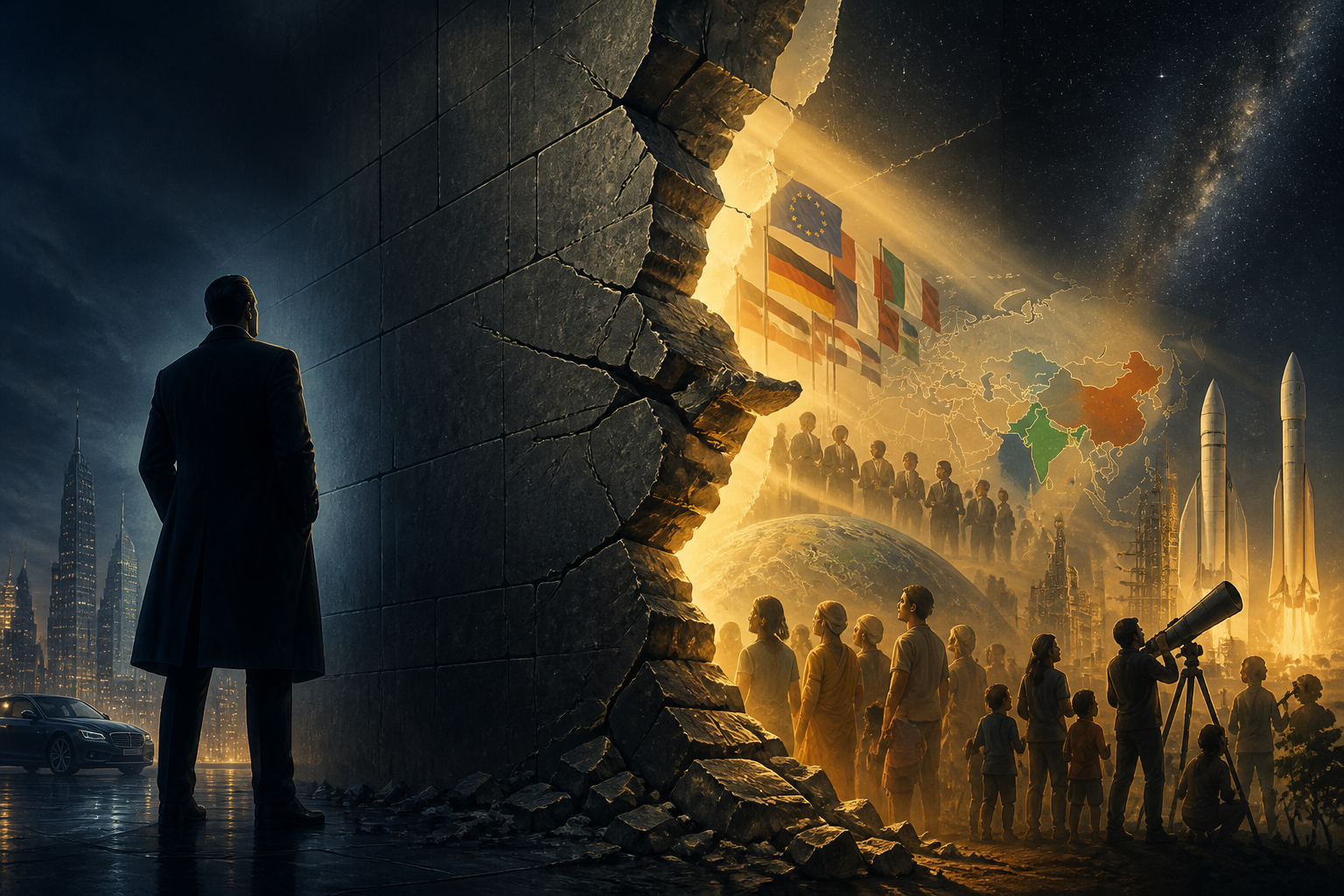
This chapter does not argue that Musk is all-powerful. It argues the opposite. The monolith is made of glass. And glass, when you apply even moderate pressure at its stress points, cracks.

"The façade of a monolith depends entirely on no one looking too closely at the seams."

— The Telescope, Chapter One

What follows is a tour of those seams: how Musk's narrative control through X works and is already degrading; how his trillionaire status was built substantially on public money and is now structurally dependent on government contracts he simultaneously pretends to reform; and how his access to federal data through DOGE represents a conflict of interest without precedent in modern democratic governance.

Then we turn the telescope outward, and look at why blocs like the EU and BRICS are actively building away from dependence on his infrastructure — and why SpaceX's own IPO filing tells the story of a company that is far more fragile than its valuation implies.

Act I

The Feed

When the subject of the story controls the wire, who is actually doing the journalism — and who is being managed?

Narrative Infrastructure

He doesn't just shape the news. He is the distribution system.

X (formerly Twitter) remains the primary real-time wire for politicians, journalists, and markets. When the owner of that wire is also a major government contractor, what you see is not a news platform. It is a propaganda asset with a subscription tier.

X Ad Revenue Lost
−59%
Since Musk's acquisition in 2022, X ad revenue fell from $4.5B to approx. $1.8B in 2025 — a near-60% collapse. Major brands including AT&T (−99%), Disney (−98%), and Apple reduced spending by over 95%.
Platform Still Controls the Narrative
~215M
Daily active users in mid-2025, down from a peak of ~260M. Despite commercial decline, X remains the primary wire for political and financial elites — giving Musk outsized narrative leverage relative to X's actual health.
xAI Revenue Backstop
$2B
Projected xAI revenue flowing into X's finances by 2026. X's social data trains Musk's AI products — the platform's user base effectively subsidizes his AI empire even as advertisers flee.

The structural advantage is not that X is profitable — it isn't, not conventionally. The advantage is that X remains essential infrastructure for elite communication. Journalists who cover Musk depend on a platform he owns and can algorithmically reward or penalise. Politicians who need to reach media cycles post on a platform he controls. Advertisers who fled on brand-safety grounds — AT&T from $33.4M to $0.1M, Disney from $27.7M to $0.5M — discovered they could not boycott completely without losing access to the conversation.

This is the architecture of soft control: not censorship, but friction. The costs of sustained critical scrutiny are higher on X than anywhere else, precisely because critical scrutineers are using the infrastructure of the person they are scrutinising.

X (Twitter) Ad Revenue Decline, 2021–2025
Annual advertising revenue in billions USD — the commercial cost of Musk's editorial control
2021
$4.5B
2023
$2.3B
2024
$1.7B
2025
$1.8B
Pre-Musk acquisition
Post-acquisition decline

If the primary "newswire" for politics and markets is owned by a defence contractor and trillionaire, can any coverage of him be truly independent? How often do major outlets cite his posts on X uncritically as if they were neutral information — rather than strategic narrative placements?

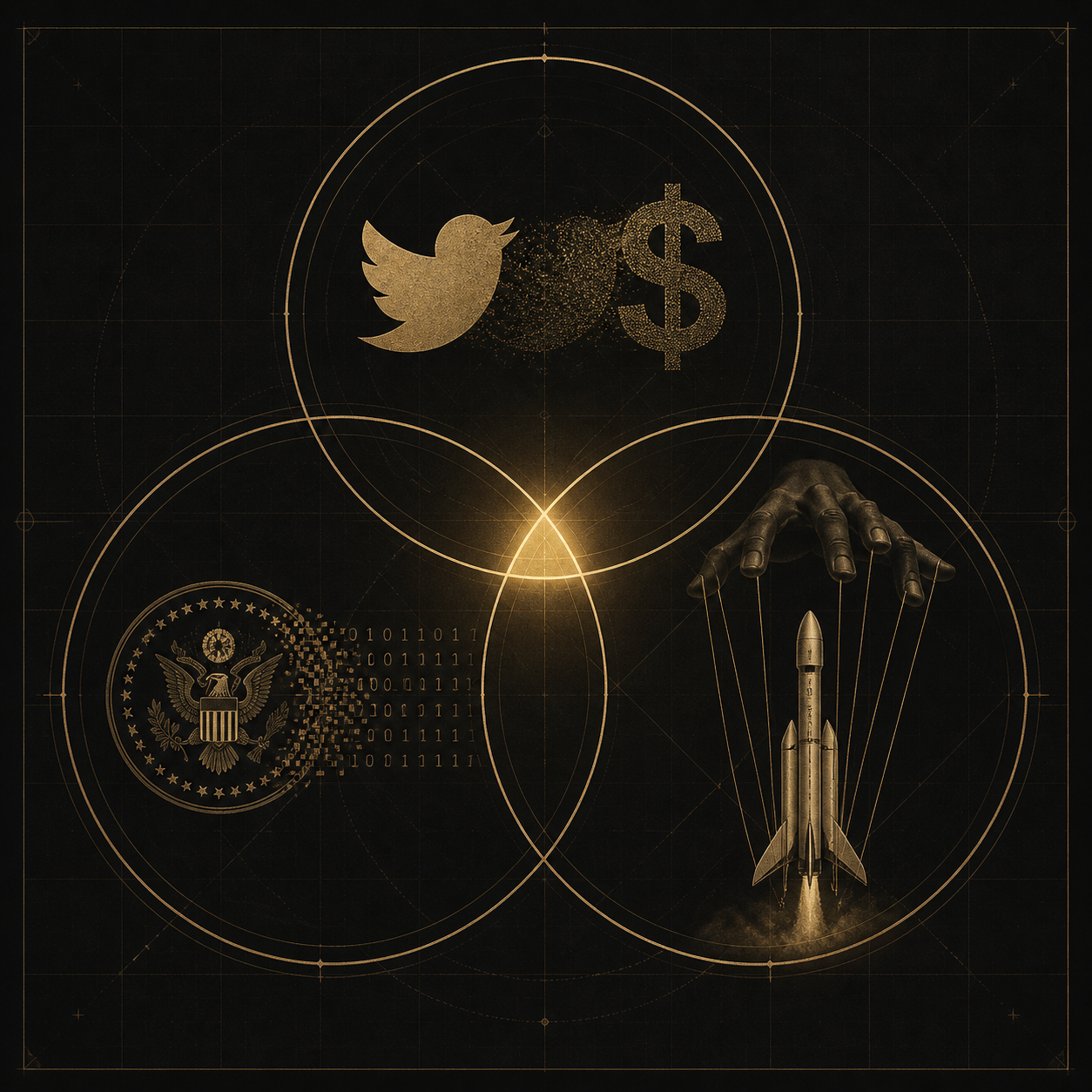
The three power circles: narrative control (X), data access (DOGE), and financial dependence (SpaceX/government contracts).

Act II

The Bill

How much of the world's first trillionaire's fortune was state-sponsored — and what did you get in return?

Government Dependency

The anti-government disruptor runs on government money.

SpaceX completed the largest IPO in U.S. history in June 2026 at a $1.77 trillion valuation. Its own IPO filing disclosed that one-fifth of its 2025 revenue came from a single customer: the U.S. government. By Q1 2026, government contracts had grown to 46.7% of its Space segment revenue.

SpaceX IPO Value
$1.77T
SpaceX priced its IPO at $135/share raising $75B — the largest in U.S. history, surpassing Saudi Aramco's record. Musk retains ~82% control after listing.
Gov't Share of Space Revenue Q1 2026
46.7%
Government launch and development contracts grew from 34.6% in Q1 2025 to 46.7% in Q1 2026 — growing faster than any other revenue segment, per SpaceX's own S-1.
Pentagon Contracts
$6.45B
Space Force awarded SpaceX $6.45B ahead of its IPO — including $4.16B for Golden Dome missile-defence satellites. This was disclosed weeks before public trading began.

The trajectory is unambiguous: SpaceX's commercial revenue (launches sold to private customers) fell from 65.4% to 53.3% of its Space segment between Q1 2025 and Q1 2026, even as government revenue grew. Analysts at the IPO flagged that "the financial projections are uncertain due to the heavy reliance on substantial government contracts." The company that promises to make humanity multiplanetary is, in terms of current revenue, increasingly a government launch provider wearing a visionary narrative.

This matters because Musk simultaneously ran DOGE — an initiative officially aimed at cutting government spending and bureaucracy — while his companies were negotiating and receiving those same government contracts. Senator Adam Schiff formally pressed the White House in February 2025 on whether Musk, as a "special government employee," was observing federal conflict-of-interest laws that prohibit officials from engaging in matters where they have a financial stake. Tesla and SpaceX had by that point received at least $15.4 billion in government contracts over the preceding decade, according to a New York Times analysis cited in the complaint.

08
From 2008
The Government-Funded Origins
SpaceX received over $24.4 billion in government grants, loans, and contracts since 2008. Early NASA Commercial Orbital Transportation Services contracts kept the company alive during years of losses.
23
2023
Pentagon Ukraine Starlink Deal
The Pentagon awarded SpaceX a ~$23M contract to use Starlink to support military operations in Ukraine. Starlink had initially provided civilian services — the military dependency formalised a strategic asset.
25
Jan–May 2025
DOGE + Contracts Conflict
Musk leads DOGE while his companies hold $15.4B+ in federal contracts. A federal judge restricts DOGE's access to Treasury payment systems. Congress formally questions conflict-of-interest compliance. White House says Musk will "excuse himself" from conflicts — without explaining the mechanism.
25
Oct 2025
$2B Golden Dome Satellite Deal
SpaceX positioned to win a $2B Pentagon contract to develop satellites for Trump's Golden Dome missile and aircraft tracking system. Contract later formalised as part of $6.45B in Space Force awards.
26
June 2026
IPO — Trillionaire Status
SpaceX IPOs at $135/share, valuing the company at $1.77T. Musk becomes the world's first trillionaire. One-fifth of SpaceX's 2025 revenue came from U.S. government, per the S-1. CNN and others explicitly note the company's rise was aided by U.S. government support.

"Tesla's earnings fell in nine of ten quarters. X lost 59% of its ad revenue. Neuralink went quiet. Yet SpaceX bucked every trend — because SpaceX has something the others don't: a captive government client whose budget is not subject to market forces."

— The Telescope, Chapter One: Act II

Tesla reported its adjusted income fell 16% in Q4 2025, with net income plunging 61%, and recorded the largest year-over-year sales volume drop in its history. Tesla's annual income by 2025 had shrunk to 30% of its 2022 peak. The company scrapped its flagship Model S and Model X to concentrate on robots and lower-cost vehicles. X's advertising business had lost nearly 35% of revenue over three years, with the majority of top global brands having reduced investment. Yet Musk's net worth hit a trillion dollars.

The variable that explains the divergence is not genius or vision. It is federal procurement. SpaceX projected $22–24 billion in 2026 revenue — more than NASA's entire budget — and the largest single driver of that growth is long-term government contracts, some lasting up to 14 years. When you build infrastructure that governments genuinely cannot do without (launch vehicles, military communications satellites, missile-defence systems), you have created a revenue stream that does not depend on the market believing your other ventures are viable.

If public money and policy made Musk a trillionaire, what oversight do citizens have over how his platforms and rockets are used? Why is there so little mainstream framing of Musk as a creature of state industrial policy — rather than a lone "genius founder"?

Act III

The Database

What happens to democratic accountability when a single oligarch sits astride both the communications layer and key national-security infrastructure — while also curating his own mythos in real time?

Data, Power, and Democratic Accountability

He didn't just cut government. He got inside it.

DOGE's stated mission was efficiency. Its operational reality — access to fifteen federal agencies, sensitive personal data, Treasury payment systems, and Social Security records — represents something closer to privatised state intelligence. The judiciary pushed back. The public record is patchy. The data trail is unknown.

Federal Agencies Accessed
15+
As of February 2025, DOGE had gained access to at least 15 federal agencies, per ABC News tracking. Agencies included Treasury, Social Security Administration, Department of Defense, and others.
Whistleblower Complaint
SSA
The Social Security Administration disclosed that DOGE staff accessed and shared sensitive data of 1,000 individuals via encrypted email, stored on third-party cloud servers outside SSA security protocols. The data may still exist on those servers.
Court Restrictions
2× blocked
Federal judges twice restricted DOGE's access — first to Treasury's payment processing system (handling 90% of federal payments), then to additional sensitive datasets. The Brookings Institution noted DOGE sought to build a "one big, beautiful database."

The DOGE data push was not just about cutting spending. Court documents, whistleblower complaints, and investigative reporting reveal that DOGE staff at Social Security signed an agreement with an unnamed political advocacy group to analyse voter rolls to "find evidence of voter fraud and to overturn election results in certain states." This is not fiscal efficiency. This is a private operator, embedded in the federal apparatus, accessing population-level data for political purposes while simultaneously negotiating defence contracts worth billions.

Combine that with Musk's Starshield programme — a classified version of Starlink providing secured satellite communications to U.S. intelligence agencies — and the picture that emerges is of a single individual who controls the dominant political communication platform (X), holds intelligence-community contracts (Starshield), accessed broad swathes of civilian federal data (DOGE), and is the primary civilian launch provider for the U.S. military (SpaceX). No single non-governmental actor in modern American history has occupied all four of those nodes simultaneously.

The most important question this raises is not whether Musk is acting with malicious intent. The question is structural: in a functioning democracy, who provides oversight when the auditor, the contractor, the data custodian, and the publisher are the same person?

Would you give this person your Social Insurance Number? Consider: through DOGE's access to Treasury, SSA, and federal HR systems, you effectively already may have.
Where the Monolith Breaks

The empire has stress points. Here they are.

The façade of inevitability requires that no one notice that blocs are rerouting around it, that his own companies' fundamentals tell a contradictory story, and that the IPO has handed the public a transparent view of the vulnerabilities for the first time.

Europe is building away

In October 2025, Airbus, Leonardo, and Thales announced a merger of space operations into a "European Space Champion" employing 25,000 people with €6.5B annual revenue — explicitly described as a response to SpaceX. The EU has also funded six Starlink alternatives including Eutelsat, SES, and the OneWeb network.

€6.5B rival consortium launched

Europe refuses dependence

In 2026, European nations chose to build their own defence satellites at five times the cost rather than use SpaceX. YouTube reported Europe saying "No to SpaceX — not because it doesn't work, but because it works too well to depend on." Dependence on a single operator for critical infrastructure is geopolitical risk.

5× cost premium to avoid dependency

Competitors are closing

Blue Origin is accelerating commercialisation and competing for government contracts directly. Rocket Lab has emerged as "the most credible challenger to SpaceX in launch services." The IPO will fund expansion, but it also hands competitors a transparent view of SpaceX's cost structure, margins, and government-contract dependency.

Rocket Lab: fastest-growing challenger

Tesla: the brand collapse

Tesla's US sales fell 8.37% in 2025 vs 2024 — on top of declines of 91,000 units in Europe and at least 28,000 in China. The company scrapped its two flagship models. Earnings fell in nine of ten quarters through 2025. The brand association with Musk's political activity drove a documented consumer boycott in key markets.

−204,965 global units sold in 2025

The Pentagon relationship is volatile

In May 2026, Musk publicly accused the Pentagon of violating the terms of its Starlink contract — accusing his most important customer of contract breach. This illustrated the contradiction at the heart of SpaceX's model: a company whose revenue depends on government good will, whose CEO's political persona requires performing conflict with government.

Musk accused Pentagon of contract breach

The IPO as X-ray

SpaceX's S-1 filing disclosed it reported losses last year and generates one-fifth of revenue from a single government customer. Analysts noted the company targets a $28.5 trillion market — but its current revenue model is a government launch utility. The IPO transforms private mythology into publicly auditable reality. Musk retains 82% control but the numbers are now on record.

Losses reported year before $1.77T IPO

The convergence of these stress points matters because each crack is independent but they reinforce one another. If the Pentagon relationship deteriorates further, government contract revenue — now 46.7% of SpaceX's Space segment — becomes uncertain. If European alternatives reach launch parity even at higher cost, the commercial launch market shrinks for SpaceX. If Tesla's brand recovers without reconnecting to Musk's political persona, it will do so by distancing from him — and the broader mythology of the "Musk empire" as a unified success story weakens.

None of these is a catastrophic failure point in isolation. Together, they are the anatomy of a glass monolith: impressive at a distance, transparent up close, and liable to shatter along its stress lines when enough pressure accumulates.

Turn the Telescope

The Mirror Test: What if this were someone else?

The most clarifying exercise in critical analysis is to ask: if the same structure of power — owning the communications platform, holding defence contracts, accessing government data, receiving public subsidies — were held by a different kind of actor, would the coverage be the same?

What if Musk were Russian — or Chinese?

Imagine a single Russian oligarch who owned the primary real-time news platform used by Western politicians and journalists, held multi-billion-dollar contracts with the Russian military for satellite communications, accessed the Kremlin's population data under a "government efficiency" initiative, and whose rocket company provided over 46% of the Russian military's launch capacity under 14-year contracts — while performing a public persona as an anti-establishment disruptor.

There is no version of that scenario in which Western media does not describe it as state capture, information warfare, and a national security emergency requiring immediate legislative response.

The same structure, in a Western context with an American accent and a libertarian aesthetic, is covered as "controversial" at best and as "visionary disruption" at most. That gap in coverage is not accidental. It is the product of the same ideological capture that allows elites to operate in plain sight — because the observers are using the infrastructure, repeating the frames, and finding the alternative analysis too large and too uncomfortable to pursue.

Once you see the pattern here, you will see it everywhere. That is the function of The Telescope: not to make you paranoid, but to make you precise.