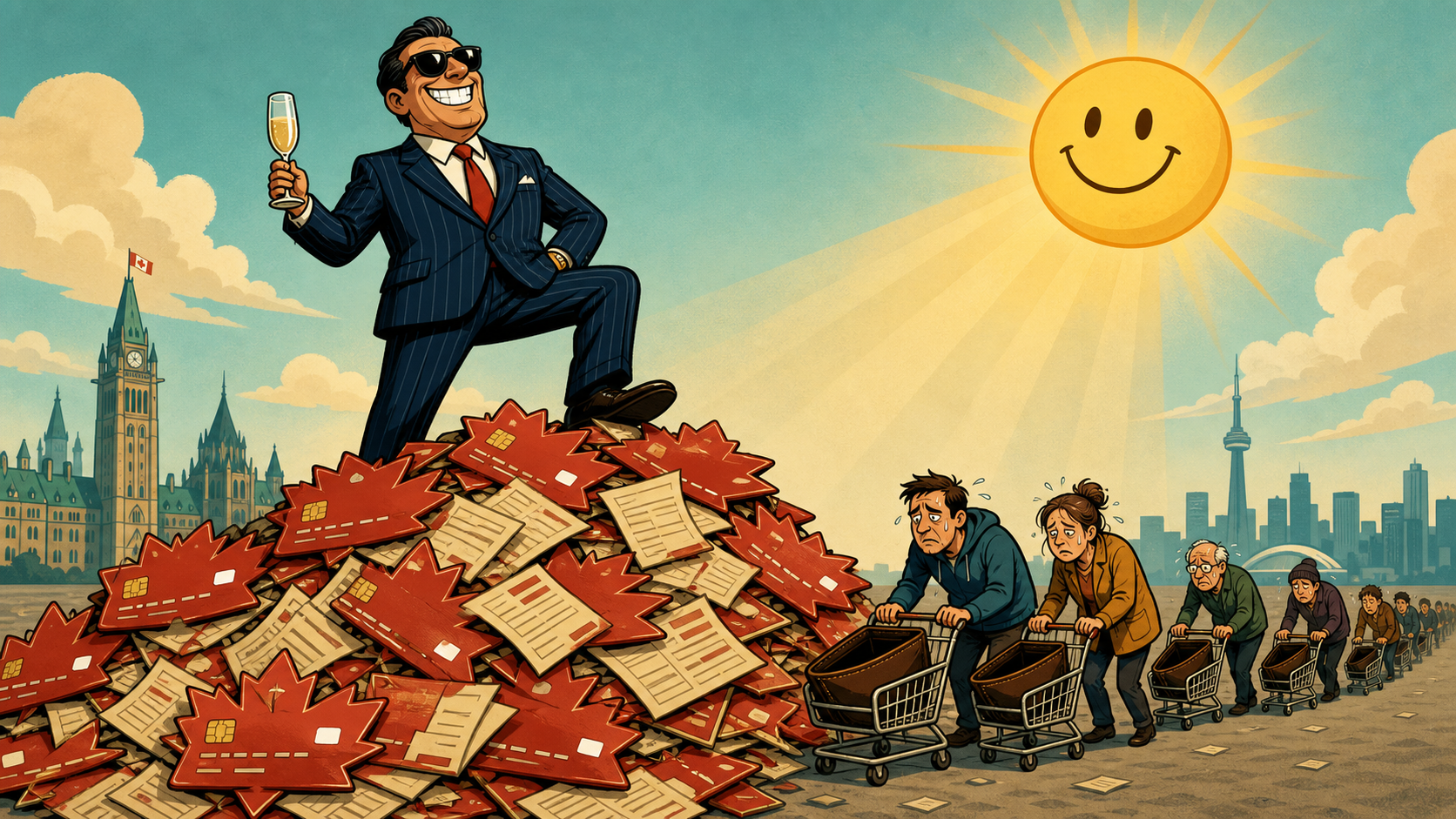
Equifax Canada walked into a parliamentary committee room and did something almost nobody in Ottawa does anymore: told the truth out loud. Debt levels for the working poor, the credit bureau said, are now "staggering," and "this gap has widened drastically". Naturally, the appropriate response from a satire desk is to note that the man now running the country's finances spent thirteen years at Goldman Sachs and ran two central banks before deciding the best use of that resume was Canadian politics. What could possibly go wrong when the guy who understood the plumbing of global finance takes over a country where the plumbing is currently on fire?
The Numbers Don't Lie, They Just SighThe Staggering Part, Quantified
For anyone who wants their despair delivered with citations, the Bank of Canada's own 2026 Financial Stability Report insists household debt is "high but below its peak," which is the financial equivalent of telling someone their house fire is "smaller than last year's house fire". Meanwhile total consumer debt hit $2.66 trillion in the first quarter of 2026, up 3.8 per cent year-over-year, and insolvencies climbed to their highest level since 2009.
"This gap has widened drastically." — Equifax Canada, telling a House of Commons committee something everyone already knew but nobody wanted printed
Meanwhile, At The TopThe Man With The Rolodex Full of Central Banks
The Prime Minister's own reported net worth sits somewhere around $6.97 million USD, built on stints at Goldman Sachs, the Bank of Canada, the Bank of England, and a board seat at Brookfield Asset Management. This is, to be fair, "modest" by international banker standards, which is a category of wealth where "modest" still means most Canadians could not pay it off before retirement even if they stopped eating. It is simply a fun bit of dramatic irony that the person best positioned to understand exactly how a debt spiral works is the one currently standing at the top of one, smiling for the cameras.
A Brief, Entirely Fair Comparison
Average non-mortgage debt per Canadian in Q4 2025: $22,377. Prime Minister's approximate net worth: $6.97 million. Ratio of PM's wealth to average citizen's debt: roughly 311 to 1. Ratio of "understanding" to "empathy" currently unclear, pending further study.
The Youth Are Not AlrightAges 26 to 35 Deliver An Encore Performance
Consumers aged 26 to 35 posted the highest delinquency rate of any age group in Canada at 2.55 per cent, an 8.39 per cent year-over-year worsening. Ontario, where delinquency rose 10.31 per cent year-over-year, is apparently the overachiever's overachiever in this particular event. Truly a banner year for the province that also happens to host the nation's capital of finance and the seat of federal government, which is either irony or just Tuesday.
- Total household credit market debt: $3.07 trillion and climbing, because apparently trillion is the new billion.
- Debt-to-income ratio: $1.75 owed for every $1 of disposable income, which is less a ratio and more a cry for help.
- Canada holds the highest household debt level among G7 countries, a podium finish nobody is putting on a mug.
- Missed payments held steady at 1 in 21 consumers in Q1 2026, technically "stable," which is doing a lot of heavy lifting as a word.
A Word From Our Sponsors, Sort OfThe Rate Cut Fairy Tale
Every time the Bank of Canada trims its policy rate, some bright-eyed headline declares "relief for borrowers," as if shaving a quarter point off a mortgage renewal is the financial equivalent of a spa day. Never mind that Canadians are still carrying $1.75 in debt for every dollar they actually take home — the vibes, apparently, have improved. It's the fiscal version of turning the thermostat down one degree in a house that's already on fire and calling it "climate action."
Fun With Compounding
If Canada's $2.66 trillion in consumer debt were stacked in $100 bills, it would circle the equator roughly 68 times. The Prime Minister's reported $6.97 million net worth, stacked the same way, would circle a Tim Hortons parking lot. Once. Slowly. While everyone inside argues about double-doubles they can no longer afford.
Breaking: Water Is WetOttawa Announces It Is "Monitoring The Situation"
Somewhere in a boardroom with a view, someone with three degrees in monetary policy is nodding gravely at a slide titled "Elevated but Manageable," which is bureaucrat-speak for "we saw this coming and did the amount of nothing that felt politically survivable." Insolvencies are at their highest since 2009, which — for context — was the year everyone agreed banks had learned their lesson. Reader, they had not.
"Households and businesses remain in stable financial condition overall." — Bank of Canada, 2026 Financial Stability Report, using the word "overall" to do the same job a magician's cape does
The Sunny Spin, As PromisedBut Here's The Good News
Denial: Canada's Real Renewable Resource
Studies on optimism bias consistently show that people who avoid checking their bank balance report higher day-to-day happiness than people who actually look. So really, when you think about it, refusing to open that credit card statement isn't financial avoidance — it's a proactive wellness strategy. Sure, the debt-to-income ratio is 174.7 per cent, but did you know that "not knowing your exact number" reduces cortisol by an amount we are choosing not to look up? Ignorance isn't just bliss anymore, friends. In this economy, it's a coping mechanism with a maple leaf on it.
Bonus Silver Lining: You're Basically an Investor Now
Every dollar of interest paid on that ballooning credit card balance is technically "capital deployed into the Canadian financial services sector." You're not drowning in debt, you're diversifying a major bank's revenue stream. Some would call that a bailout. The Gazette calls it civic duty, unpaid, involuntary, and renewed monthly at 22.99% APR.
So chin up, Canada. The plumbing may be leaking, the man who used to fix plumbing for a living is now in charge of the house, and the water bill is "staggering" according to people whose entire job is measuring water. But the sun is out, the loonie is doing its best, and if you squint hard enough at your bank app, you almost can't read the balance at all. Sunny ways. Sunny ways. Eh.
This is satire, produced for editorial commentary and commentary purposes only. All statistics are drawn from cited public reporting; the jokes are entirely the author's own doing and should not be attributed to Equifax Canada, the Bank of Canada, or anyone's actual bank statement.