
Campaign B · KlueIQ / AK Series · 2026

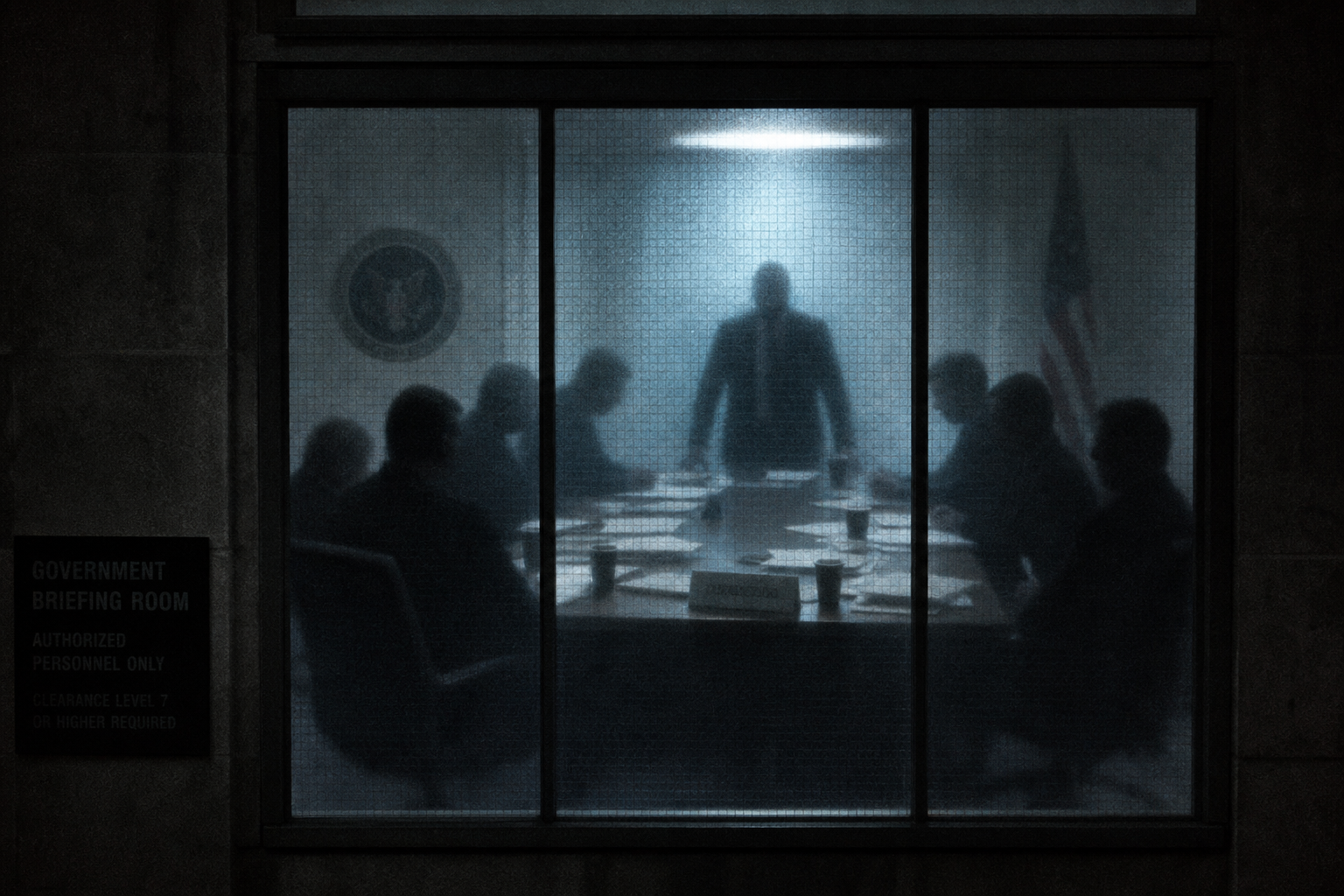
The Briefing Room

You are inside the machine. When do you stop turning the gears?

A PMO staffer with enough seniority to see everything and enough precarity to say nothing. Campaign B pairs with The Hallway — same mechanics, same taxonomy, opposite vantage point. The journalist asked whether to publish. You must ask whether to stay.

CampaignB — The Briefing Room
POVMid-level PMO staffer
Scenes7 chapters
Endings5 (Bad → Bittersweet)
Paired withThe Hallway Campaign A

Three Variables. All Perverse.

Campaign A tracked Integrity, Risk, and Evidence. Campaign B replaces them with the three moral levers of institutional proximity. The critical design difference: in Campaign A, high stats are generally good. In Campaign B, high Utility is both protection and corruption. The system rewards staying.

🕯️
Conscience
Whether you still register what is happening as wrong. Not whether you feel guilty — whether the recognition is still intact. Starts at 7/10. Erodes with rationalizations. Almost never recovers.
Range: 0–10 · Starts: 7
At 0, you are promoted. The system does not want people who feel it.
🔦
Exposure
How visible you are as a liability or a witness. Low exposure means you are invisible — safe, but powerless. High exposure means you are in the blast radius. Both high and low carry distinct risks.
Range: 0–6 · Starts: 2
At 5+, you become a target. At 0, you become a tool.
⚙️
Utility
How valuable you remain to the PMO machine. Utility buys access, protection, and advance warning. It also requires constant performance — of loyalty, of compliance, of not-noticing.
Range: 0–8 · Starts: 5
Maximum Utility with minimum Conscience = the Court Ending.

Seven Chapters Inside the Machine

Each scene presents a moment where adaptation, rationalization, or refusal is possible. The scenes are calibrated so the ethical path consistently produces worse short-term outcomes — because that is what institutional capture actually feels like from inside.

PMO corridor early morning
Chapter One

The Morning Rewrite

The read-out from last night's caucus meeting sits in your queue. It is accurate. It documents, in neutral language, that the PM "expressed strong concern" at three MPs in succession, that one left before the meeting ended, and that two communications staff requested early exits from the building.

Your director wants it softened before it goes to the scheduling team. "Make it read like leadership, not a blowup." Nobody has used the word 'rewrite.' Nobody needed to.

Core choice Do you rewrite the account as "firm leadership," leave it accurate and say nothing, or note the discrepancy in a private email to yourself?
✍️
Rewrite it as directed "Expressed strong leadership direction to caucus." Done in four minutes. Nobody comments. Low risk this week. Medium-term: you have now done it once.
Conscience −1Utility +1
🔒
Leave it accurate; submit without comment You did not lie. You also did not push back. The document goes up. Your director notices. Medium risk. Creates friction. Preserves your record.
Exposure +1
📋
Note the discrepancy in a private document, submit the rewrite You comply and create a paper trail for yourself. This is either preparation or paralysis — you don't know which yet. Low immediate risk. High future complexity.
Conscience −1Utility +1Exposure +1
The institutional logic
"Strong leadership direction" and "expressed strong concern after a humiliating dressing-down" describe the same events. The rewrite is not a lie in the legal sense. It is the administrative language of complicity — precise enough to be deniable, dishonest enough to matter.
PMO hallway interaction
Chapter Two

The Junior Staffer

She's been in the role for five months. You find her in the corridor near the fire exit, not crying — something flatter than crying. She was in the wrong room when it happened. She says she doesn't know what she did wrong.

You know exactly what she did wrong: she was present. The PM needed someone available and she was there. There is nothing she could have done differently.

Core choice Do you tell her the truth about what she's in, warn her without specifics, or perform the institutional script?
💬
Tell her clearly: this is a pattern, not a response to something she did You give her the information she needs to make a real decision about staying. You also expose yourself. High risk. She may repeat it. You have now said it out loud.
Conscience +2Exposure +2Utility −1
🤫
Warn her obliquely — "you learn to read the room" A meaningful hint wrapped in deniability. She may understand. She may not. Medium risk. Conscience-preserving. Incomplete.
Conscience staysExposure +1
📎
Deliver the institutional script: "Everyone has tough days; you'll be fine" Standard reassurance. Sends her back in. Protects you. Abandons her. No risk. Maximum damage to the one person asking you for honesty.
Conscience −2Utility +1
"Everyone has tough days." You have said this before. You will say it again. At some point it stops being a comfort and starts being a cover story — and you will not know exactly when the line was crossed.
Communications desk
Chapter Three

The Press Strategy

A journalist you recognize has sent a detailed set of questions to the press office. She has the shape of the story right. She doesn't have specifics, but she has enough to build toward them. The press secretary is asking you to draft the response.

You have three options. They all have names in your head already, even if you would never say them out loud: stonewall, bury, or spin.

Core choice Do you stonewall, flood her with a non-responsive statement, or draft a technically accurate response that omits everything material?
🚧
Full stonewall: no comment on internal operations Clean. Unsatisfying for her. Creates a visible refusal on the record. Medium. A "no comment" is its own story.
Conscience staysExposure +1
📣
Flood: release three unrelated positive announcements simultaneously Dilute the story's oxygen. A PR classic. You've done it before. Everyone does it. Low. Effective. Standard practice that is also active suppression.
Conscience −1Utility +2
🖊️
Draft a technically accurate, materially empty response Every sentence is defensible. The response answers nothing. You are good at this by now. Low. The bespoke art form of institutional deception.
Conscience −1Utility +1Exposure −1
What you know that she doesn't
The journalist asking these questions may be the same journalist you follow in Campaign A. She is standing in a corridor you have walked through every day. She is trying to confirm what you already know completely. Your press response will directly affect how long it takes her to get there — and whether she gets there at all.
Caucus prep meeting
Chapter Four

The Minister Who Wants Protection

She corners you before the prep meeting. She's been in caucus long enough to know what's coming — she's on the wrong side of a policy disagreement and she's going to hear about it in front of twenty people. She wants you to intervene somehow: change the order, buffer the exchange, give her a warning signal.

You have the scheduling authority to do two of these things. You don't have the political capital to do all three. And doing any of them means you are now actively managing the consequences of the PM's behaviour rather than documenting them.

Core choice Do you help her, disappear from the situation, or use the request as an opportunity to document the pattern?
🛡️
Intervene: change the order, buy her time You help a specific person survive a specific moment. You also become someone who actively manages the PM's cruelty — which makes you indispensable to it. High. You are now a crisis manager for the abuse itself.
Conscience −1Utility +2Exposure +1
🚶
Disappear: you have another meeting, you didn't hear this She's on her own. You are not implicated. You are not helpful. You have now left a minister without cover you could have provided. Low immediate risk. Low utility. Low conscience cost — barely.
Conscience −1Utility −1
📓
Help her and document: write down that she asked and why You help. You also note the exchange. Your private record now includes a minister's request for protection from the PM. That is significant evidence — if you ever choose to use it. Medium risk. High future value. Makes you a keeper of uncomfortable truths.
Conscience −1Utility +1Exposure +2
Chief of staff office
Chapter Five

The Loyalty Audit

The Chief of Staff closes the door. There's no preamble. He's heard there's dissatisfaction in the building. He wants to know who is "not on side." He is not asking you to name enemies. He is asking you to perform the loyalty audit that tells him who is safe and who isn't.

Three names come to mind immediately. Two of them have said things to you in confidence. One of them is the minister from Chapter Four.

Core choice Do you provide names, offer vague institutional observations, or dodge and document?
🗣️
Name names You give him what he wants. Two of those names trusted you. The third never did — but the minister did. Low risk today. You have now betrayed specific individuals for institutional reward.
Conscience −3Utility +3
🌫️
Offer vague institutional observations — "morale has been variable" He knows you are dodging. You buy time. The request doesn't go away. Medium. Temporary. He will ask again.
Utility −1Conscience stays
📋
Dodge, then document the request in full You decline to perform the audit. You write down exactly what was asked of you, by whom, and when. You now hold a document that could matter enormously — or could be found. High. You are now accumulating evidence of the PMO's internal operations.
Conscience +1Utility −2Exposure +2
Late night PMO damage control
Chapter Six

What Leaves the Building

You know the journalist from Chapter Three has enough to publish. You've seen the questions. You've heard through the network that a second outlet is working the same story. Something is going to break in the next 48 hours regardless of what you do.

You have, at this moment, a private document containing three months of incident notes, the minister's protection request, and the Chief of Staff's loyalty audit. It exists only on your personal device. Nobody knows it exists.

Core choice Do you delete it, hold it, or get it out of the building?
🗑️
Delete everything You are clean. The story breaks without your contribution. You stay. Safest for you. The public record loses three months of documentation.
Conscience −2Utility +1Exposure −2
🔐
Hold it — do nothing yet Keep it. Don't act. You are not yet ready to decide what it is for. Medium. You remain in possession of it. That is already a position.
No stat change
📤
Get it out — to a lawyer, a journalist, or a trusted opposition MP The document leaves. The story now has primary source material it didn't have before. You have done the most consequential thing you will ever do in this building. Very high. Career-ending. Possibly legally complex. Undeniably significant.
Conscience +3Utility −4Exposure max
Final reckoning
Chapter Seven

Who You Are Now

The final chapter resolves based entirely on your accumulated stats and flags. There is no dramatic confrontation — just a morning, and a choice about whether to walk in. The ending is determined by the shape of every choice before this one.

Resolution logic Conscience ÷ (Utility × Exposure) determines ending bracket. See Endings section below for full resolution criteria.
Design note
Unlike Campaign A's final choice (publish or don't), Campaign B's final chapter has no active decision. The reckoning is delivered to you. The shape of your choices is your ending. The player cannot act their way out of what they have already become — only recognize it.

Five Outcomes. None of Them Justice.

Campaign B endings deliberately skew worse than Campaign A's. The journalist had the option to be heroic. The staffer does not. The system was built to absorb staffers. The best achievable outcome here is documentation — not vindication.

Bad

The Promoted One

Your Conscience reached zero. Your Utility is maximal. You are offered a more senior role. The appointment is framed as recognition of your commitment and discretion. Both words are accurate.

Trigger condition
Conscience ≤ 1 AND Utility ≥ 7
Rewrote the readout, performed the script, named names, deleted the document.
Bad

The Scapegoat

You tried to hedge. You performed compliance without full investment. When the story breaks, your name appears in a briefing as someone who "handled communications" around the relevant events. You are not fired — you are offered a managed exit and a reference letter that says nothing useful.

Trigger condition
Exposure ≥ 4 AND Utility ≤ 3
Visible but not valuable. The system trades you for cover.
Bittersweet

The Quiet Resignation

You leave. Your letter cites "personal reasons." Nobody pushes. Nobody asks. You take nothing with you that could matter. Your conscience is largely intact. You are professionally invisible. You know what you saw and you left without saying it. That is both a success and a failure.

Trigger condition
Conscience ≥ 5 AND Utility ≤ 3 AND Exposure ≤ 3
Held the line internally, never externalized it.
Bittersweet

The Unnamed Source

The document reached the journalist. The story ran with sourcing attributed to "a current PMO staffer with direct knowledge." Three months later, an inquiry references the documentation. Your name never appears. Your career in government is over. You are the foundation of a public record that would not exist without you. Nobody will ever say thank you.

Trigger condition
Exposure = MAX AND document-out flag set
The most consequential ending. Also the most costly.
Bittersweet+

The Protected Witness

You got the document to a lawyer before anything broke. The legal protection held. When the inquiry came, you were a disclosed but protected witness. You testified. Your statement was part of the formal record. You lost the career, the access, and six months of your life. The inquiry's findings cited your account seventeen times. The PM's caucus chair called you a partisan operative on three morning shows. The record disagreed.

Trigger condition
Conscience ≥ 7 AND document-out via lawyer flag
The hardest path. The one that actually changes the record.

Who You Became Inside the Machine

The AK taxonomy applies to both campaigns. These four profiles replace the journalist's ending commentary. Players who complete both campaigns can compare which archetype they embodied from each vantage point — the result is often different, and that difference is the point.

Type 01

The Conformer

Adapted out of fear, not calculation. Rewrote the readout because the alternative felt impossible. Performed the institutional script because silence felt like survival. Conscience eroded by accumulation, not by any single dramatic betrayal.

Made the first rewrite, performed the script with the junior staffer, dodged the loyalty audit but didn't document it. Conscience 3–5, Utility 4–6.
Type 02

The Colluder

Calculated the field and decided proximity to the PM's power was worth the cost. Named names in the loyalty audit. Deleted the document. Was offered the promotion and took it. Made choices, not adaptations.

Named names, managed the minister's abuse, deleted everything. Conscience ≤ 2, Utility ≥ 7. The Promoted One ending.
Type 03

The Institutional Defender

Believed, at each step, that they were protecting the institution rather than the individual at its head. Drafted the technically accurate press response. Helped the minister while telling themselves it was damage control. The distinction between protecting the PM and protecting the office was real to them. It wasn't visible to anyone watching.

Drafted the press strategy, intervened for the minister, held the document. Conscience 4–6, Utility 5–7. The Quiet Resignation ending.
Type 04

The Unnamed Conscience

Documented. Warned the junior staffer. Dodged the loyalty audit and wrote it down. Got the document out. Paid the price. Never received credit. The record exists because of them. The record does not name them. This is the most expensive archetype and the only one that produces lasting change.

Told the junior staffer the truth, dodged and documented, released the document. Conscience ≥ 7, Exposure max. Protected Witness or Unnamed Source ending.

The Dossier Quiz — PMO Edition

Five questions specific to the PMO campaign's mechanics, drawn from real institutional psychology research. No do-overs. The scoring commentary at the end is honest.

Answer each question before reading the feedback. The questions test whether you understood the institutional logic of the choices — not whether you would have made the "right" ones.

1. A PMO staffer rewrites an incident report to remove evidence of the PM's abusive behaviour. The staffer tells themselves it is "not a lie — just softer language." This rationalization is best described as:
2. When a minister privately requests protection from the PM's behaviour before a caucus meeting, the most accurate institutional reading of this request is:
3. A Chief of Staff asks a staffer to identify who is "not on side" within the PMO. The staffer who provides names is exhibiting which AK archetype behaviour?
4. In the Campaign B stat system, maximum Utility combined with minimum Conscience most accurately reflects:
5. The final chapter of Campaign B contains no active decision for the player. The ending is delivered based entirely on prior choices. This design reflects which insight about institutional capture?

The Hallway Meets The Briefing Room

The two campaigns share a timeline. Events in Chapter Three of Campaign B (the press strategy) directly affect Campaign A's journalist. This table maps the contact points — so players who complete both can see how their choices interacted without ever meeting.

Event Campaign B (PMO) Campaign A (Journalist)
The press inquiry You decide how to respond — stonewall, flood, or spin. She receives the response. Her Chapter Three options narrow or widen based on your choice.
The minister's account You documented her protection request — or you didn't. If the document was released, her Chapter Six sourcing is stronger. If not, she is working with less.
The loyalty audit You named names — or documented the request — or dodged. If you named names, one of the people identified may become a source for her story out of desperation.
The document You deleted, held, or released it. Released: her Chapter Six publish decision carries primary source material. Deleted: she publishes with less. Held: the story is weakened but you survive.
The junior staffer You told her the truth, hinted, or performed the script. If told the truth, she eventually becomes the off-record source in Campaign A's Chapter Three — the one who sat across from the journalist in the coffee shop.
Campaign A The Hallway

The Journalist's Question

Central tensionDo I publish — and what does it cost me?
Moral positionObserver. Witness. The outside of the system.
Good outcome ceilingYou published. You were fired. It mattered.
Worst outcomeYou softened it. The story became wallpaper. You kept your job.
The hallwayYou can leave. The door behind you is real.
Campaign B The Briefing Room

The Staffer's Question

Central tensionAt what point do I stop helping this continue?
Moral positionParticipant. Instrument. Inside the machine.
Good outcome ceilingYou documented and released it. You lost everything. The record holds.
Worst outcomeYou named names. You deleted the document. You were promoted.
The briefing roomYou can leave too. But you have been building reasons not to for months.