WON'T SOMEONE
THINK OF
THE CHILDREN?
Canada's Definitive Guide to Panicking About the Wrong Things Since Forever
Sources confirm a Canadian legislator has learned children use the internet. Legislation expected by Thursday.
Year 12 of this not being front-page news. More at 11.
"The correlation was 15%," writes columnist who has never taken statistics.
SOCIAL MEDIA
IS KILLING
OUR CHILDREN!!!
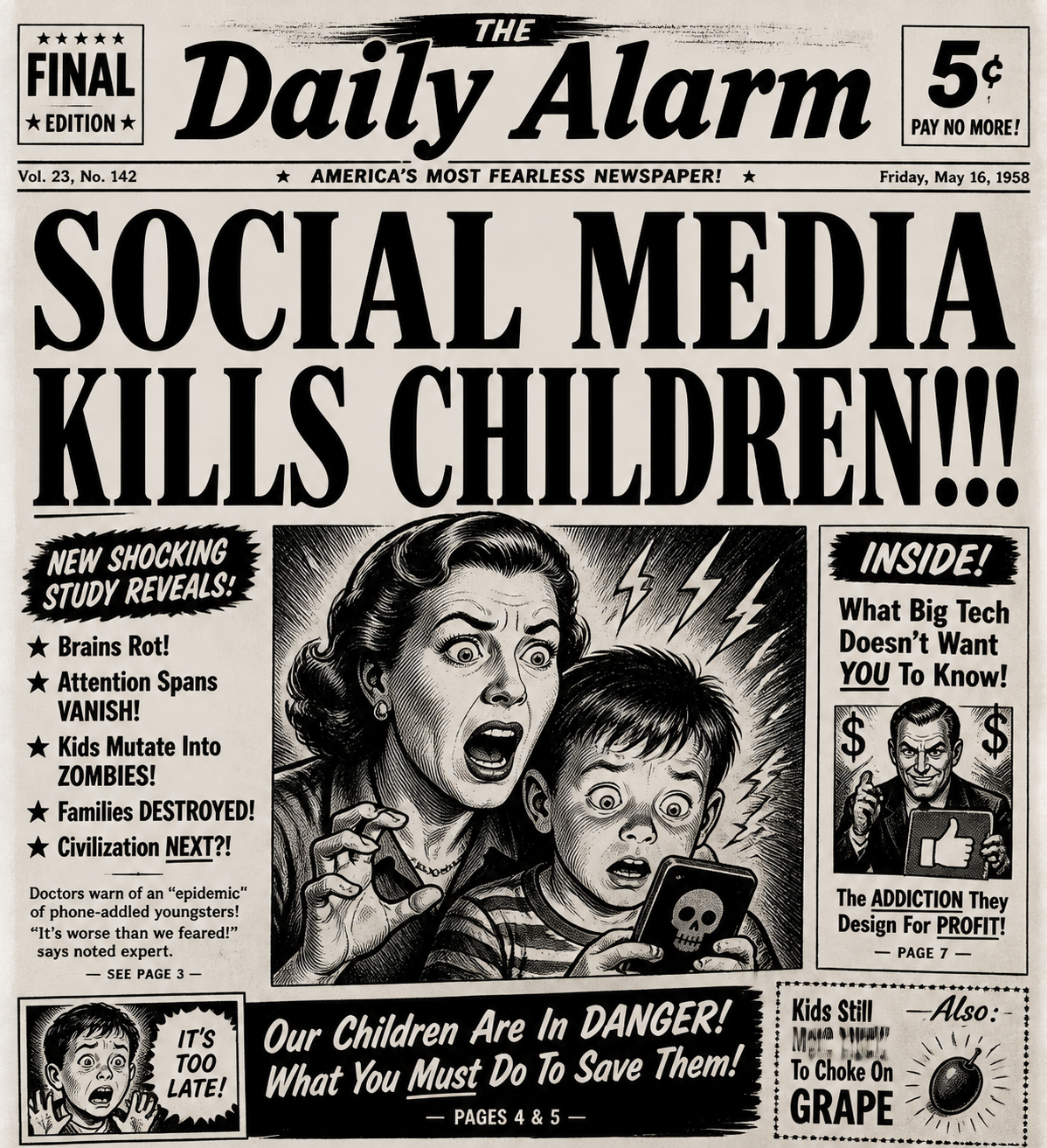
A satirical investigation into the gap between what politicians say kills children and what actually does.
Statistics Canada searched. Ctrl+F, the whole database. Nothing. We checked twice.
Still waiting for the press conference. Still waiting for the emergency legislation. Just... waiting.
PANIC
THE
PANIC-O-METER
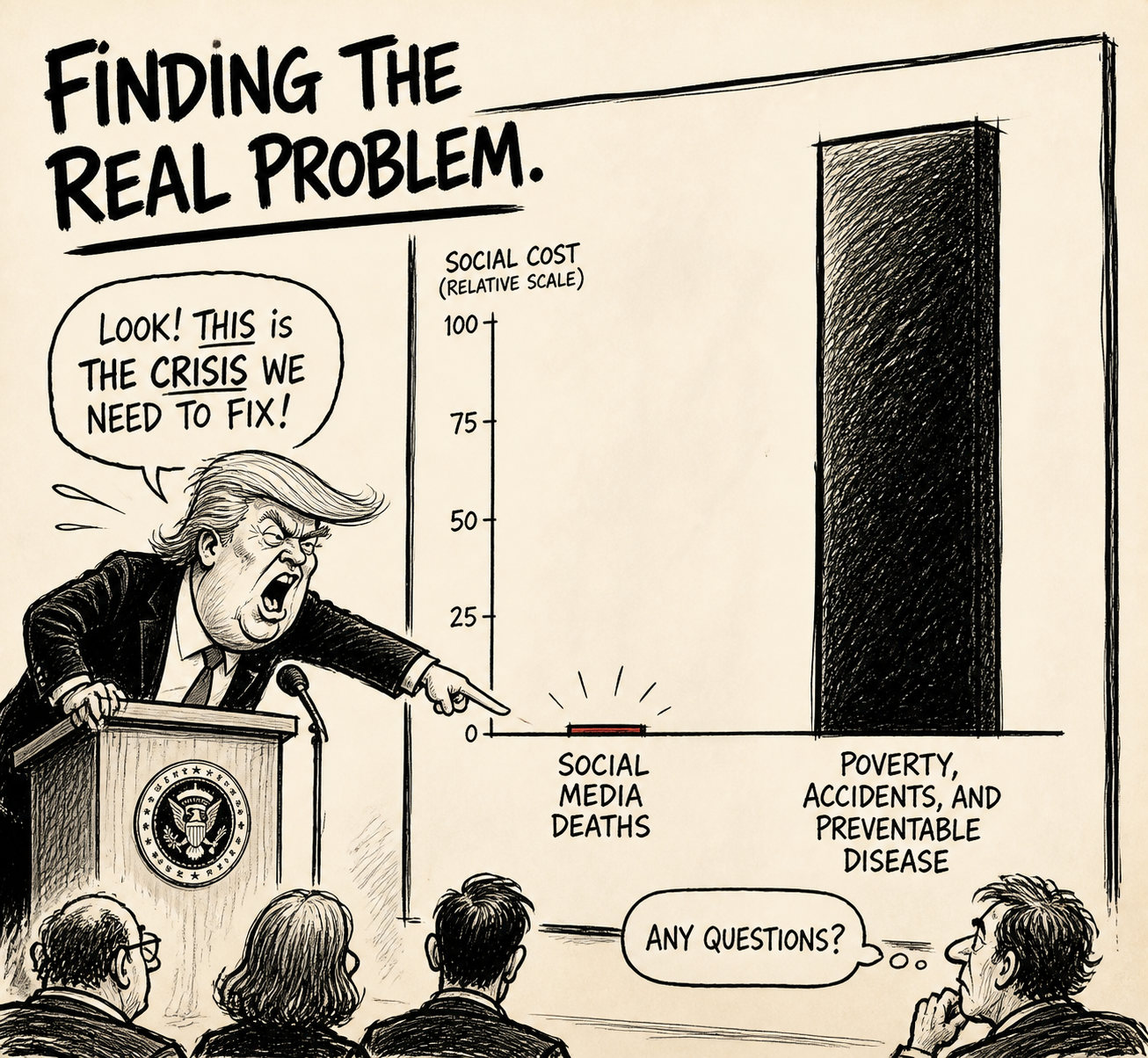
A scientific instrument for measuring the gap between political hysteria and statistical reality. Higher bars mean more media coverage and legislative energy. The gap between the bars is what we call "the problem."
Sources: Statistics Canada mortality tables, Parliament of Canada records, House of Commons Hansard, Canadian Press archives. The irony writes itself.
MORAL PANIC
BINGO
Play along at home during any parliamentary debate about children and technology.
The script of a moral panic is remarkably consistent. Whether it was comic books in the 1950s, violent video games in the 1990s, or social media today, the rhetorical playbook barely changes. New villain, same hysteria.
Political scientists call it "folk devil" construction: identify a threat, amplify it past all evidence, legislate. The children are always "at risk." The solution always involves restricting something. The underlying structural causes — poverty, neglect, inadequate services — never make the card.
"Kids are dying."— Minister Marc Miller, June 2026, justifying social media legislation while Nunavut's infant mortality rate quietly hummed along at 21.4 per 1,000.
To be clear: online harm is real. But "real" and "leading cause of child mortality" are not synonyms. When every public health dollar chases the panic, the silent killers — drowning, car crashes, preventable disease in underfunded communities — keep their body count.
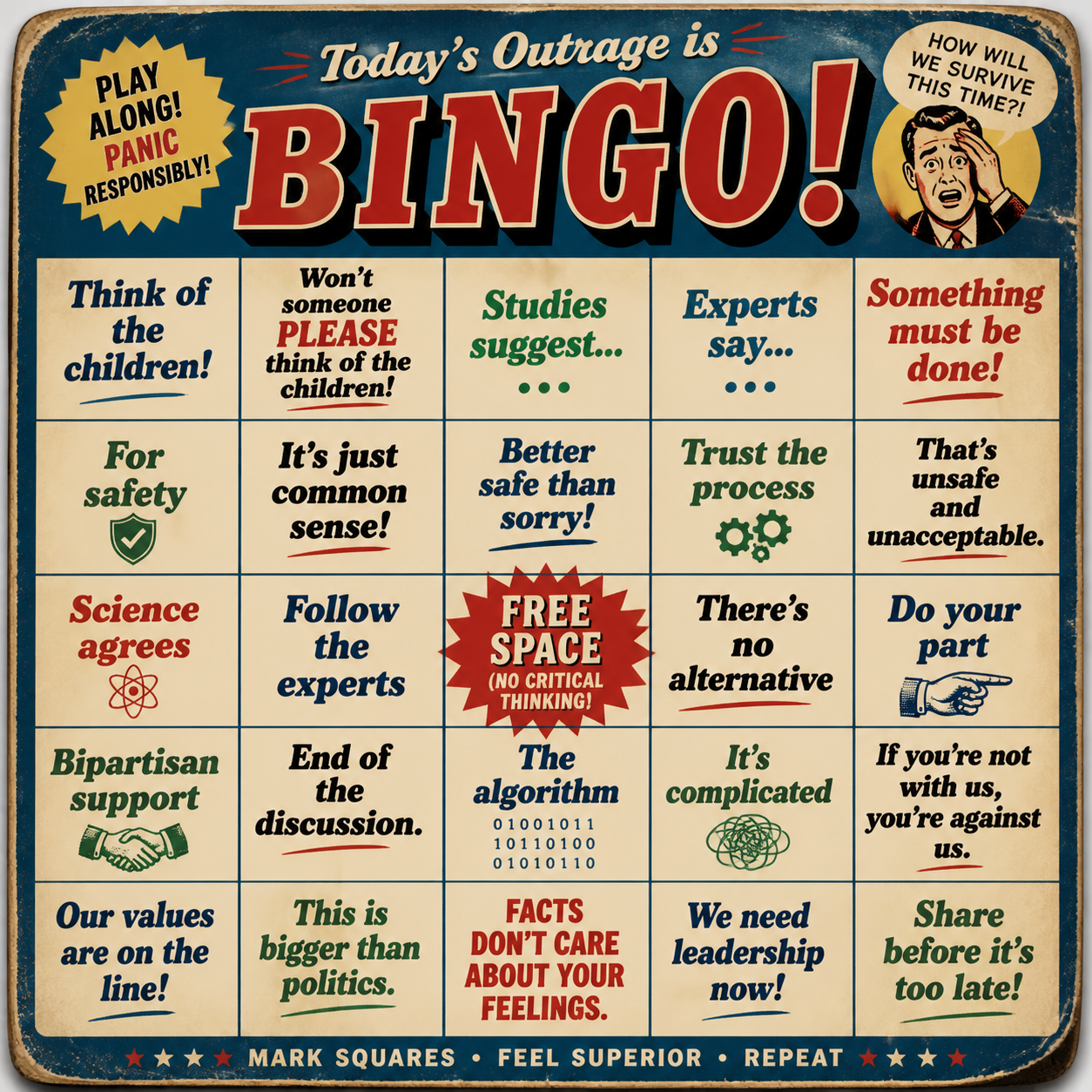
Print and play. Guaranteed BINGO within 8 minutes of any parliamentary committee hearing.
THE ACTUAL
SUSPECT
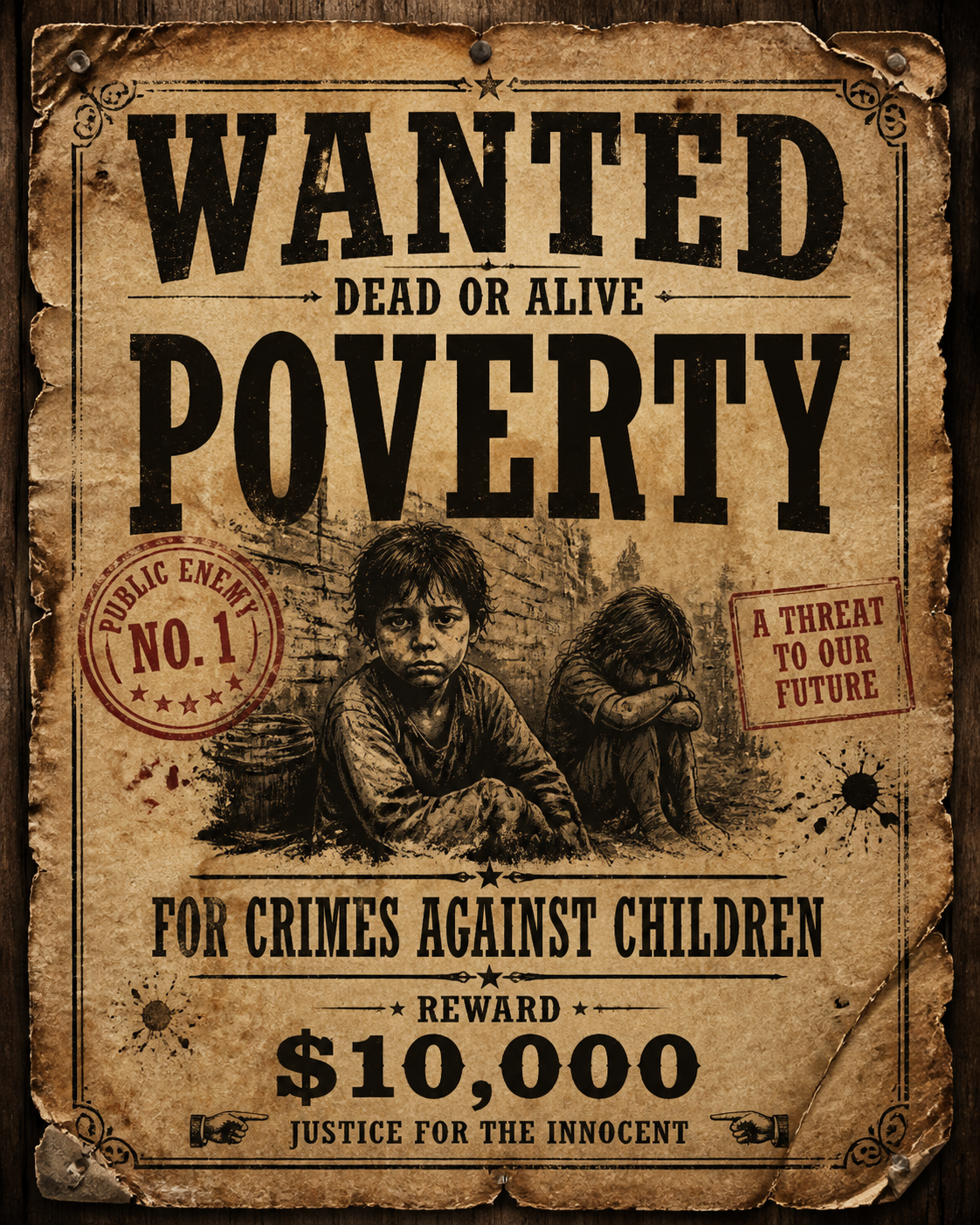
Has been operating in plain sight for decades. Extensive documentation. No arrest warrant issued.
Poverty doesn't get a press conference. It doesn't trend on social media. It doesn't make a good 30-second clip. It's slow, structural, and expensive to fix — which makes it the perfect legislative blind spot.
- 1 Nunavut Infant Mortality 21.4 per 1,000 live births vs. national 4.8. You are more likely to die as a baby in Nunavut than as a 70-year-old in the rest of Canada.
- 2 First Nations Child Poverty Rate 37.4% on reserve vs. 10.8% for non-Indigenous children. Poverty is not an equal-opportunity killer.
- 3 Tuberculosis in Nunavut 62× the national average. Caused by overcrowded housing. Not caused by Instagram.
- 4 Food Insecurity 4× the national average in Nunavut. Malnourished children have worse outcomes. This is not a controversial finding.
- 5 Inuit Youth Suicide Rate 30× higher than other Canadian youth. Driven by isolation, loss of culture, and absence of mental health services — not TikTok algorithm design.
- 6 Drowning (Ages 1–4) Together with suffocation, accounts for 40%+ of unintentional injury deaths in young children. Swimming lessons: not yet legislated.
THE CLAIM
VS. THE DATA
Every moral panic runs on a handful of claims that circulate faster than the debunking. Here they are, checked against the evidence.
| The Claim | Status | What The Data Says |
|---|---|---|
| "Kids are dying because of social media" | Claim | Not in Statistics Canada's top causes of death for any age group under 16. |
| "The science is clear" | Weak | Haidt's own data: 15% correlation. ITIF, Science Media Centre, and 70+ independent researchers: evidence does not support a ban. |
| "Social media causes teen suicide" | Contested | Correlation exists in some studies, not others. Confounding variables abound. Causation not established. |
| "We must act to protect children" | True | Agreed. Start with Nunavut's 21.4/1,000 infant mortality rate. Then First Nations child poverty at 37.4%. |
| Poverty kills more Canadian children than social media | Documented | Yes. By every available metric. Unambiguously. This is not in dispute. |
| Emergency legislation addresses the leading causes | No | Leading causes: accidents, cancer, congenital conditions, poverty-driven illness. Social media: not on the list. |
THINGS THAT WOULD ACTUALLY
SAVE CHILDREN'S LIVES
Evidence-based. Unsexy. No press conferences required.
Overcrowding drives TB rates 62× the national average. Adequate housing would directly reduce infant mortality, respiratory disease, and suicide risk.
Drowning + suffocation = 40%+ of unintentional deaths in under-5s. Subsidized swimming lessons and pool access are cheaper than one week of parliamentary hearings.
4× national food insecurity rate in northern communities. Nutrition directly affects infant mortality, development, and long-term health outcomes.
Brain cancer alone causes 41% of all cancer deaths in children ages 1–14. It appears in Statistics Canada's data. Repeatedly. Every year.
Inuit youth suicide is 30× higher than other Canadian youth. Remote communities lack basic mental health infrastructure. Broadband without therapists is not a solution.
Motor vehicle injuries account for ~75% of accidental deaths in older children. Infrastructure investment and enforcement saves demonstrably documented lives.
THE CHILDREN
ARE FINE.
MOSTLY.
Canada is one of the safest places on earth to be a child. Child mortality has fallen dramatically over decades of genuine public health work. The children most at risk are dying from poverty, accidents, and preventable illness — not from scrolling.
Acknowledging this does not minimize online harm. It means we should be able to hold two thoughts at once: regulate harmful platforms and fix the crumbling infrastructure in Nunavut. Emergency sessions for both, or for neither.
— PANIC! MEDIA INVESTIGATIVE UNIT
All statistics sourced from Statistics Canada, CIHI, FNIGC, and peer-reviewed literature. Snark sourced from lived frustration with evidence-free legislating.