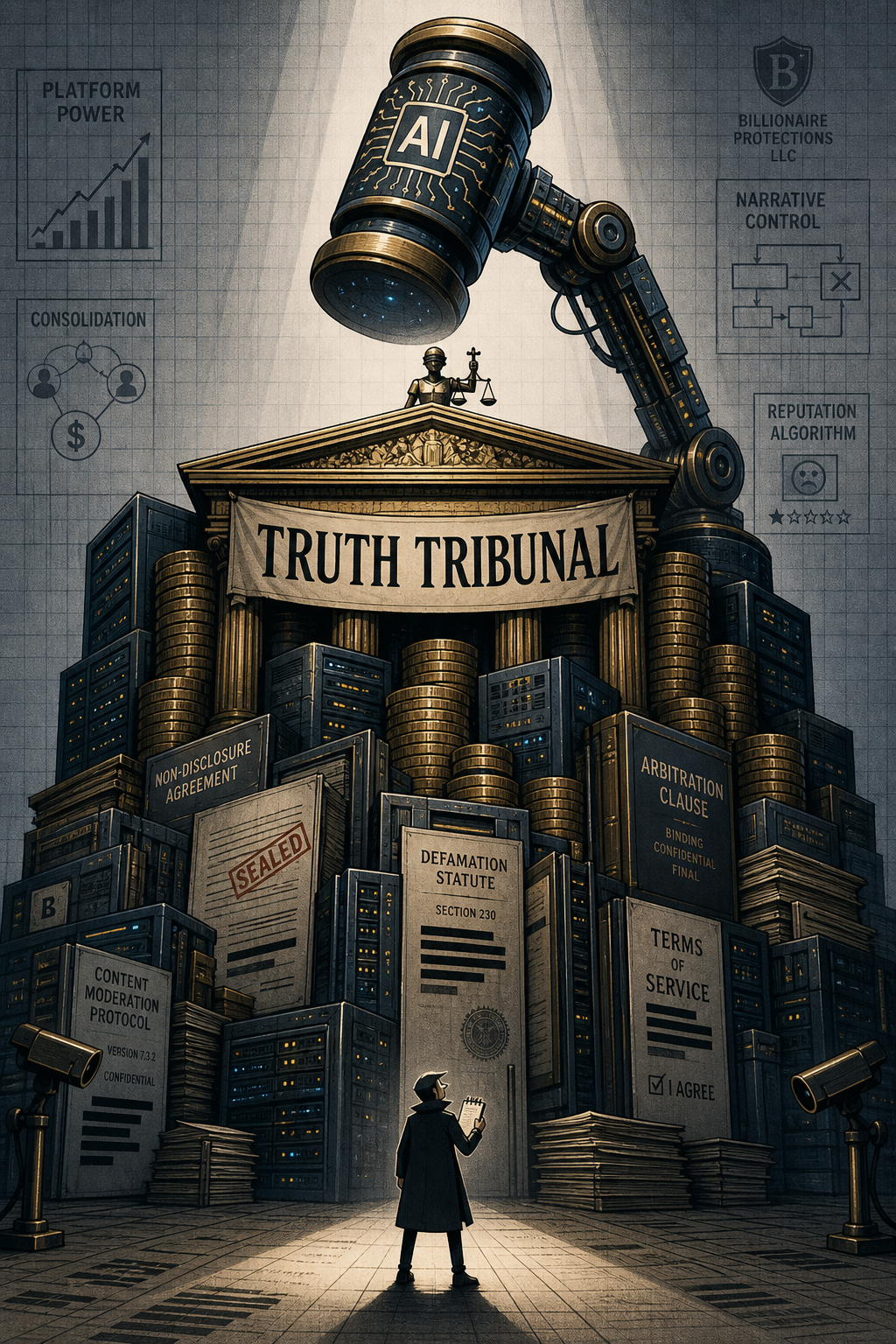
Satirical illustration: a towering AI courthouse looms over a journalist
An Interactive Documentary by AK

The Legitimacy Machine

When the powerful can't silence the press, they build a court. When the court fails, they build a machine. A satirical deep-dive into how elites manufacture pseudo-authority — and why it always falls apart.

June 2026 ● 15 min read ● Thiel · D'Souza · Miller
The Central Claim

People who want to manipulate press coverage are people with something to hide.

This is not a conspiracy theory. It is the straightforward logic of self-interest applied to information control. Every elaborate mechanism built to discipline journalism is, at its core, an admission of vulnerability.

In April 2026, a startup called Objection.ai launched with the backing of Peter Thiel and crypto evangelist Balaji Srinivasan. For $2,000–$15,000, you can submit a journalist's story to an "AI tribunal" staffed by ex-CIA, FBI, and NSA analysts, which will issue a public "verdict" on whether the reporting is truthful.

Around the same time, Canadian Heritage Minister Marc Miller introduced legislation allowing a federal regulator to issue blocking orders against social media posts deemed to undermine "social stability" — a phrase so elastic it could encompass nearly any criticism of any institution. The law, he noted, would apply "as soon as it comes into force."

Different mechanisms. Different actors. Same impulse: the powerful drawing lines in the sand and calling the lines law.

Satirical cartoon: a billionaire draws a line in sand while crowds ignore it completely
"A process that would take 5–10 years in court can now be completed in 72 hours."
— Aron D'Souza, Objection.ai co-founder, on industrialising what he did to Gawker

The statement is meant to sound like progress. Read it again. He is describing the compression of due process — with its appeals, its standards of evidence, its public scrutiny — into a private pipeline controlled by himself and his investors. The efficiency being celebrated is the efficiency of removing accountability from accountability.

This is not new. The technique is ancient. What's new is the costume: the language of AI objectivity, the theatre of an "impartial jury," the borrowed authority of intelligence community credentials. Pseudo-legitimacy 2.0.

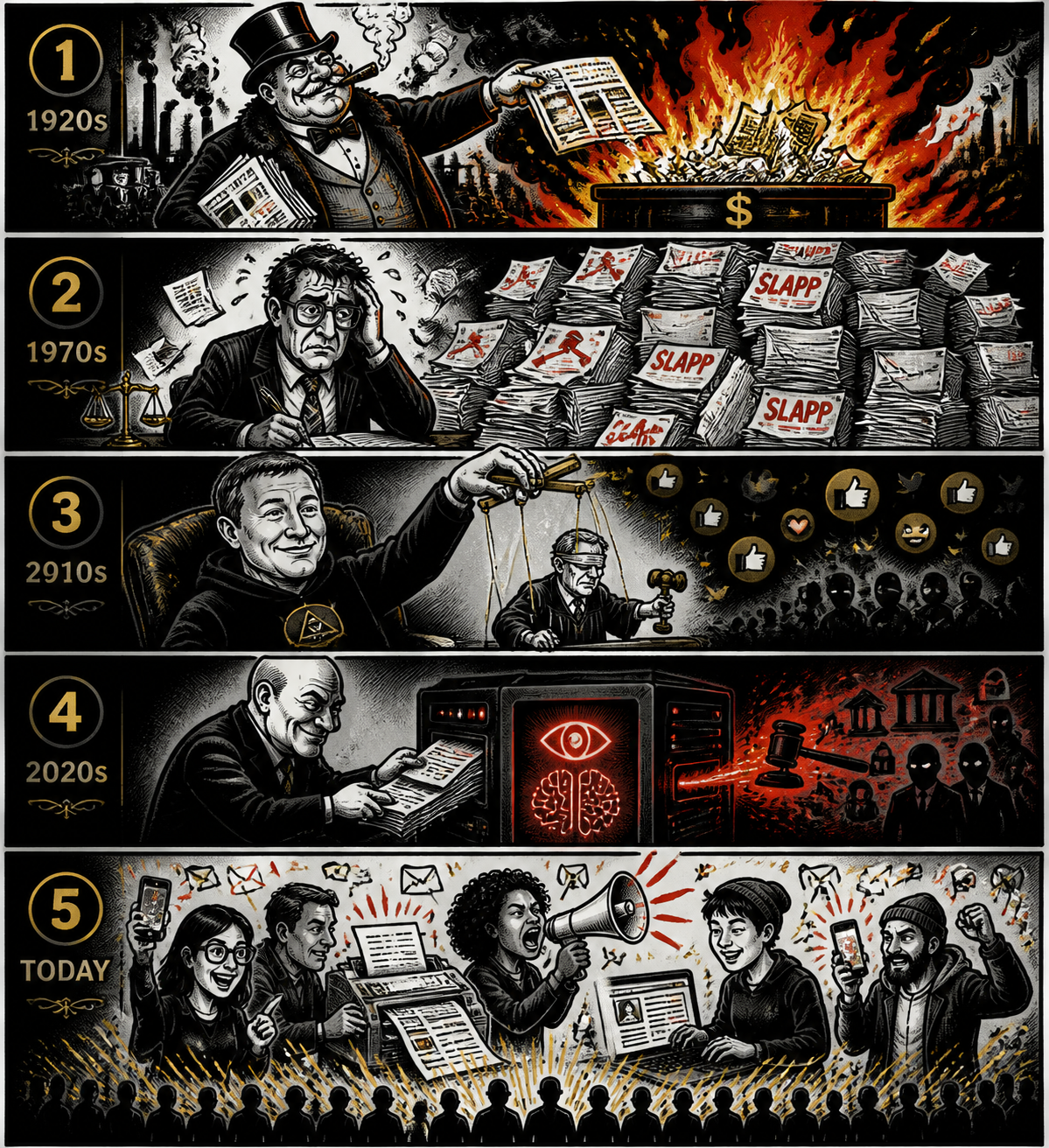
Editorial timeline illustration: from press baron suppression to AI tribunals

"The playbook never changes. Only the technology of the gavel."

Anatomy of Objection.ai

How to launder censorship as a product

The mechanics are revealing in their design choices.

01
Step One

File the Objection

Anyone — theoretically. But at $2,000–$15,000 per case, the real customer base is wealthy individuals and corporations who feel they've been reported on unfavourably.

02
Step Two

The Intelligence Team

Ex-FBI, NSA, and CIA analysts investigate the journalist's work. Their authority is borrowed from institutions they no longer represent. The badge is real. The jurisdiction is not.

03
Step Three

The AI Tribunal

LLMs from OpenAI, Anthropic, xAI, and Google are convened as "impartial jurors." Models trained on human text are presented as superior arbiters of human truth.

04
Step Four

The Public Verdict

A "ruling" publishes — even if the journalist declines to participate. Anonymous sources are pre-ranked as less credible. Whistleblower claims sit near the bottom of the hierarchy.

05
The Add-On

The Fire Blanket

A monitoring service that watches social media for mentions and auto-triggers objections. An always-on reputational defence system — for those who can afford the subscription.

06
The Tell

No Participation Needed

If the journalist doesn't respond, the verdict is issued anyway. This is not a dialogue. It is a declaration dressed in procedural clothing.

Historical Pattern

The line in the sand: a history

Objection.ai is the latest entry in a long tradition of powerful interests constructing private mechanisms to discipline public speech.

I
Early 20th Century
The Press Baron Model

Wealthy owners controlled newspapers directly, spiking stories about themselves or allies. The mechanism was ownership. The legitimacy claim: editorial discretion.

Mechanism: Ownership
II
1970s–1990s
The SLAPP Era Begins

Corporations and powerful individuals began filing Strategic Lawsuits Against Public Participation — not to win in court, but to exhaust and bankrupt critics. The goal was never justice; it was silence through attrition.

Mechanism: Litigation Cost
III
2007–2016
Thiel vs. Gawker

After Gawker outed him as gay in 2007, Peter Thiel spent nearly a decade secretly bankrolling lawsuits against the outlet. The Hulk Hogan privacy lawsuit produced a $140 million judgment that pushed Gawker into bankruptcy. Thiel described it as "philanthropy."

Mechanism: Proxy Litigation
IV
2020s
The Platform Moderation Wars

Governments and billionaires alike demanded content moderation aligned with their interests. Canada's Bill C-63 proposed blocking orders for content undermining "social stability." The EU's Digital Services Act created compliance machinery smaller outlets cannot afford.

Mechanism: Regulatory Capture
V
April 2026
Objection.ai Launches

D'Souza explicitly frames it as "industrialising" the Gawker strategy. What took ten years and millions can now be done in 72 hours for $15,000. The privatised, AI-branded inquisition is now a subscription service. Rebuilt within two months after a wave of critical press coverage.

Mechanism: AI-Branded Marketplace
The "Stability" Sleight of Hand

Censoring for those already comfortable

Every suppression mechanism arrives wearing the language of protection. Social stability. Truth integrity. Child safety. Brand reputation. The noun changes; the grammar is always the same.

Canada's Heritage Minister Marc Miller introduced legislation allowing a federal censor to issue blocking orders against social media posts deemed to undermine "social stability." The vagueness is strategic: it creates uncertainty that chills speech through self-censorship, without requiring active enforcement.

This is the government's third attempt at such legislation. The previous two bills died when Parliament was dissolved. The persistence is instructive. So is the failure: every time a line is drawn, people find ways around it, through it, over it.

The internet routes around censorship because it was designed to. People are no different. When people are determined to speak, they will speak through every available channel — and jam every mechanism designed to stop them.

Satirical illustration of the AI tribunal
"Social stability is what you call it when the people currently in charge want to stay in charge."
— On the elasticity of censorship rationale
Interactive Decoder

Decode the Tactics — and the Jams

Every suppression mechanism has a structural vulnerability. Click each tactic to understand the playbook — and how it gets broken.

How it works

A private company staffed by ex-intelligence figures deploys LLMs as "jurors" to issue public verdicts on journalism. Anonymous sources are pre-ranked lower. Verdicts publish even if the journalist refuses to participate. The borrowed authority of "AI" and "CIA" launders what is simply a rich person's grievance machine.

🔨 How to jam it

Ignore, document, and mock. The verdicts have no legal force. Covering the tribunal as a story exposes its mechanics to more scrutiny than any story it targets. The Streisand Effect is structural: every "objection" creates coverage of the objection. Objection.ai was already rebuilding within two months of launch after the press it generated.

How it works

Sue journalists or outlets not to win, but to drain them financially and psychologically. The lawsuit is the punishment, not the verdict. Works best against small, underfunded outlets and freelancers with no institutional backing. Daphne Caruana Galizia faced 50 such suits before she was assassinated in Malta in 2017.

🔨 How to jam it

Anti-SLAPP legislation (33 US states; "Daphne's Law" in the EU adopted 2024), legal defence funds, crowdfunding, and naming the suit as retaliatory in coverage. The more public the SLAPP, the more expensive it becomes for the plaintiff in reputation costs. Filing is now public. The internet sees.

How it works

Legislation with legitimate-sounding aims includes broad blocking powers. The vagueness is strategic: it creates uncertainty that chills speech without requiring active enforcement. Canada's Bill C-63/C-34 is the current iteration — the third attempt. The UK Online Safety Act has already resulted in arrests for social media posts.

🔨 How to jam it

Charter challenges, parliamentary dissent, decentralised publishing, encryption, VPNs, international hosting, and sheer volume. The bill has died twice before. The internet routes around censorship by design. Use all methods simultaneously. Satirise the law publicly. Satire is one of the hardest forms of speech to suppress — it hides in plain sight.

How it works

A billionaire secretly funds lawsuits by third parties against a media outlet, insulating themselves from reputational cost. Thiel did this for nearly a decade before it became public. The funded plaintiff bears visible risk; the funder bears the cost and directs the strategy.

🔨 How to jam it

Investigative journalism into litigation finance disclosure. Transparency laws requiring disclosure of third-party funders. And the fundamental irony: the story of Thiel's secret funding became bigger than any Gawker story. He is now more famous for destroying Gawker than for founding PayPal. Exposure is the jam.

How it works

Balaji Srinivasan (co-investor in Objection.ai) has proposed paying cryptocurrency to "vote" on whether factual claims are true — making truth a market mechanism. The implication: truth is whatever the holders of capital agree it is. Those with more capital have more votes about reality.

🔨 How to jam it

Name it clearly: this is not a truth market, it is a plutocracy of claims. The same mechanism could "vote" that tobacco doesn't cause cancer. Prediction markets work for forecasts; they are structurally broken for established facts. Point this out. Loudly. Repeatedly. In the satirical simulator below, for example.

The Mockery Engine

Submit a Claim to the Tribunal

The most powerful weapon against a pseudo-legitimate system is ridicule. Here is a satirical simulation of the Objection.ai experience — because the best way to expose an emperor's clothes is to ask him to model them.

OBJECTION.AI™ Satirical Simulation — Truth Tribunal v2.1
Select a claim for AI tribunal adjudication:
Choose a claim below to begin adjudication…
⚠️ Satirical simulation. This mock tribunal demonstrates how a private AI system with no accountability, no evidentiary standards, and no appeals process can produce any verdict it is designed to produce. The real Objection.ai operates on the same structural logic — with real consequences for real journalists.

The mockery has a serious point. When Objection.ai describes itself as "the wisdom of the crowd plus the power of technology," it is borrowing the legitimacy of two things — democratic consensus and computational objectivity — that it structurally cannot deliver. There is no crowd; there are LLMs. There is no objectivity; there are models trained on data curated by humans with interests.

The tell is always in what the mechanism excludes. A real accountability system would apply to Thiel, D'Souza, and Srinivasan as readily as to any journalist. And notably, it would also be available to journalists to use against billionaires who mislead the public. Objection.ai is not that system.

The Inevitable Outcome

The system always jams

Here is the thing about lines in the sand: the tide does not negotiate.

Timeline illustration: press suppression through history ending in chaotic public resistance

The Gawker takedown was, by the standards of its architects, a success. One outlet is gone. But the story of how it happened — the secret funding, the decade of lawfare, the use of a sex tape as a legal vehicle — became one of the most-covered media stories of the decade. Thiel intended to silence a critic; instead he created a permanent public record of his willingness to use his wealth as a weapon.

Objection.ai launched in April 2026 and had already announced a major rebuild by June after customer feedback and overwhelming critical coverage. Journalists wrote about it. Critics dissected it. Satirists mocked it. The machinery of public speech it was designed to discipline turned around and did what it does.

Canada's "social stability" censorship bill is the government's third attempt. The persistence suggests conviction; the failure rate suggests that drawing lines in democratic legislatures is harder than drawing them in sand.

The deeper pattern: people who have something to hide keep having to build new machines to hide it. Each successive machine is more elaborate, more technology-forward, more dressed in borrowed legitimacy. But the underlying problem doesn't change. The information exists. The journalists exist. The public exists. And when people are determined to speak, they find a way — through every channel available, jamming every mechanism designed to stop them.

3rd
Attempt by the Canadian government to pass social media content-blocking legislation. The previous two bills died before passing.
72hrs
D'Souza's claimed turnaround for an AI verdict vs. 5–10 years in court — framing the removal of due process as an efficiency gain.
$140M
The judgment against Gawker that pushed it into bankruptcy — secretly funded by Thiel over nearly a decade of proxy litigation.
The number of ways speech finds to route around censorship — through satire, encrypted channels, mirror sites, and the irresistible human impulse to say the thing that someone powerful doesn't want said.