You pay the premiums. They pay the lawyers.
Auto insurers failed to pay out 45% of liability and medical claims they resolved in 2025 — up from 35% a decade ago. Explore how premium dollars fund a legal and lobbying apparatus stacked against the person who just had a crash.

A fight you didn't train for, against a team that trains for nothing else
You have one accident. Your insurer's defense apparatus handles thousands. That asymmetry compounds at every stage of a claim — and it's getting worse, not better.
Insurer spending isn't just claims — it's a machine for reducing claims
Beyond paying verdicts and settlements, the industry spends heavily on lobbying that shapes tort law, funds "tort reform" messaging campaigns, and retains defense counsel paid to minimize what you receive.
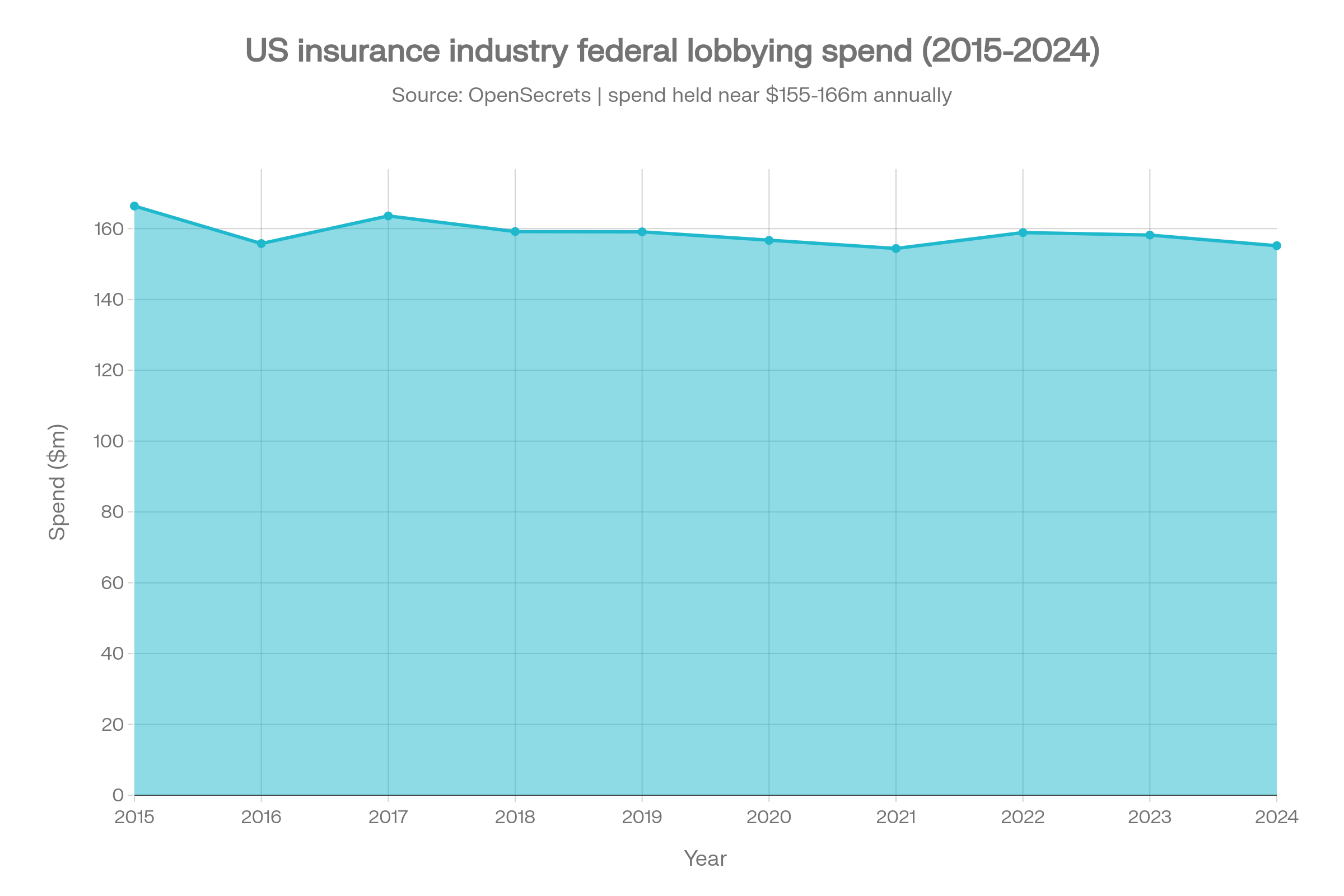
US insurance industry federal lobbying spend held between $154M and $166M every year from 2015-2024 — money spent shaping the rules of the game before your claim is ever filed.
Insurers retain outside defense firms on flat-fee or low hourly contracts, but at massive volume. Defense attorneys process high caseloads with an incentive to bill and litigate, while claimants without lawyers face them alone.
Groups like the American Tort Reform Association and the U.S. Chamber of Commerce popularized the term "nuclear verdicts" starting in 2019 — a PR framing device with, critics say, "zero empirical basis," used to justify rate hikes and push for damage caps.
The insurance industry spent over $636 million through the broader finance/insurance/real-estate sector on federal lobbying in 2024 alone, consistently ranking among the top-spending industries in Washington.
Major insurers use claims-valuation software like Colossus to standardize low settlement offers — systems that assign point values to injuries and penalize "gaps in treatment," reducing payouts algorithmically before a human ever negotiates.
When claims get denied, delayed, or lowballed
Real patterns documented by attorneys, courts, and regulators show how the tactics above play out for actual claimants.
Impaired-driving coverage denial upheld
An Alberta court confirmed an insurer could deny a claim for impaired driving based on a "balance of probabilities" standard alone — no breathalyzer or roadside screening required, showing how low the bar can be for insurers to walk away from a payout.
Colossus-style software undervaluation
Documented claims-handling practice: injury-valuation software assigns point scores that penalize treatment gaps and conservative care plans, producing standardized low offers regardless of a claimant's actual medical reality.
$1 billion verdict, $1 million policy
A Nassau County jury awarded $1 billion after a fatal truck crash caused by an unlicensed, unvetted driver — but the trucking company's insurance policy limit was only $1 million, leaving the family to chase an insolvent defendant for the rest.
Common denial & devaluation tactics, explained
Their legal team vs. yours
The mismatch isn't just about money — it's about experience, repetition, and who is under duress when the clock starts.
| Dimension | Insurance company | You, the claimant |
|---|---|---|
| Courtroom experience | Defense attorneys handle high-volume caseloads daily, refining trial strategy across hundreds of similar cases | Typically one accident, one claim, often the first and only lawsuit of your life |
| Financial pressure during the case | None — billing continues regardless of outcome, absorbed as a normal cost of business | Mounting medical bills, lost wages, and possible physical incapacity while the case drags on |
| Access to specialists | Retained medical experts, accident reconstructionists, and valuation software like Colossus on call | Must locate and pay for independent experts, often only if a lawyer fronts the cost |
| Influence on the rules | Industry trade groups spend $150M+ a year lobbying on tort law, damage caps, and "reform" | No comparable lobbying presence; relies on existing consumer-protection law |
| Public narrative framing | Funds "nuclear verdict" messaging campaigns portraying large jury awards as irrational, shaping juror expectations before trial | No PR budget to counter the framing |
| Negotiating leverage | Can absorb a denial or lowball offer and wait out an appeal; loses nothing by delaying | Often needs cash quickly and can be pressured into an early, lower settlement |
How delay and pressure erode a claim's value
This simplified model shows how settlement pressure can compound over time when a claimant faces mounting bills without legal representation. Adjust the sliders — the numbers are illustrative, not a quote or legal advice.
Illustrative only: models the general pattern documented by consumer attorneys — that delay and lack of representation correlate with lower realized settlements — using simplified assumptions, not actuarial data.
Leveling the field, one decision at a time
You can't match their budget. You can reduce the leverage the tactics above depend on.
- Get medical treatment immediately and follow through on every recommended appointment — gaps in care are used against you.
- Avoid giving a recorded statement to an adjuster before speaking with a lawyer.
- Never accept the first offer — it is rarely designed to reflect long-term costs.
- Keep a detailed claim diary: every call, every name, every date.
- Consider independent legal representation early — represented claimants consistently recover more