
Canada's job market delivered a sharp reversal in August, shedding 42,000 positions in a result that caught economists off guard after months of gradual recovery, Statistics Canada reported Friday.
The decline defied a Reuters poll of economists, who had forecast a gain of roughly 15,000 jobs, while the unemployment rate itself held steady at 6.4 per cent — still the lowest reading in two years, but a signal that the labour market's momentum has stalled.
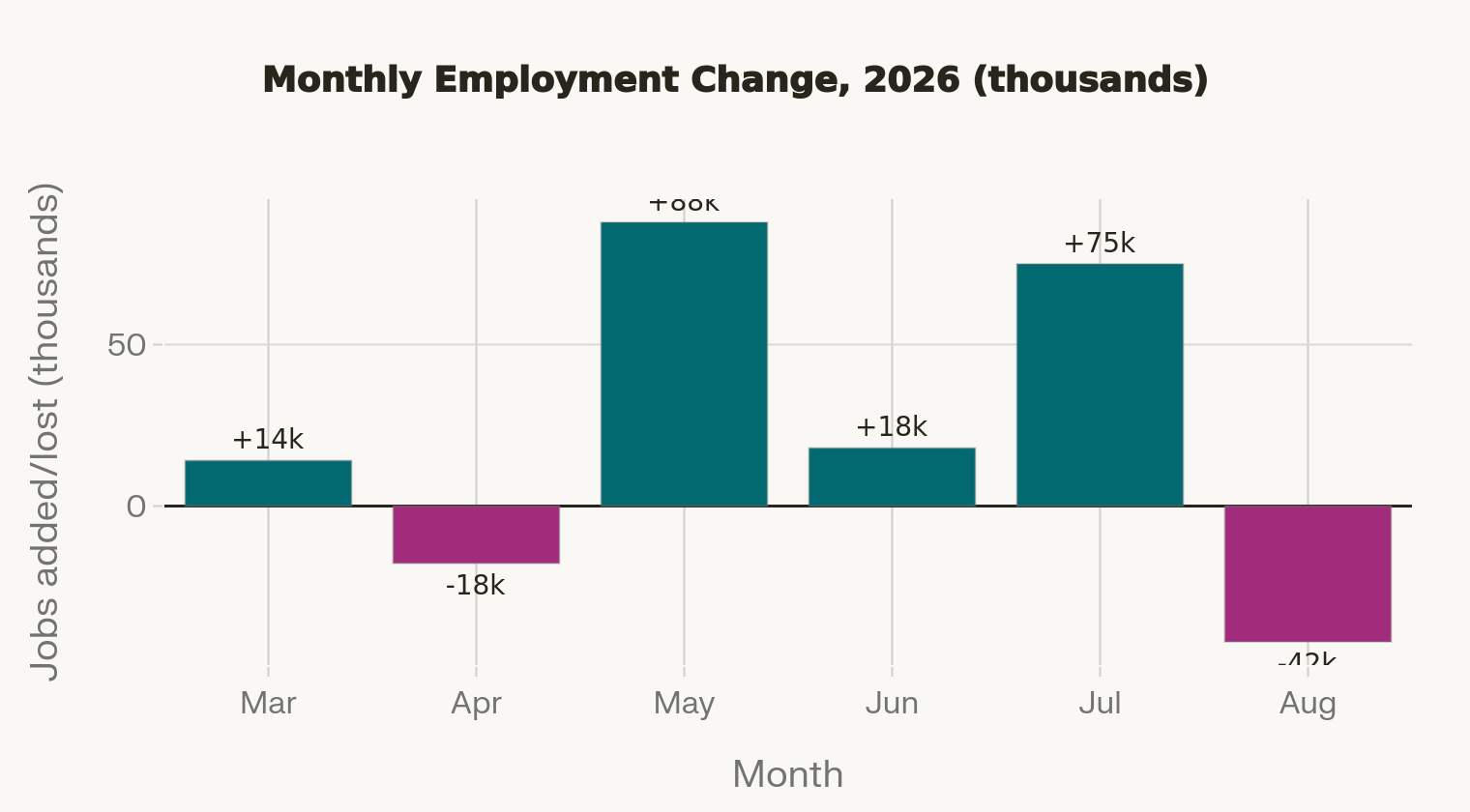
Monthly employment change, March–August 2026 (thousands of jobs). Source: Statistics Canada, Labour Force Survey.
The public sector bore much of the brunt, shedding 20,000 positions for a third consecutive month, while private-sector employment was little changed. Regionally, Quebec absorbed the heaviest losses, down 19,000 jobs, followed closely by Ontario, which lost 18,000.
The abrupt pullback lands just as new U.S. tariffs threaten further strain on export-dependent industries. Economists have warned that escalating trade measures could put tens of thousands of additional Canadian jobs at risk in manufacturing, trucking, and related sectors in the months ahead.
Ottawa moved last week to cushion the blow, rolling out a $7.5-billion expanded relief program for workers and businesses affected by the trade dispute. Whether that support is enough to steady the labour market through the fall will likely hinge on how the tariff standoff with Washington evolves in the coming weeks.